
Epistemic Networks: The Invisible Threads of Social and Semantic Coevolution
Social and semantic coevolution in knowledge networks ଝ
The paper introduces a theoretical framework for "epistemic networks" by modeling the coevolution of social links (agent-agent) and semantic links (agent-concept). Using longitudinal data from a scientific community (Zebrafish) and the political blogosphere, it demonstrates that macroscopic structural properties remain remarkably stable despite intense local dynamics.
TL;DR
In the digital age, we don't just connect with people; we connect through ideas. This paper proposes that knowledge networks—whether scientific communities or the political blogosphere—are defined by the coevolution of social ties and semantic interests. By analyzing years of data, the authors reveal that while individuals enter and leave these networks rapidly, the global "shape" of knowledge remains uncannily stable due to deep-seated behavioral biases like semantic homophily.
The Motivation: Why Social Networks aren't Enough
Most social network studies focus on "who knows whom." But in a professional or intellectual context, "what you know" is arguably more important. The authors argue that a strictly social lens misses the inductive bias of knowledge creation: we choose collaborators because of their expertise (concepts), and our interactions, in turn, redefine our expertise. To capture this, they introduce the Epistemic Network— a dual-ontology framework where agents and concepts are inextricably linked.
Methodology: Mapping Agents to Ideas
The researchers modeled two distinct datasets:
- The Zebrafish Community: A scientific network of 15,204 authors over 8 years.
- The Political Blogosphere: 1,066 US political blogs during the 2008 election.
Through a bipartite mapping (Agents Concepts), they defined Social Capital (number of collaborators) and Semantic Capital (variety of topics mastered).
 Figure 1: The dual structure showing social interactions (left) and socio-semantic affiliations (right).
Key Insight 1: The Stability of Hierarchies
One might expect a rapidly growing network to be chaotic. Instead, the authors found that both social and semantic distributions are log-normal and stable.
- Zebrafish: Scientists with high social capital are almost always semantically "rich."
- Blogs: Interestingly, even "poor" (rarely cited) bloggers can address a vast range of topics, suggesting different rules for authority in informal media versus formal science.
Key Insight 2: Semantic Homophily & Growth
The paper dives into "Why" links form. By calculating interaction propensities, they found that:
- Social Distance: You are exponentially more likely to cite or collaborate with a "friend of a friend" (Distance = 2) than a stranger.
- Semantic Proximity: For scientists, collaboration specifically happens with those who share concepts, effectively pulling their semantic profiles even closer together over time.
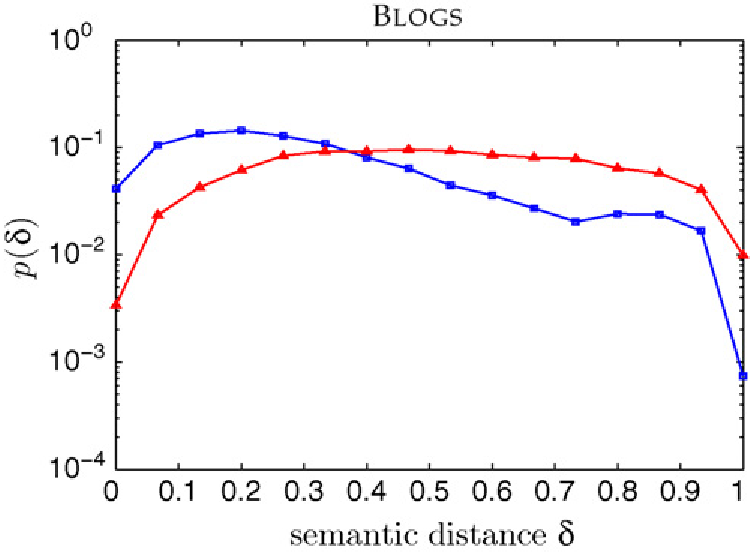 Figure 2: Semantic distance within the neighborhood vs. the whole network. Note how neighbors (blue) are significantly closer in "concept space."
Methodology: Epistemic Communities as Bicliques
To find "vibrant" areas of knowledge, the authors used Bicliques—maximal groups of agents sharing a maximal set of concepts. This mathematical approach allows us to see "Epistemic Communities" not as arbitrary clusters, but as rigorous intersections of people and ideas.
Critical Analysis & Conclusion
The value of this work lies in its "Naturalist" approach to social science. It proves that:
- Activity over Attraction: Preferential attachment isn't just about "fame"; it's a byproduct of high-activity agents generating more opportunities for connection.
- Structural Robustness: The "spinning-top" model holds—the elite positions and topic clusters remain even as the individual members change.
Limitations: The study uses static concept lists (65-80 keywords). In modern contexts, using dynamic NLP or embeddings (like BERT/Ada) would likely reveal even more nuanced "drifts" in the semantic landscape.
Takeaway: If you want to understand the growth of a community, don't just look at the people—look at the concepts they "clump" around. The coevolution of the two is the true engine of collective intelligence.