
Deciphering Social Annotations: Why "Friends" Don't Always Make Search Better
Social annotations: utility and prediction modeling
The paper investigates "Social Annotations" in web search—visual markers showing when social connections have liked or shared a result. It proposes a taxonomy of social relevance aspects and utilizes a Multiple Additive Regression Tree (MART) model to predict the utility of these annotations in both head and tail search queries.
TL;DR
In this classic SIGIR study, researchers from Microsoft explore the "utility" of social annotations—those little snippets telling you a friend liked a webpage. They discovered that not all likes are created equal: while advice from an expert or a close family member significantly boosts search value, endorsements from distant acquaintances can actually be distracting. By using Gradient Boosted Decision Trees, they proved that search engines can (and should) predict when to show or hide these social cues to improve user experience.
The Motivation: Moving Beyond "Likes"
For years, social features were treated as a monolithic "plus-one." If someone in your network liked a link, search engines assumed it was relevant. However, the authors argue that relevance is multi-dimensional. Is a "like" on a navigational query (e.g., searching for "Facebook login") actually useful? Does a recommendation from a "distant friend" carry the same weight as one from a "subject matter expert"?
The core insight here is that social utility is a product of the relationship, the topic, and the document quality. If a friend likes a "Bad" (irrelevant) page, the annotation doesn't help—it just highlights a mistake.
Methodology: The Taxonomy of Social Relevance
To quantify "Social Relevance," the authors broke the problem down into three primary pillars:
- Query Aspects (QA): Distinguishing between Navigational vs. Non-Navigational and specific categories like Health, Music, or Restaurants.
- Social Connection Aspects (SA): This is the heart of the paper. It tracks Affinity (closeness), Expertise (topic knowledge), and Circle (Family, Friend, Work).
- Content Aspects (CA): The baseline relevance of the URL (Perfect, Good, Fair, Bad).
The Experimental Framework
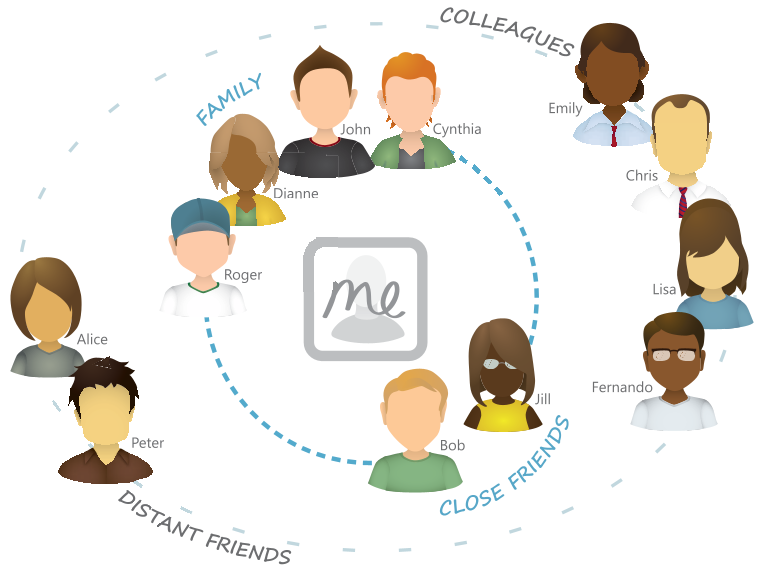
The team simulated a social network of 12 distinct individuals for their judges to interact with, ensuring privacy while allowing for controlled variables (e.g., "Bob" is an expert friend; "Chris" is a distant colleague).
Key Findings: The Hierarchy of Influence
The user study revealed several counter-intuitive truths:
- The Family Factor: Annotations from family members had the highest expected utility (R-Rel 0.654), significantly higher than friends or colleagues.
- Affinity Matters Most: Knowing if a connection is "Close" or "Distant" provides more predictive power than knowing their specific social circle.
- Expertise in the Tail: For rare, specific queries (Tail queries), expertise becomes the dominant driver of value.
- The Negative Impact of "Shares": Interestingly, "Shared" content often had lower utility than "Liked" content, possibly due to the vagueness of why a document was shared.
Performance Comparison
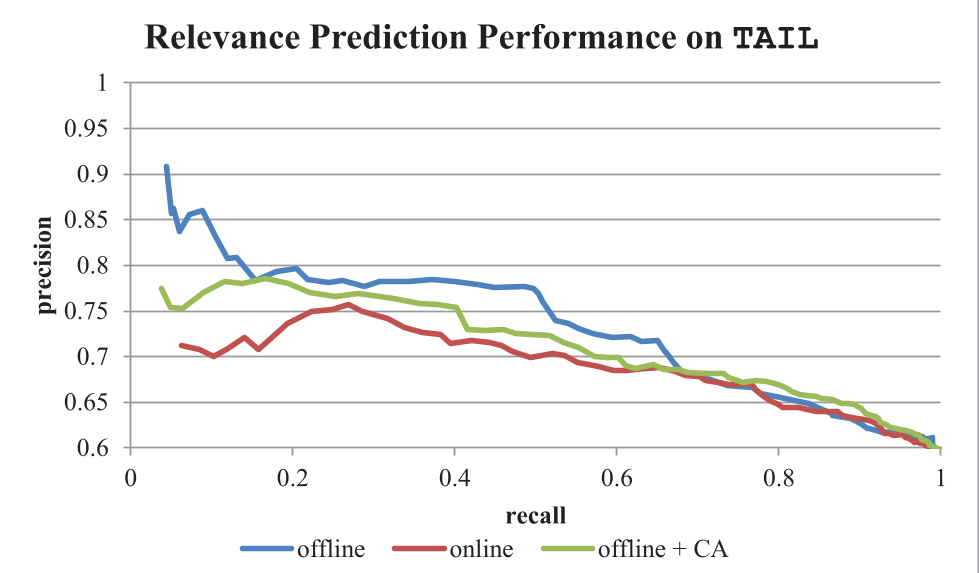
When predicting utility, the model using Offline features (exact knowledge of relationships) performed best. However, even with Online features (proxies like query classifiers and click logs), the MART model showed a strong ability to filter out low-value annotations.
Critical Analysis & Conclusion
The true value of this work lies in its Heuristic Precision. It moves social search from a "social-by-default" logic to a "value-by-prediction" logic.
Takeaways for Practitioners:
- Contextual Filtering: Don't show social annotations for navigational queries where users just want a specific URL.
- Relationship Mapping: Invest in understanding "Affinity" and "Expertise" signals; they are the strongest predictors of whether a user will find a social cue helpful.
- Content Guardrails: Even the best friend's recommendation cannot save a "Bad" search result. Social features should augment high-quality results, not try to polish low-quality ones.
Limitations: Since this study used a simulated network to protect privacy, it may miss the "serendipity" factor of seeing a real friend’s name. Future work in this space now likely leverages real-world graph embeddings to capture these nuanced ties even more accurately.