
Social Answer: Intelligent Question Routing Across Specialized Social Media Ecosystems
Social Answer: A System for Finding Appropriate Sites for Questions in Social Media
Social Answer is a recommendation system designed to route user questions to the most appropriate social media platforms (e.g., StackOverflow for coding, TripAdvisor for travel). It utilizes Wikipedia-based query expansion and a "conflict allocation" ensemble of search engine results to match short, noisy queries with the domain-specific strengths of various social sites.
TL;DR
Social Answer is a system that identifies the best social media community to answer a user's question. By expanding short queries with Wikipedia data and aggregating domain-restricted search results from Google, Yahoo, and Bing via a Conflict Allocation algorithm, the system achieves a 6% accuracy improvement over traditional search baselines.
Problem & Motivation: The "Where to Ask" Dilemma
While social media is a goldmine for subjective and expert advice, its fragmented nature is a hurdle. A question about "Mexican restaurants" belongs on Yelp, not StackOverflow.
The technical challenge is twofold:
- Query Sparsity: User questions are typically short, noisy, and lack context.
- Indexing Latency: Social media content changes so fast that traditional crawling and indexing cannot keep up.
Existing solutions often rely on a single search engine's ranking, which is problematic because search algorithms are "black boxes" and can return conflicting results.
Methodology: Wikipedia Expansion & Conflict Allocation
The authors propose a three-stage pipeline to solve the site-matching problem:
1. Intent Expansion (Wikipedia)
To overcome the brevity of queries like "XML processing in Python," Social Answer extracts nouns as keywords and fetches related Wikipedia articles. This transforms a 5-word question into a dense word-frequency vector that better represents the underlying intent.
2. Multi-Engine Content Retrieval
Instead of indexing sites directly, the system queries search engines with the site:domain.com operator. This leverages the near-instant indexing capabilities of major search engines to get the most "expressive" current content of a site.
3. Conflict Allocation Ensemble
Since different search engines might suggest different site rankings, the system employs a sophisticated ensemble method based on conflict allocation.
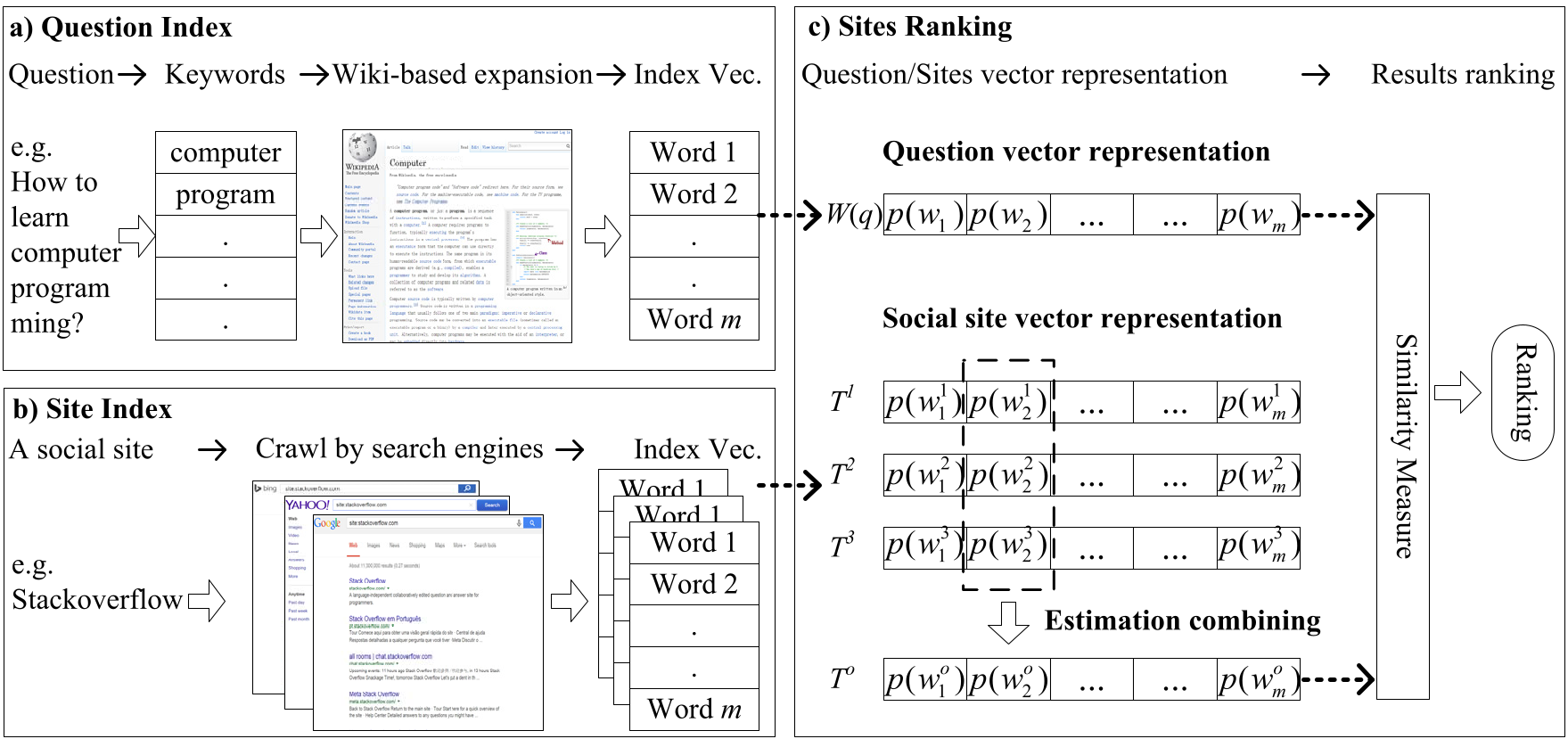 Fig 1. The architecture shows the flow from keyword extraction to search engine merging.
The core math involves calculating an optimal frequency estimate for a word by combining probabilities from different sources, while specifically accounting for the "conflicting belief" between search engines:
Experiments & SOTA Results
The researchers tested the system against 25 social media sites categorized into groups like "Microblogs," "Professional Networks," and "Collaborative Q&A."
| Category | Top Sites Included |
|---|---|
| Social Networks | |
| Professional | LinkedIn, Xing, Viadeo |
| Media Sharing | Instagram, YouTube, Pinterest |
| Q&A | StackOverflow, Answers |
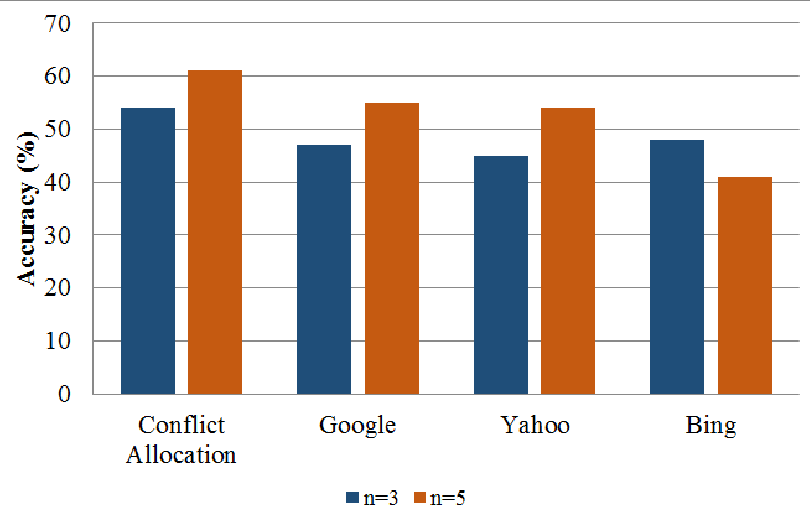
Key Finding: Social Answer outperformed standalone searches on Google, Bing, and Yahoo by 6% in accuracy. By using top-n (n=3,5) evaluation, the system proved that its ensemble approach is more reliable than any single source of truth.
Critical Analysis & Conclusion
The value of Social Answer lies in its infrastructure-light approach. It doesn't require a massive local database of social media posts; instead, it acts as an intelligent "meta-layer" atop existing search giants.
Limitations
- Privacy: The study notes that private messaging and virtual game worlds were excluded due to privacy constraints, which are significant silos of human knowledge.
- Latency: Relying on multiple API calls to Wikipedia and three search engines could introduce response delays in a real-time production environment.
Future Outlook
As the internet moves toward more specialized "micro-communities," systems like Social Answer will be vital. Integrating this with Large Language Models (LLMs) could further enhance the "intent expansion" phase, perhaps replacing Wikipedia keywords with synthetic contextual expansions for even higher precision.