
Enhancing Social Privacy: From All-or-Nothing to Granular Access Control
Social Applications: Exploring A More Secure Framework
The paper explores a granular access control framework for 3rd-party social network applications (e.g., Facebook apps). It introduces a "user-to-application" policy model and a prototype interface designed to prevent over-disclosure of personal data to developers while maintaining application functionality.
TL;DR
Social network applications (like games or horoscopes) often harvest way more data than they need. This paper proposes a more secure framework that allows users to pick exactly which parts of their profile—and their friends' profiles—an app can see. While it successfully empowers "Privacy Fundamentalists," it reveals a daunting challenge: half of users still blindly click "Accept," leaving the whole network vulnerable.
Problem & Motivation: The "All-or-Nothing" Trap
In the late 2000s, the explosion of Facebook and OpenSocial created a gold rush for developers. However, the security model was fundamentally broken. When you installed a simple "Horoscope" app, you weren't just giving it your birthday; you were often handing over your high school, work history, and the private data of all your friends.
The authors identify two fatal flaws in prior work:
- The Principle of Least Privilege Violation: 91% of apps accessed data they didn't need to function.
- The Proxy Dilemma: Strict "Privacy by Proxy" (hiding all data behind tags) protected users but "killed" the app's social value and portability.
The researchers sought a middle ground: Granularity.
Methodology: The Granular Framework
The core contribution is a formal mathematical model for access control that layers three distinct policies:
- (User-to-User): What your friends can see.
- (Default App Policy): What uninstalled apps can see.
- (NEW User-to-App Policy): A specific filter for each individual application.
The "Friendship Shield"
One of the most insightful parts of this model is friendship-based protection. In this framework, if Alice is a "Privacy Fundamentalist" and sets a strict policy for a Chess app, that app is also restricted in what it can see about her friend Bob—even if Bob has more relaxed settings. Human discernment becomes a firewall for the community.
The Prototype Interface
To test this, the authors built a Facebook-integrated prototype:
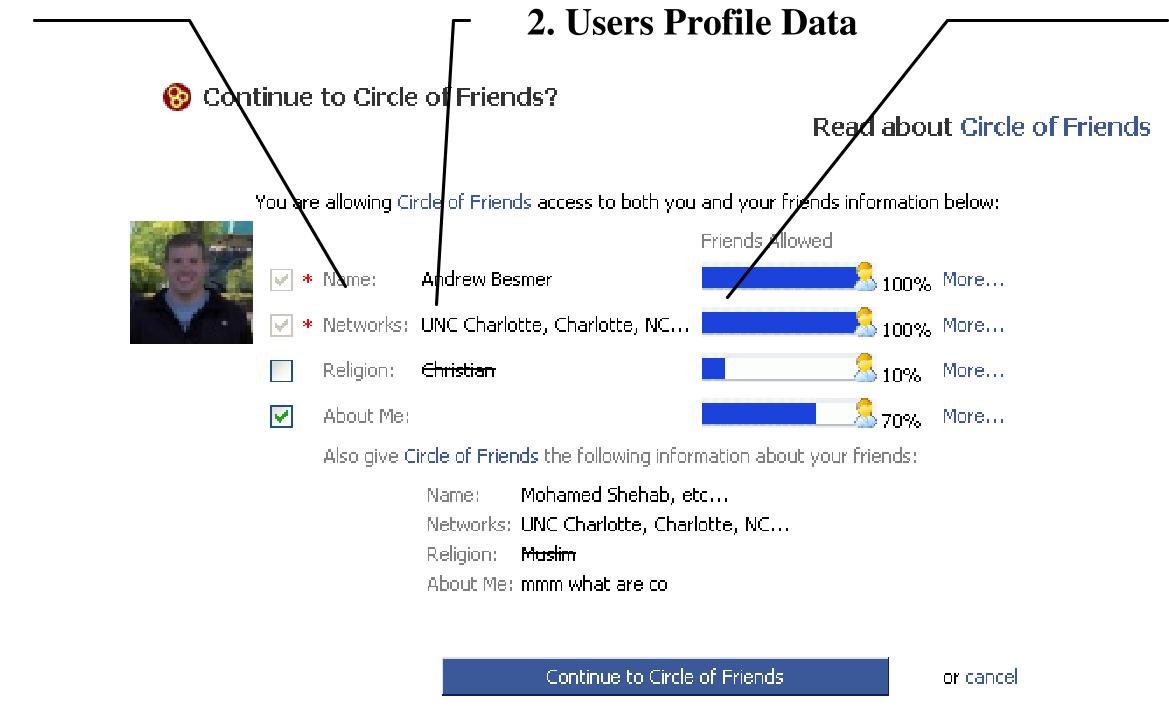
The interface included:
- Required vs. Optional: Starred fields were mandatory for the app to run; others could be unchecked.
- Community Indicators: A bar showing what percentage of friends allowed a specific field (Social Proof).
- Data Previews: Showing the actual data that would be shared, making the risk concrete.
Experimental Results: The Great Privacy Divide
The researchers categorized users into two camps: Motivated and Unmotivated.
| Metric | Motivated Users | Unmotivated Users |
|---|---|---|
| Customized Policy | 45.45% | 7.07% |
| Accepted Defaults | 31.82% | 75.76% |
| Avg. Time Taken | 23 seconds | 10 seconds |
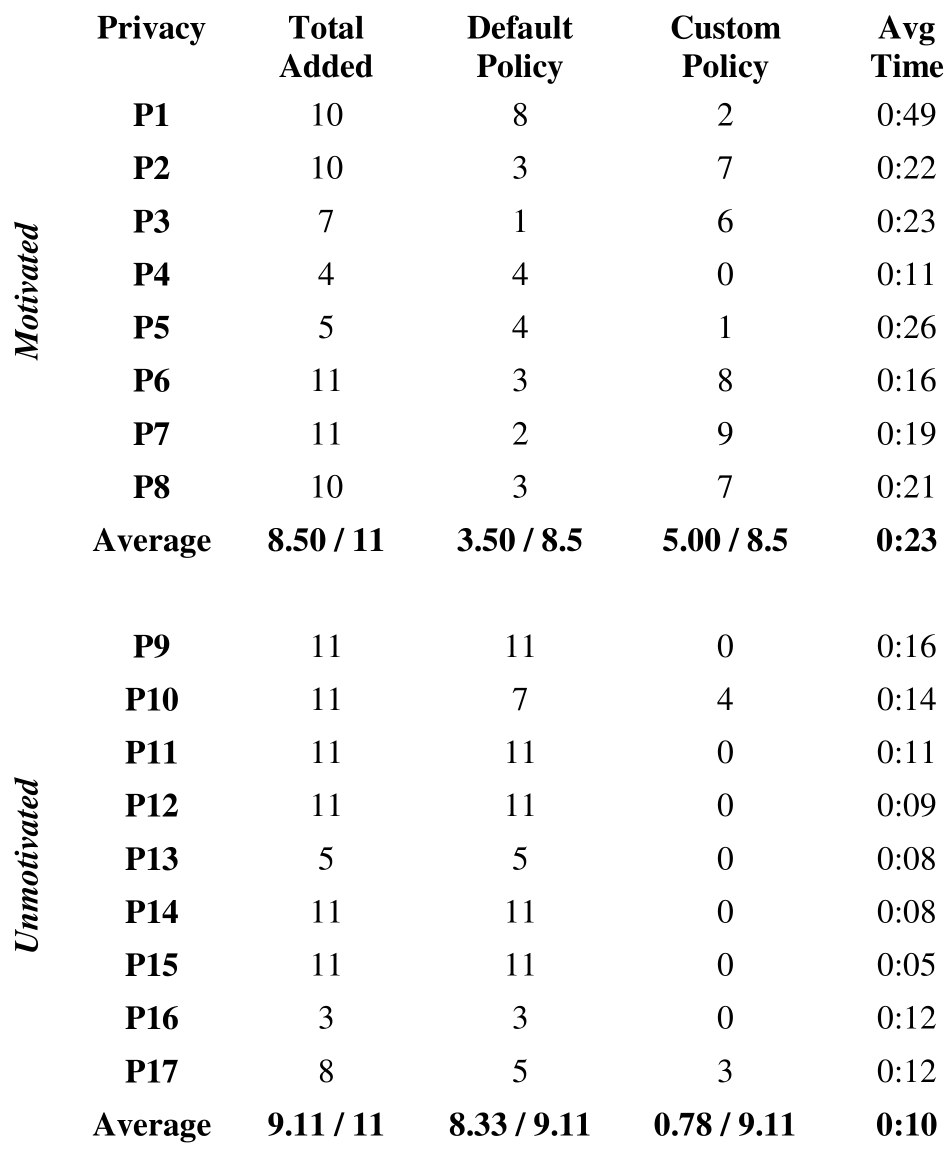
The results were a reality check. For Motivated Users, the framework worked perfectly. They restricted access to sensitive data (like hometowns for horoscopes) and often refused to install "creepy" apps like SpringWater (which asked for high school and work info for no reason).
Unmotivated Users, however, were a "blank check" for developers. They installed 83% of apps with almost zero customization, proving that better interfaces are only half the battle.
Critical Analysis & Conclusion
Takeaway
The paper proves that granular control is technically feasible and desired by a significant subset of the population. By allowing "Privacy Fundamentalists" to act as gatekeepers, we can reduce the overall "attack surface" of a social network.
Limitations & Future Work
The biggest hurdle is User Apathy. If 50% of your users don't care, their data (and parts of yours) will always be at risk. The authors suggest a brilliant pivot for future research: Harnessing Community Knowledge. Perhaps the strict policies of the motivated 50% should become the default for everyone else.
This work laid the groundwork for the modern permission systems we see in iOS and Android today, where "Allow only while using the app" or "Don't track" have become standard—moving from a world of "all-or-nothing" to a world of "only-what-you-need."