
SDWM: Leveraging Social Network Theory for Smarter Multi-Agent Learning
A social approach for learning agents
The paper introduces Social Dynamic Weighted Majority (SDWM), a multi-agent learning framework that leverages Social Network Theory (SNT) to manage ensembles of learners. It specifically targets concept drift detection in dynamic environments, such as bilateral negotiations, by using a scale-free network model to calculate agent reputation and voting power.
TL;DR
Researchers have developed SDWM (Social Dynamic Weighted Majority), a novel approach that treats an ensemble of learning agents as a social network. By using centrality in a scale-free network instead of simple accuracy weights, the system detects concept drift faster and operates with a fraction of the computational overhead of previous SOTA methods like DWM.
Background: The Limits of Individual Intelligence
In Distributed Artificial Intelligence (DAI), we often find that "several heads are better than one." However, in dynamic environments—like high-frequency trading or automated negotiation—the "context" changes (Concept Drift). Managing a committee of agents to handle these changes is notoriously difficult:
- How many agents do we need?
- Which agents should we trust?
- How do we retire "old" knowledge without losing stability?
Traditional methods use heuristics (e.g., "if an agent is wrong, decrease its weight by 10%"). The authors argue this is "myopic" and lacks a structural understanding of how agents should relate to one another.
The Insight: Accuracy vs. Reputation
The core contribution of this paper is the shift from Performance-based weighting to Reputation-based centrality.
In human societies, we don't just trust people who were right once; we trust people who are consistently aligned with the collective truth and are well-connected to other reliable sources. The authors implement this using Social Network Theory (SNT), specifically the Scale-Free Network model.
The SDWM Workflow
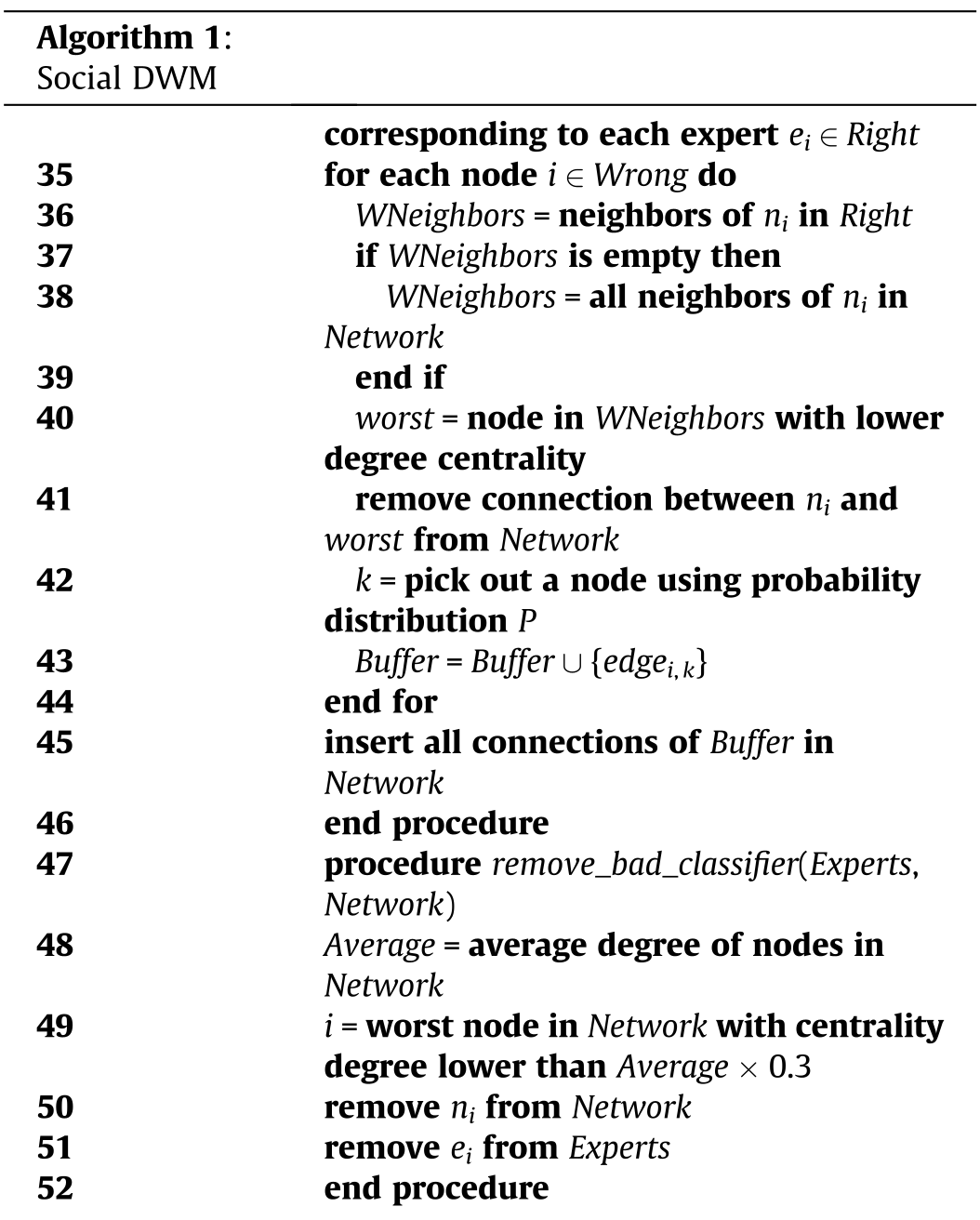
- Prediction: Every agent (expert) in the network makes a local prediction.
- Voting: Their votes are weighted by their Degree Centrality (how many successful connections they have).
- Structural Evolution:
- Agents that are correct together form new "edges" (connections).
- Agents that are wrong lose connections to successful peers.
- Pruning: Agents with low centrality (poor reputation) are randomly removed, keeping the ensemble "lean and mean."
Methodology: The Scale-Free Advantage
Instead of a regular or random graph, SDWM uses a Scale-Free model (Barabási–Albert). This is crucial because:
- It allows for a dynamic number of agents.
- It facilitates "Preferential Attachment"—successful agents become "hubs" of knowledge, while new, unproven agents must quickly find their place or be eliminated.
Experimental Battleground: Dynamic Negotiations
The authors tested SDWM in a bilateral negotiation scenario (Buyer vs. Vendor) where the vendor's preferences change abruptly, moderately, or gradually.
Key Result: Maximum Efficiency
While SDWM and DWM both achieve high accuracy, the efficiency gap is staggering.
- Accuracy: SDWM maintains significantly more stable learning curves, especially in "moderate" and "gradual" drift zones where contexts overlap.
- Resource Usage: In benchmark tests, the DWM ensemble often ballooned to 40+ experts, while SDWM achieved the same results with only 10 experts.
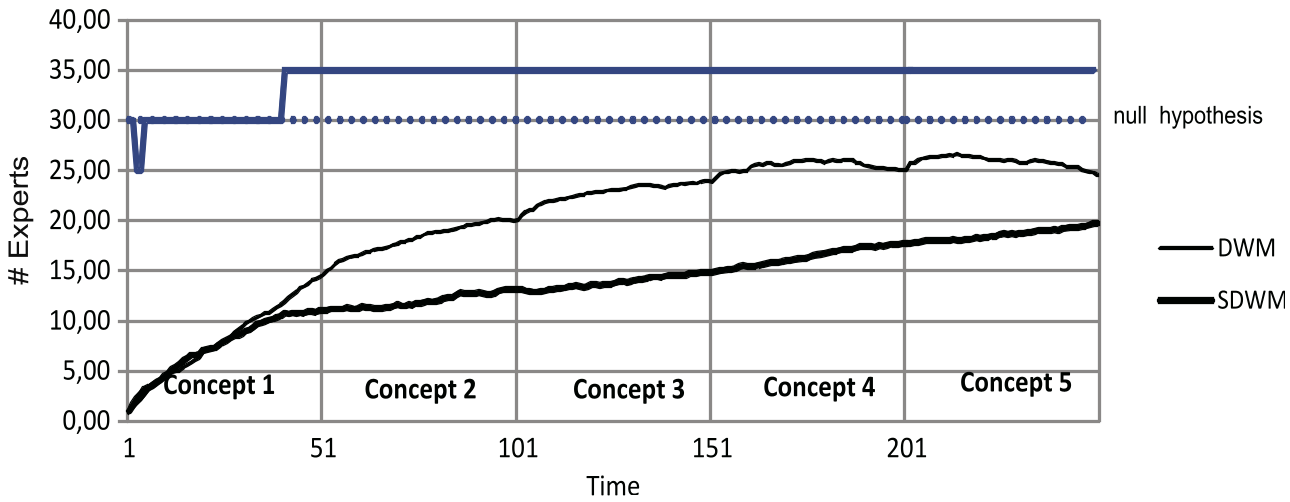 Fig: SDWM shows higher stability and faster recovery during abrupt concept changes.
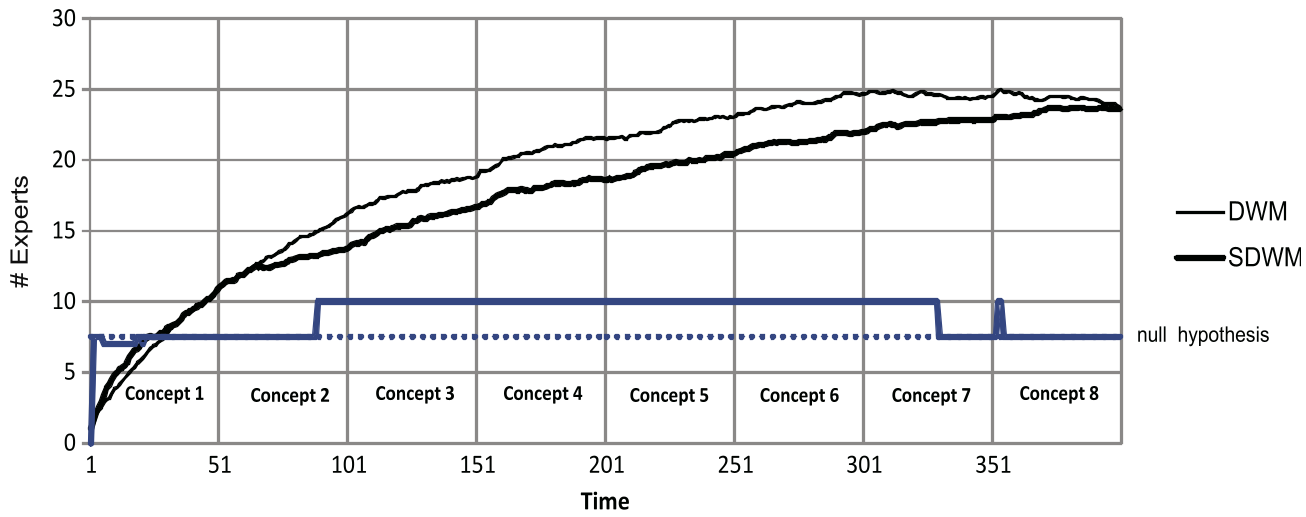 Fig: SDWM (bottom line) maintains a much smaller committee of agents compared to DWM.
Critical Insights & Future Work
Why does it work? By using network topology, SDWM implicitly captures the diversity of agents. Redundant agents don't add unique value to the network's connectivity and thus fail to gain high centrality, leading to their eventual pruning.
Limitations:
- The current model only uses Degree Centrality (simple connection counting).
- More complex measures like Betweenness Centrality (measuring how much an agent acts as a bridge between different "schools of thought") could provide even deeper insights but would increase computational complexity.
Conclusion
This paper successfully bridges the gap between Sociology and Machine Learning. It proves that the structure of interactions is just as important as the content of the learning algorithm itself. For any developer building multi-agent systems in non-stationary environments, SDWM offers a blueprint for highly efficient, reputation-driven coordination.