
Beyond the Machine: Decoding the Social DNA of Collaborative Design
Social aspects of collaborative design
This paper explores collaborative design through a sociological lens, proposing a social factor-based architecture to manage distributed engineering teams. It introduces a formal methodology for analyzing how human behaviors—such as perspectives, preferences, and cognition—influence the efficacy of design teams, groups, and communities.
TL;DR
Collaborative design is often misconstrued as a purely technical optimization task. This paper argues that it is, in fact, a sociological phenomenon. By introducing a social factor-based architecture, the authors move beyond traditional "rational machine" models of designers, proposing a framework where perspectives, attitudes, and interpersonal coordination are the primary drivers of engineering success.
Background: The Gap in Computational Design
For decades, design methodology has been dominated by models like Suh’s Axiomatic Design or Pahl and Beitz’s Systematic Approach. These paradigms excel at structural and functional decomposition but fail to account for the "Human in the Loop." In a distributed, globalized world, design happens in Virtual Communities where social friction often outweighs technical constraints. The authors position this work as a transition from Technical Decision Making to Socio-Technical Interaction.
The "Why": Why Engineering Models Aren't Enough
The paper identifies a critical insight: Solutions are as subjective as the problems.
- Subjective Perception: Two engineers see the same constraint differently based on their experience.
- Social Influence: Choices are rarely made in a vacuum; they are influenced by "feeling" and group dynamics.
- The Four "C"s: Communication, Cooperation, Coordination, and Collaboration are often confused but serve distinct social roles in preventing design "conflict."
Methodology: The Social Architecture
The authors redefine the design organization into three distinct mathematical tiers:
- The Design Team: Focused on objective functions and local variables.
- The Design Group: A network of teams sharing a common target.
- The Design Community: A virtualized, decentralized network of groups.
The Formal Socio-Technical Model
The core contribution is the formalization of the Design Process () as a set of variables influenced by social behavior:
Where (Process Variables) are not just physical dimensions, but are weighted by the social preferences of the designers involved.
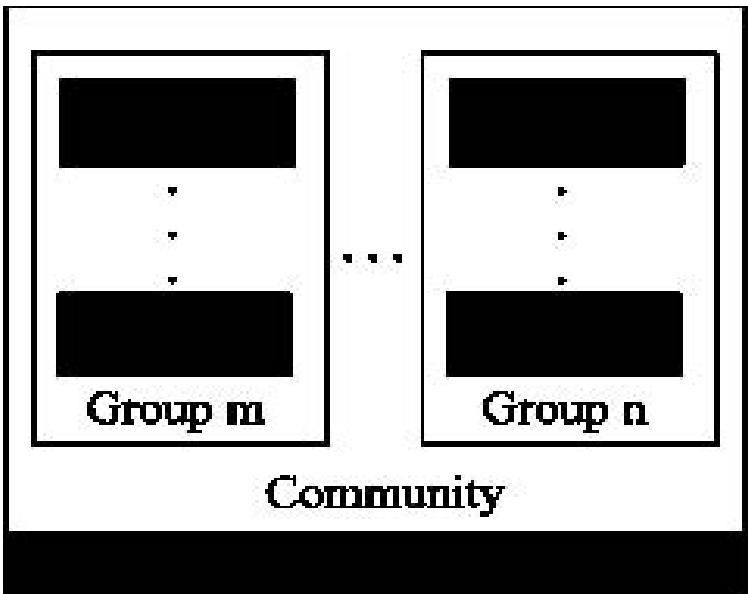 Figure 1: The hierarchical structure from individual nodes to virtual communities.
Visualizing the Impact of Social Factors
The design process is depicted as an iterative loop where Conceptualization, Synthesis, Analysis, and Evaluation are constantly bombarded by social "noise"—perspectives, habits, and beliefs. Effective design requires "Cognitive Synchronization"—a state where shared meaning is achieved despite distributed locations.
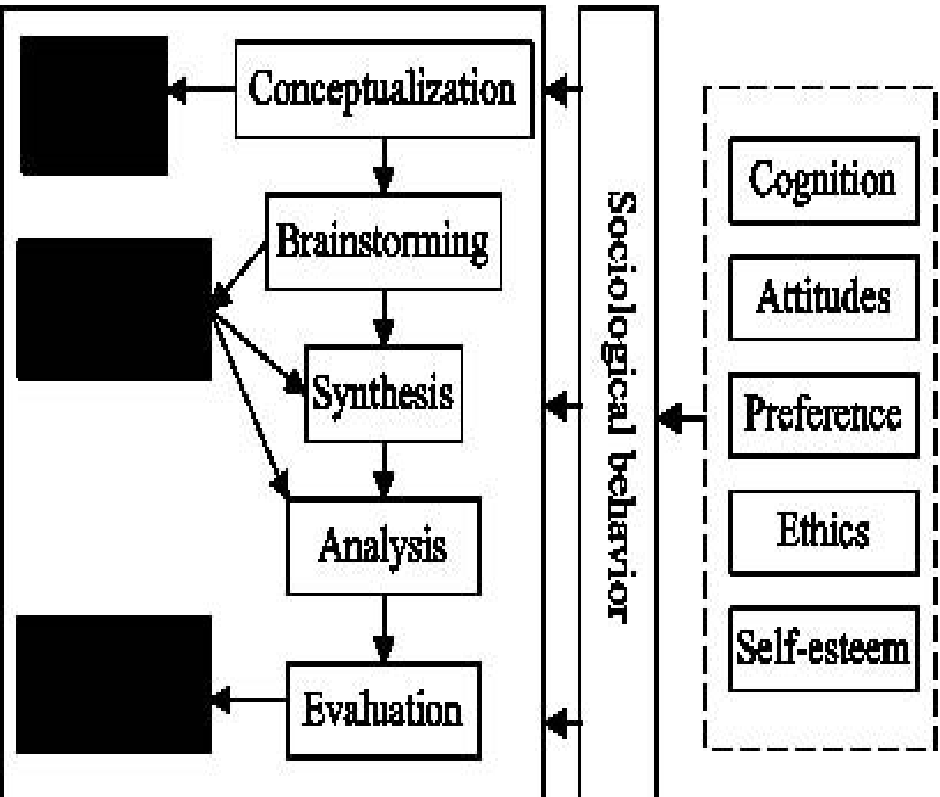 Figure 2: Mapping social variables like Ethics, Cognition, and Attitude onto the technical workflow.
Critical Insight: The Transition to Node-to-Node Design
One of the most profound observations in the paper is the shift from Face-to-Face to Node-to-Node interaction. While P2P and Client/Server architectures provide the plumbing, they often suffer from "diminished social-context cues." The authors argue that future groupware must compensate for the loss of non-verbal expression to maintain the "creative sparks" that arise from disagreement.
Conclusion & Future Outlook
This paper serves as a manifesto for the next generation of Collaborative Design Support Systems (CDSS). The authors conclude that:
- Conflict is necessary: Creativity comes from disagreement; the goal isn't to eliminate it but to coordinate it.
- Shared Narrative: Documentation should not just be a CAD file, but a socially shared narrative of why decisions were made.
The limitation of this work lies in its high-level abstraction—the specific "weighting" of social factors remains difficult to quantify. However, it opens the door for Group Decision Support Systems that treat engineers as people first, and data-processors second.