
Beyond Semantics: Leveraging Social Networks for Personalized Web Service Ranking
On the Social Aspects of Personalized Ranking for Web Services
The paper proposes a "community-aware" personalized ranking approach for Web Services by modeling historical interactions between consumers and providers as a social network. By integrating Social Network Analysis (SNA) with non-functional properties (NFPs), the system employs a hybrid Bayesian classification model to rank services with high efficiency and personalization.
TL;DR
While the Semantic Web promised automated service discovery, "heavyweight" ontologies often collapse under the weight of their own complexity. This paper introduces a hybrid approach: modeling service interactions as a Social Network. By analyzing the "community" behavior of consumers and providers alongside Non-Functional Properties (NFPs), the authors achieve a personalized ranking system that is both faster and more scalable than traditional semantic reasoners.
The "Precision vs. Complexity" Dilemma
In the world of Web Services, ranking is the final gatekeeper. When a consumer requests a service (e.g., a currency converter), the system must pick the "best" one.
- The Heuristic Approach: Fast, but "dumb." It lacks the depth to understand specific user constraints.
- The Semantic Approach: Smart, but slow. Reasoning through complex OWL-S or WSMO ontologies is computationally expensive and hard for average users to model.
The authors' insight? Social context matters. If a group of similar consumers frequently uses a specific provider with high satisfaction, that "social link" is a powerful, low-cost heuristic for ranking.
Methodology: The Matrix Perspective
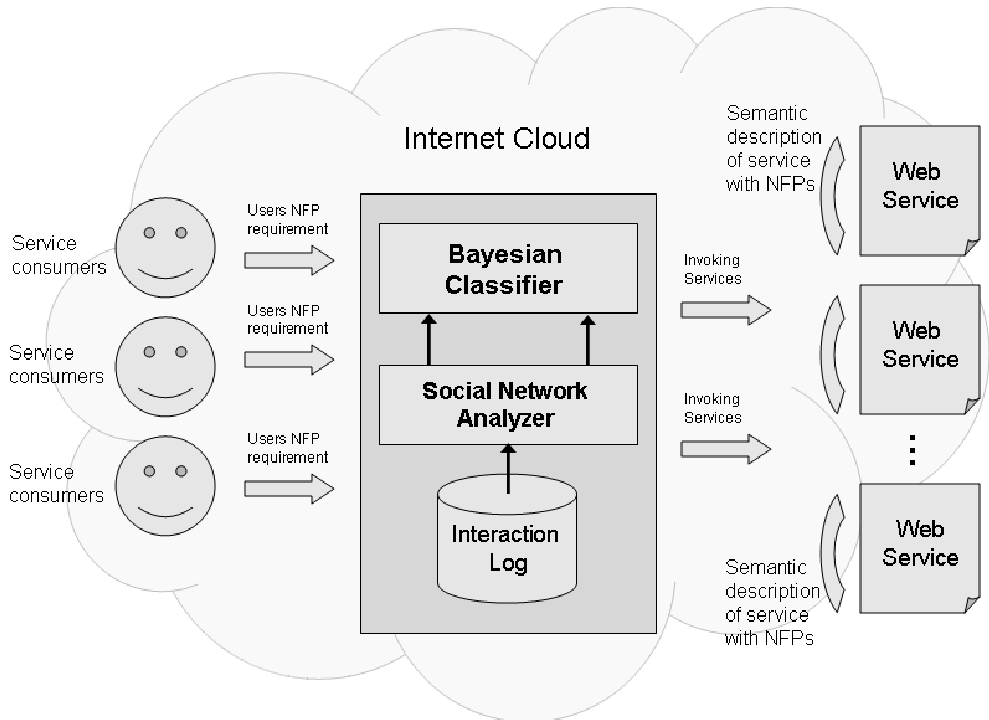
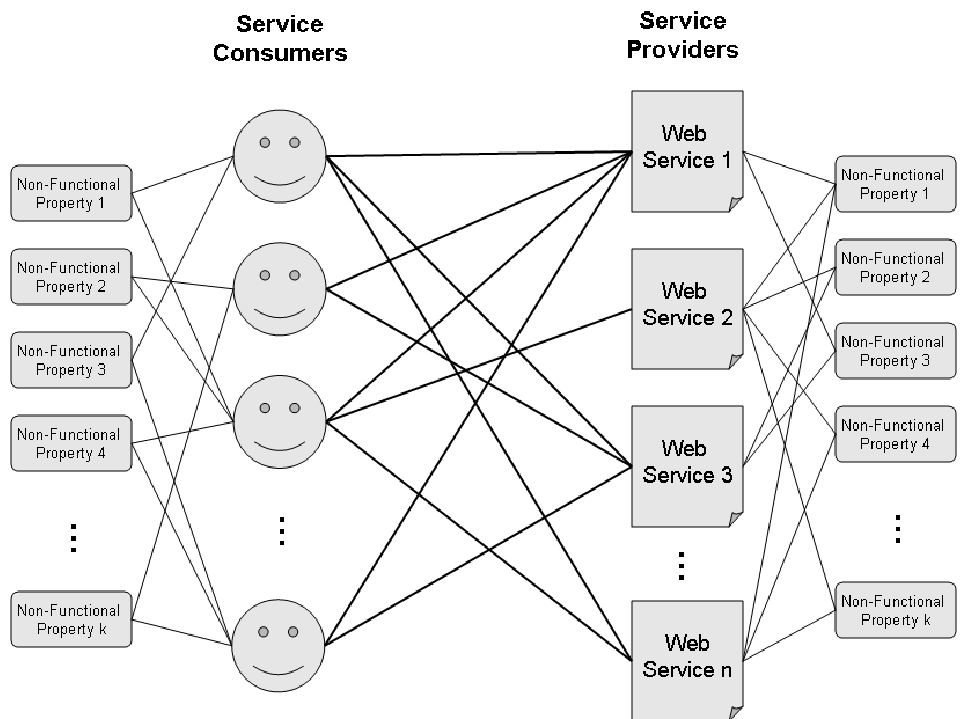
The core of the methodology lies in treating Web Service logs not just as data, but as a graph. The authors identify three primary entities: Service Consumers (SC), Service Providers (SP), and Non-Functional Properties (NFP).
Architecture Overview
The system monitors an Enterprise Service Bus (ESB) to extract interaction logs. These logs are transformed into matrices:
- SN(SC, NFP): User preferences.
- SN(SP, NFP): Provider capabilities.
- SN(SC, SP): Historical interaction strength.
Computation and Classification
By applying matrix algebra (e.g., ), the system calculates the degree of relevance. This relevance score then serves as a training signal for a Naive Bayesian Classifier. This allows the system to predict how likely a consumer is to prefer a provider based on NFP inputs like Price, Trust, and Reliability.
Experiments: Performance at Scale
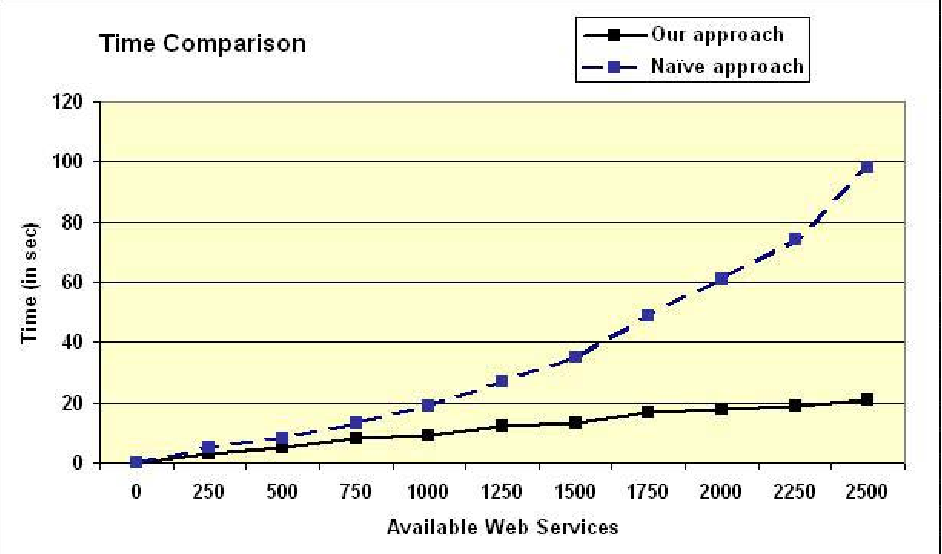
The researchers tested their approach using a real-world currency converter scenario. The results highlight a critical advantage in scaling.
- Efficiency: While a naive discovery engine slows down linearly as the number of available services increases, the Community-Aware Engine maintains a flat execution time of approximately 0.5 seconds.
- Precision: Despite being a "lightweight" approach, the precision for specific providers (like "Voorspring") reached 95.6%.
The variance analysis (Figure 4 in the paper) further proved that the approach is stable, with negligible deviations (approx. 60ms) in real-world applications.
Critical Insight & Conclusion
The true value of this work lies in its Inductive Bias. It assumes that the "crowd" (the community of consumers) acts as a natural filter for quality. By combining this social intelligence with a Bayesian framework, the authors bridge the gap between "hard" semantic logic and "soft" historical data.
Limitations
- Cold Start: The paper relies on interaction logs. New services with no history might be ranked unfairly (the "cold start" problem typical of recommender systems).
- Data Sparsity: If consumers only use a few services, the matrices become sparse, potentially reducing the accuracy of the social analysis.
Future Outlook
This paper serves as a precursor to modern Service Meshes. In contemporary cloud-native environments, the "social" data is the telemetry data. Applying these SNA techniques to modern observability logs could revolutionize how load balancers and service discovery agents route traffic in 2026 and beyond.