
SaMob: Bridging Social Attributes and Node Mobility in Ad Hoc Networks
SaMob: A Social Attributes Based Mobility Model for Ad Hoc Networks
SaMob is a social-attribute-based mobility model for Ad Hoc networks that quantifies human social relationships into an "Attractor Matrix." It moves beyond simple physical parameters by leveraging "assortative mixing" to drive node movement, achieving a mobility pattern that closely matches real-world human traces.
TL;DR
SaMob is an executable mobility model that replaces pure randomness with social logic. By quantifying user attributes (like age or profession) into an Attractor Matrix, it guides nodes to move toward socially similar communities. This approach successfully replicates the power-law contact patterns found in real-world human movement traces, providing a more accurate environment for Ad Hoc network simulations.
Problem: The "Random" Flaw in Mobility Models
In the world of Ad Hoc networks, the movement of nodes determines everything from link stability to routing efficiency. Historically, researchers have relied on Synthetic Models like the Random Waypoint (RWP). However, humans—the primary carriers of mobile devices—do not move randomly. We are social animals. We congregate based on shared interests, professions, and demographics.
Prior social-based models attempted to fix this but often required an "Interaction Matrix" (a record of who talks to whom), which is rarely available during the design phase of a network protocol.
Methodology: The Power of Assortative Mixing
The core "Insight" of SaMob is Assortative Mixing: the tendency for individuals to associate with others who are similar to them. The authors break down the modeling process into three technical steps:
1. Quantifying Social Attributes
Instead of tracking interactions, SaMob tracks Attributes (). Whether it’s gender, age, or a major at a conference, these are mapped into an Attribute Matching Matrix ().
2. The Attractor Matrix ()
The model calculates the "Attraction" between any two nodes and by averaging their attribute matches: This matrix acts as the gravitational pull of the social network.
3. Socially-Driven Dynamics
Nodes don't just pick a random coordinate. They calculate a Community Attractive Factor (). A node will move toward the community that has the highest concentration of "compatible" nodes according to the Attractor Matrix.
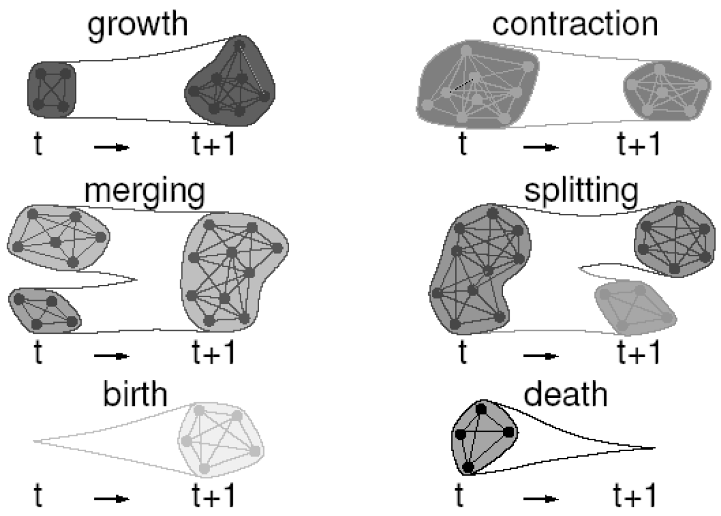 Figure: The dynamic evolution of communities—merging, splitting, and moving based on social attraction.
Experiments: Validation Against Real Traces
To prove SaMob isn't just theoretical, the authors simulated an academic conference environment with 20 nodes and compared the results against real-world traces provided by Intel Research Laboratory.
Performance Metrics
The study focused on two critical properties for Ad Hoc networking:
- Contact Duration: How long two nodes stay in range.
- Inter-contact Time: How long the gap is between meetings.
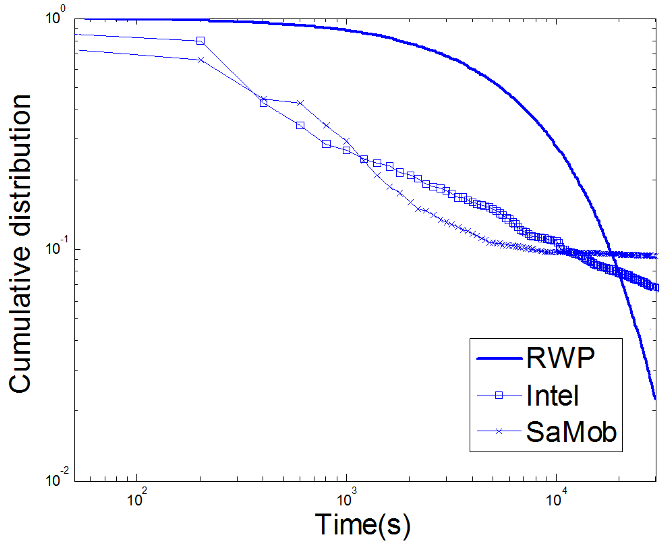 Figure: SaMob (represented in the distribution plots) shows a clear power-law distribution, matching the empirical Intel data almost perfectly.
The results show that by simply using a few key social attributes (Gender, Age, Major, Institute), SaMob can generate movement patterns that are statistically indistinguishable from real human movement.
Critical Analysis & Conclusion
Takeaway: SaMob successfully shifts the bottleneck of mobility modeling from "data collection" (traces) to "attribute quantization." By identifying 3-4 key social drivers, researchers can generate realistic synthetic traces for any specific environment (e.g., a hospital, a battlefield, or an office).
Limitations:
- Static Attributes: Currently, the model assumes social attributes are static. In reality, "transient interests" (like a temporary session at a conference) might change the Attractor Matrix dynamically over time.
- Weighting (): The weighting of different attributes still requires some heuristic tuning or prior knowledge of the specific social environment being modeled.
Future Outlook: Integrating SaMob with edge computing or opportunistic forwarding protocols could lead to "socially-aware" routing, where packets are passed to nodes not just based on distance, but on their social probability of meeting the destination node.