
Social Auto-Scaling: Leveraging the "Social Buzz" to Predict and Prevent Server Crashes
Social Auto-Scaling
This paper introduces "Social Auto-Scaling," a proactive resource management approach that leverages social media "buzz" (specifically Twitter/X hashtags) to trigger cloud infrastructure scaling. Orchestrated on AWS, the system anticipates traffic surges by monitoring social signals before they manifest as heavy server load, significantly reducing scaling latency.
TL;DR
Social Auto-Scaling shifts cloud management from reactive to preemptive. By monitoring Twitter hashtags as early-warning signals for real-world events (like traffic strikes or emergencies), the system provisions AWS resources before the traffic surge actually hits the load balancer, effectively neutralizing the latency of VM provisioning.
Background: The Latency Trap of Traditional Scaling
In the world of High Availability (HA), timing is everything. Most modern infrastructures rely on the MAPE-K (Monitor-Analyze-Plan-Execute-Knowledge) cycle. However, when an unexpected "flash flood" of traffic occurs—prompted by breaking news or localized incidents—the server's CPU or network adapters usually hit their redline before the system can spin up new nodes. This creates a "latency gap" where the service remains unavailable despite the auto-scaler's best efforts.
The Insight: Social Media as a "Lens" into Future Traffic
The authors posit that social media activity often precedes web traffic surges. For public services like transportation (e.g., Dublin’s LUAS tram), a strike or a breakdown is reported on Twitter minutes or even hours before thousands of commuters simultaneously rush to the official website for updates.
By treating "Buzz" (the volume of specific hashtags) as a quantifiable resource metric, we can move the "Monitor" phase of the MAPE-K cycle outside the immediate technical perimeter and into the social sphere.
Methodology: The Social-Cloud Architecture
The proposed architecture (implemented on AWS) integrates a specialized Social Network Integration (SNI) server.

Core Components:
- SNI Server: Built in Java, it taps into the Twitter Streaming API. Unlike the REST API, the Streaming API provides live, continuous feedback without rate-limit bottlenecks.
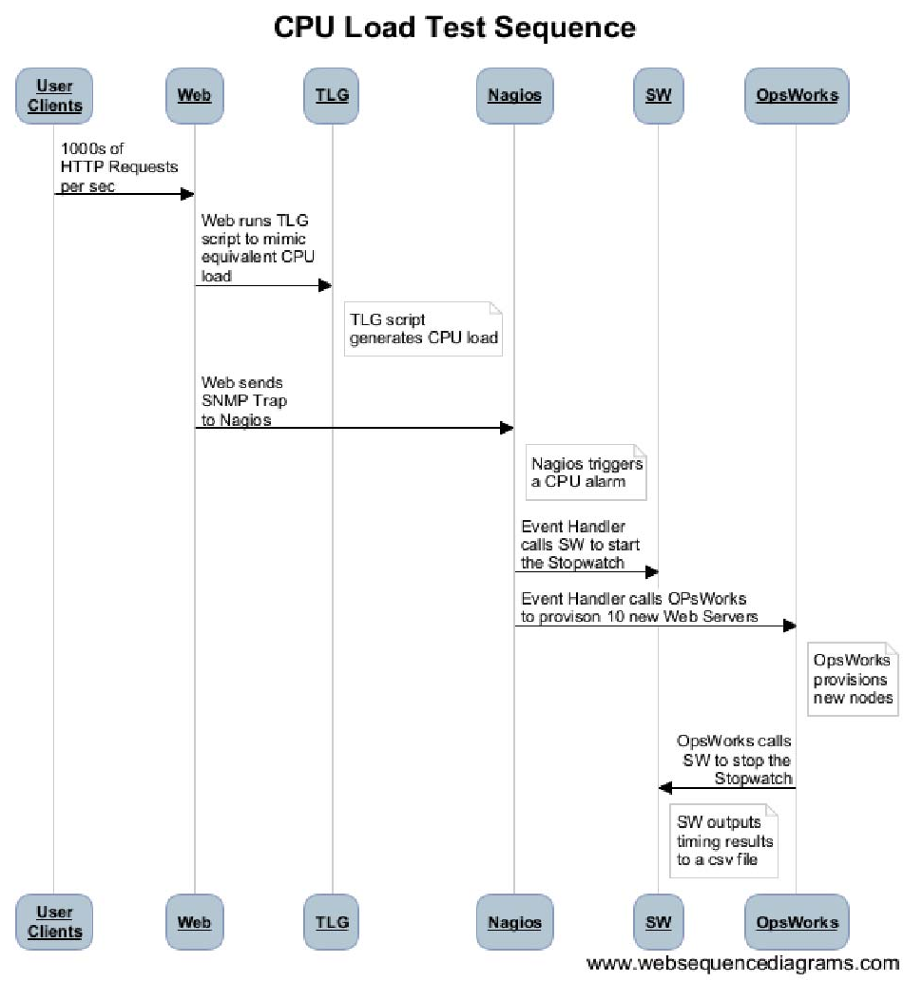
- Nagios & SNMP: A custom Nagios server acts as the central alarm hub. It receives SNMP traps from the SNI server when hashtag counts exceed "Normal" thresholds derived from a 5-week statistical baseline.
- AWS OpsWorks: Rather than simple Auto-Scaling Groups, the authors use OpsWorks (based on Chef) to allow for more granular configuration and rapid specialized deployment of web nodes.
Proactive vs. Reactive: The Sequence of Events
The effectiveness of this method is best visualized by comparing the call-flows. While traditional scaling (Fig. a & b) waits for internal hardware stress, the social approach (Fig. c) initiates the "Add Node" command as soon as the external "Buzz" threshold is crossed.
Experiments & Real-World Use Case: DUBLIN LUAS
The authors validated their model using the LUAS transportation system in Dublin. They analyzed social data during three actual strike events in May 2016. During these strikes, tweet volume spiked by 85% to 140% compared to an average Friday.
 Fig: Correlation between passenger activity and tweet volume, providing a predictable pattern for threshold setting.
Key Results:
- Provisioning Speed: The social-driven trigger successfully provisioned new servers in roughly 8 minutes.
- Lead Time: By acting on "Buzz" before "Load," the system provides a safety margin. In real-world scenarios, this 8-10 minute lead time is often the difference between a sluggish site and a complete outage.
Critical Analysis & Conclusion
Takeaway
The paper successfully demonstrates that external social signals are robust "leading indicators" for infrastructure demand. By augmenting traditional metrics with social data, SREs (Site Reliability Engineers) can combat the inherent physical delay of spinning up new virtualized hardware.
Limitations & Future Work
- Sample Bias: The system relies on the Twitter 1% sample, which may fluctuate in accuracy.
- False Positives: Not all "Buzz" leads to traffic. A celebrity tweeting about a strike might cause a buzz spike without a corresponding surge in website users. The authors suggest using social data to provision but relying on traditional data to de-provision.
- Lack of Semantic Depth: The current model only counts keywords. Future iterations could use Sentiment Analysis or NLP to distinguish between a "service praise" buzz and an "emergency complaint" buzz.
In conclusion, Social Auto-Scaling represents a significant step toward "Context-Aware" cloud computing, where the infrastructure reacts not just to its own internal state, but to the pulse of the world it serves.