
SoCS: Leveraging Social DNA to Tame the Chaos of Wireless Ad Hoc Networks
Social-aware clustering for wireless ad hoc networks
This paper introduces the Social-aware Clustering Scheme (SoCS), a decentralized framework for wireless ad hoc networks that leverages past link history to optimize cluster formation. By integrating social connection patterns into the joining logic, SoCS achieves superior scalability and reduced overhead compared to traditional location-aware schemes like DiLoC.
TL;DR
Wireless ad hoc networks are notoriously difficult to manage due to their unpredictable, dynamic nature. The Social-aware Clustering Scheme (SoCS) introduces a paradigm shift: instead of treating node movement as random, it uses link history as a proxy for social ties. This simple yet profound insight allows the network to form more stable clusters, slashing maintenance overhead and boosting routing performance in environments where human-driven mobility patterns exist.
Background & Positioning
In the landscape of network topology management, clustering is the standard recipe for scalability. However, most existing schemes are reactive or purely geographic. SoCS positions itself at the intersection of Social Network Theory (SNT) and distributed systems. It’s not just an incremental improvement over its predecessor, DiLoC; it’s a re-imagining of clusters as digital reflections of human social groups.
The Problem: The High Cost of Randomness
Existing protocols often suffer from "cluster churning"—nodes constantly switching clusters because the system doesn't realize that a node moving away briefly is likely to return to its "social home." This leads to:
- High Control Overhead: Constant re-signaling to update routing tables.
- Reduced Scalability: As the network grows, the management traffic overwhelms the functional data traffic.
- Inaccurate Routing: Paths are broken prematurely because the underlying cluster structure lacks "stickiness."
Methodology: The Power of Link History
The core innovation of SoCS is the Link History Table. Unlike traditional methods that only look at the current signal strength or geographic proximity, SoCS looks at time.
1. Decision Logic
When a node needs to join a cluster, it doesn't just pick the nearest one. It calculates the total historical "contact time" with nodes in each potential cluster.
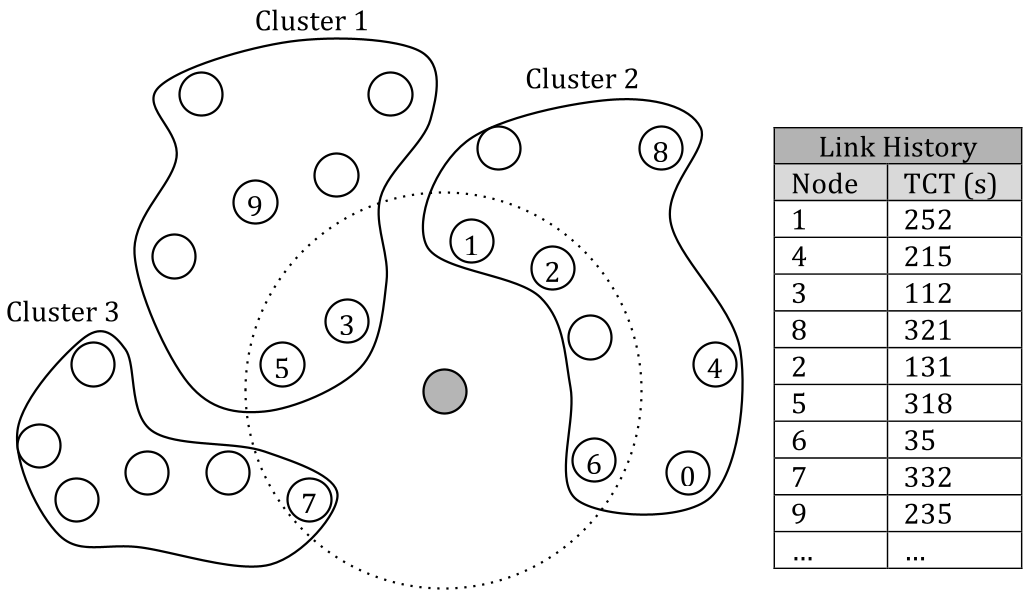 Figure 1: Comparison of cluster selection based on connectivity history.
2. The Best Clustering (BC) Metric
To prevent "popular" clusters from becoming bottlenecks, the authors introduce a balancing formula: Where represents remaining capacity and represents current in-range neighbors. This ensures the network remains balanced even as it seeks social stability.
Experimental Validation
The researchers tested SoCS against the DiLoC scheme using two drastically different mobility models: the chaotic Random Waypoint (RWP) and the structured Social Network Theory (SNT) model.
Performance Gains
- Overhead Reduction: In SNT scenarios, SoCS showed a clear reduction in kbit/s required for maintenance. By forming clusters that align with social groups, nodes moved together, reducing the need for re-affiliation.
- Structural Stability: The "Topology Changes" metric (crucial for protocol scalability) remained remarkably low in SoCS compared to non-social schemes.
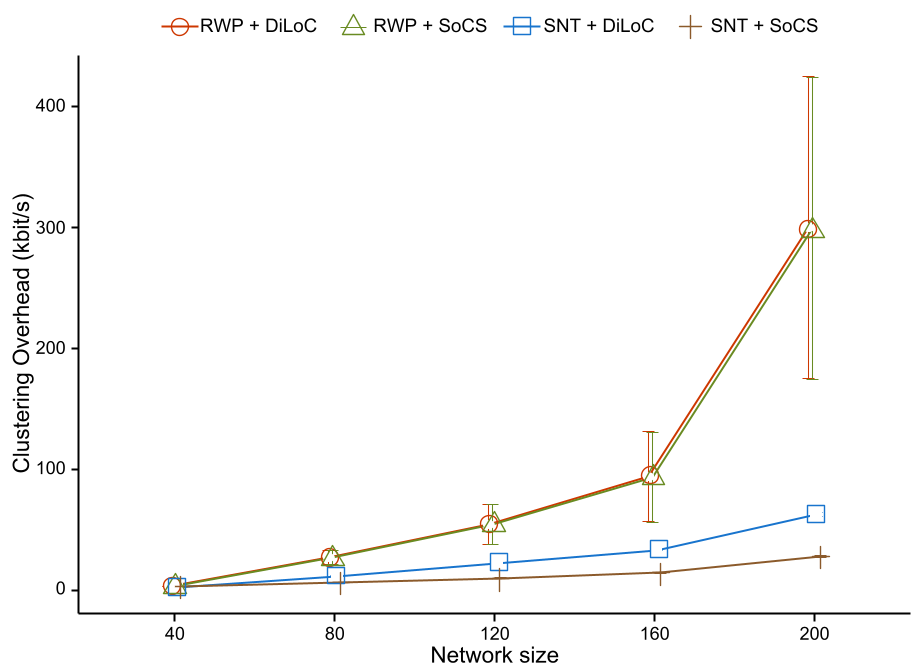 Figure 2: Clustering Overhead per second (kbit/s) showcasing the efficiency of SoCS.
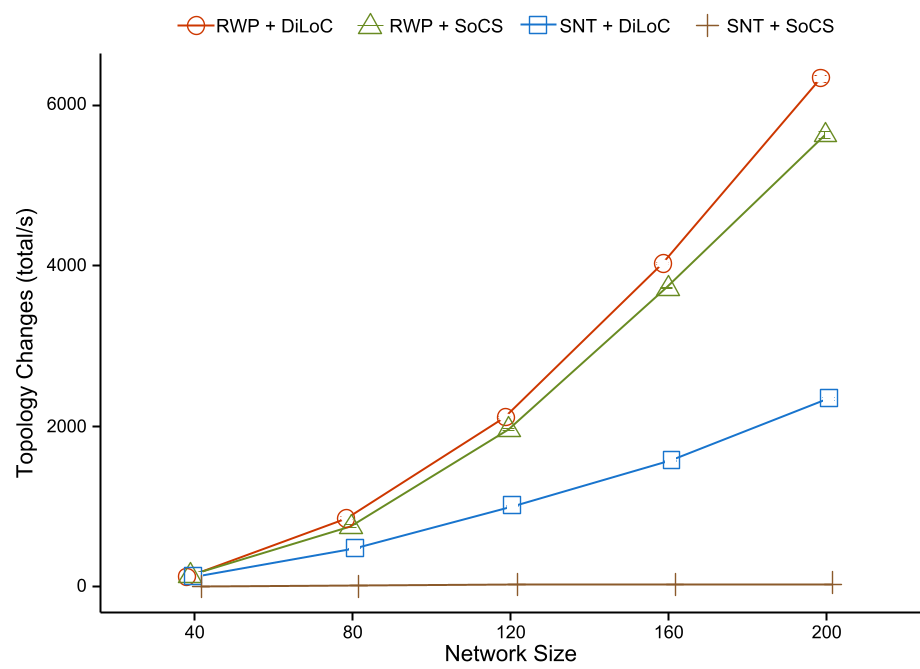 Figure 3: Drastic reduction in Topology Changes per second under SNT mobility.
Critical Insight: Why Social-Awareness Wins
The success of SoCS lies in its Inductive Bias. By assuming that past connections are a predictor of future proximity (a core tenet of social networks), it builds a "memory" into the network layer. This allows the system to filter out "noise" (transient neighbors) and focus on "signals" (reliable social partners).
Conclusion & Future Outlook
SoCS proves that "who you know" is just as important as "where you are" in wireless networking. While the current model relies on simple time accumulation, future iterations could integrate more complex metrics like Betweenness Centrality or Similarity based on user interests. As we move toward more autonomous IoT and edge computing environments, social-aware logic like that in SoCS will be essential for creating networks that are as organized as the societies they serve.
Limitations: The scheme's performance is highly dependent on initial history; in "cold-start" scenarios where no history exists, it reverts to standard clustering, offering no immediate advantage.