
Social-Aware MD2D: Reimagining Content Downloading through Social Trust and Multi-Link Cooperation
Social-aware content downloading mode selection for D2D communications
This paper introduces a social-aware content downloading mode selection scheme for D2D communications, featuring a novel multi-link D2D (MD2D) mode. By integrating physical transmission rates with social ties (reciprocity and trust), the authors model the selection process as a combinatorial auction problem to maximize social welfare.
TL;DR
As mobile data demand skyrockets, Base Stations (BS) are becoming bottlenecked by redundant requests for popular content. This paper proposes a transformation of D2D (Device-to-Device) communication by introducing MD2D—a mode that allows a downloader to pull content from multiple providers simultaneously. By blending physical channel quality with social trust metrics, the authors use Combinatorial Auctions to ensure that content sharing is not only fast but also secure against selfish and malicious users.
Problem & Motivation: The Altruism Fallacy
Most existing D2D research shares a common "blind spot": they assume mobile users are altruistic entities willing to sacrifice battery and bandwidth for strangers. In reality, users are selfish.
The authors identify three critical pain points:
- Redundant BS Load: Serving the same popular content multiple times via cellular links is inefficient.
- Social Obliviousness: Ignoring the human element leads to "free-riders" who consume data but never provide it.
- Security Risks: In an open D2D environment, malicious providers could deliver corrupted data or disrupt the network.
The insight here is that Social Tie Strength—comprising intimacy and historical reciprocity—acts as a natural filter for reliability, much like how humans prioritize favors for friends over strangers.
Methodology: The Dual-Domain Framework
The core of the paper lies in its unified performance metric, which bridges two worlds:
1. The Physical Domain
It models the "can we transmit?" aspect. Using a weighted graph, it calculates the Normalizing Achievable Rate. It accounts for interference when D2D links reuse cellular downlink resources, ensuring that D2D communication doesn't degrade the experience for traditional cellular users.
2. The Social Domain
It models the "should we trust?" aspect. It uses two indices:
- Closeness Index (): Based on common friends (Jaccard similarity).
- Reciprocity Index (): A "give-and-take" balance that tracks how many bytes a provider has contributed versus consumed.
The final metric is a weighted sum: . This allows the network to tune its priority between raw speed () and high reliability/trust ().

3. The Auction Mechanism
The problem is formulated as a Submodular Welfare Problem. Since selecting the optimal set of providers is NP-complete, the authors adapt a Combinatorial Auction algorithm. Downloaders act as "bidders" and content-holding devices act as "items." This ensures a stable convergence with polynomial complexity .
Experiments & Results: The Power of Collaboration
The researchers simulated a hexagonal cell with varying numbers of downloaders () and providers ().
Key Findings:
- MD2D Superiority: The MD2D mode (red curves in Fig 1) consistently outperformed single-pair D2D/B2D modes, especially as the number of providers increased.
- Social Awareness Gain: Compared to social-unaware schemes, the proposed method saw utility gains of up to 24.1%.
- Robustness: By prioritizing users with high Reciprocity Indices, the system naturally sidelined "malicious" or "selfish" nodes, creating a self-policing ecosystem.
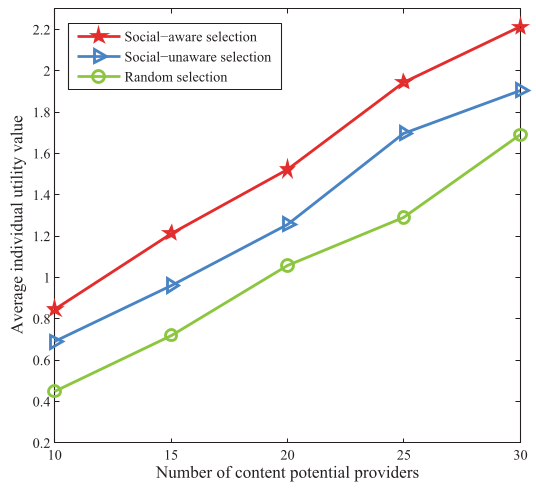 Fig 1: Successive increase in individual utility as MD2D capitalizes on multiple local providers.
Critical Insight & Conclusion
This paper’s true value is in its mathematical proof of equivalence. By proving that social-aware D2D selection follows submodular properties, it moves the field away from "heuristic" social rules into the rigorous domain of Auction Theory.
Limitations: The model assumes that social information (friends, historical bytes) is shared truthfully and stored locally. In a real-world 6G scenario, protecting the privacy of this social metadata while maintaining the Reciprocity Index will be a significant challenge.
Future Work: Integrating Zero-Knowledge Proofs (ZKP) or Blockchain-based ledgers to manage the "Reciprocity Index" could be the next step in making this framework truly decentralized and private.
Final Takeaway: Moving from "Direct D2D" to "Social-Aware MD2D" isn't just a technical upgrade—it's a shift toward a more human-centric, cooperative network architecture.