
Social-Aware D2D Dissemination: Bridging the Gap Between Altruism and Self-Interest
Social-Aware Data Dissemination via Device-to-Device Communications: Fusing Social and Mobile Networks with Incentive Constraints
The paper proposes a three-phase social-aware data dissemination framework for Device-to-Device (D2D) communications. It introduces a "social-physical graph" to optimize seed selection and employs truthful moneyless incentive mechanisms to manage data forwarding among altruistic friends and selfish strangers.
TL;DR
Mobile data dissemination is transitioning from purely cellular broadcasts to decentralized Device-to-Device (D2D) sharing. This paper introduces a three-phase framework that uses social-physical graphs for seed selection and high-efficiency, moneyless incentive mechanisms to ensure that users—whether friends or strangers—participate truthfully and effectively in data spreading.
Executive Summary
In the era of hyper-connectivity, the bottleneck is often the Base Station (BS). D2D communication offers a way out, but it relies on a fickle variable: human cooperation. This research provides a mathematically grounded approach to incentivizing data forwarding by recognizing that users behave differently based on social ties. By combining social graphs with physical encounter probabilities, the authors achieve a completion ratio that far exceeds traditional community-based methods.
The Problem: The Dual-Face of the Mobile User
Existing D2D dissemination strategies usually fall into two traps:
- The Altruism Trap: Assuming every user is a "good samaritan" who will use their battery and bandwidth to help anyone.
- The Complexity Trap: Using monetary incentives (micropayments) which introduce security risks and high transaction overhead.
The core challenge is: How do we design a system that maximizes data spread while respecting that users are selfish to strangers but altruistic to friends, all without using a single cent?
Methodology: The Three-Phase Architecture
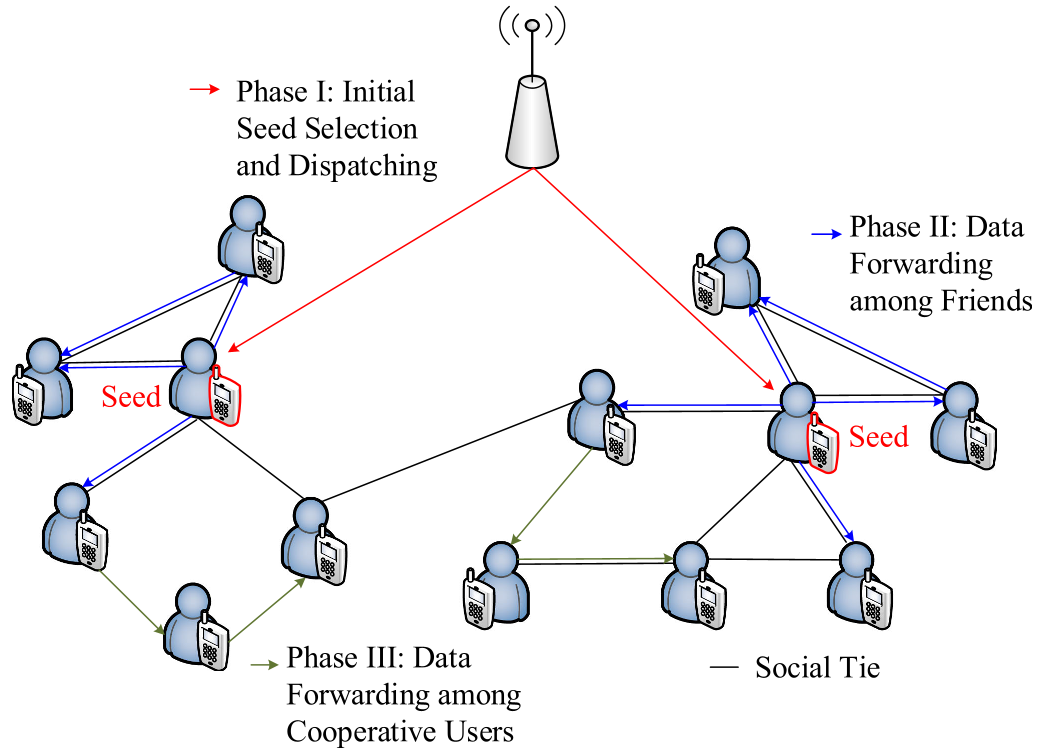
The authors propose a structured pipeline to handle the lifecycle of a message:
Phase I: Smart Seeding (Social-Physical Fusion)
Instead of picking seeds randomly, the paper constructs a Social-Physical Graph.
- The Metric: Edges are weighted by , where is the contact probability.
- The Partition: It uses the Girvan-Newman algorithm to find communities and selects seeds based on Harmonic Centrality (closeness). This ensures seeds are both socially influential and physically "mobile" enough to encounter others.
Phase II: Data Forwarding among Friends
Within social circles, users are altruistic. The challenge here is Message Selection under energy constraints. The authors provide a Greedy Truthful Mechanism.
- The Logic: If a user lies about which messages they want, they might end up with nothing. The proposed algorithm ensures that "Truth-telling" is the dominant strategy.
- Theoretical Bound: They prove that while an optimal solution is not inherently truthful, their greedy approach remains competitive ( approximation in the absolute worst case, but significantly better in practice).
Phase III: The Cooperative "Insurance"
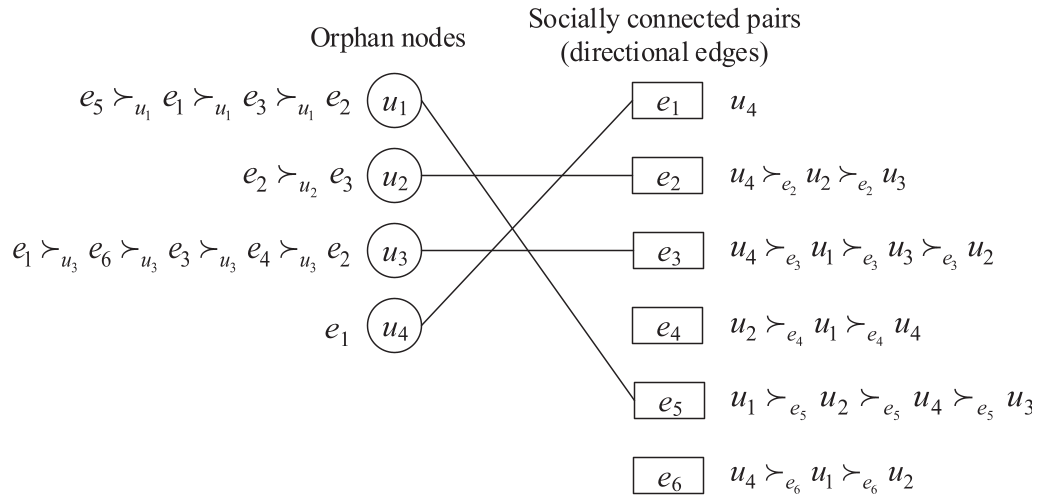
For "orphan" nodes (those without friends near a seed), the BS intervenes by setting up a Stable Matching (Gale-Shapley Algorithm). Strangers are incentivized to carry data for others in exchange for gaining access to the data themselves once the delivery is verified via a session key.
Experiments & Results
The researchers validated their approach using synthetic data and real-world traces from conferences (Infocom and Sigcomm).
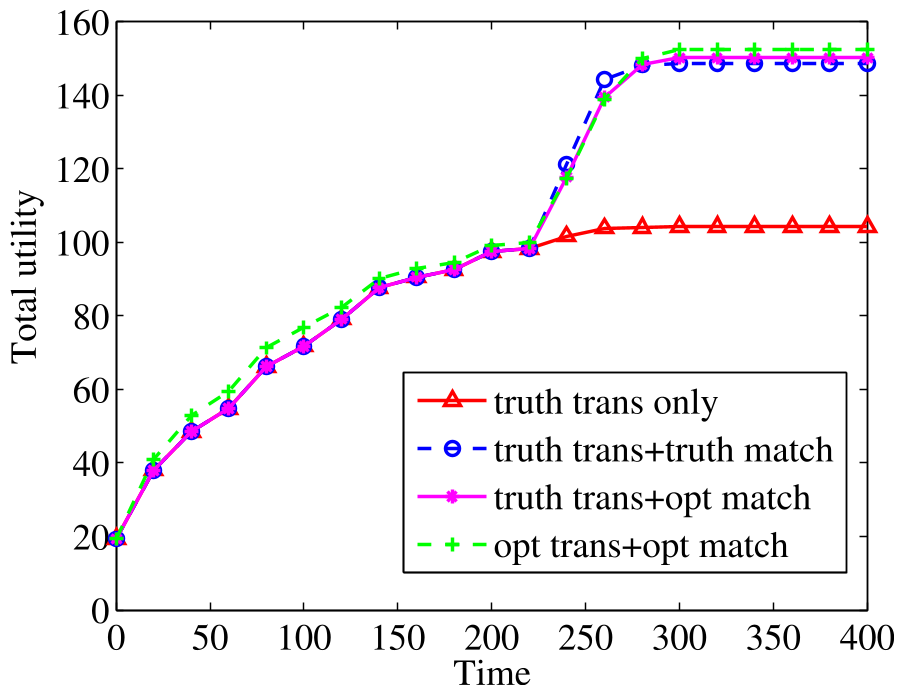
- Performance vs. Optimal: The total utility achieved by the "Truthful" greedy mechanism was remarkably close to the theoretical optimal (MWBM), proving that you don't need to sacrifice much efficiency to ensure honesty.
- Completion Ratio: In simulations, the three-phase approach reached a ~97% completion ratio, whereas reference community-based schemes stalled around 82% because they couldn't handle "orphan" nodes or deal with selfish behaviors effectively.
Critical Insight & Conclusion
The brilliance of this work lies in its Game-Theoretic pragmatism. By acknowledging that social networks and physical mobility are inseparable, the authors move beyond the "epidemic" models of the past.
Takeaway: Future D2D protocols should stop treating users as passive nodes and start treating them as rational agents. The success of moneyless incentives in this paper suggests that data access and social reciprocity are powerful enough currencies to drive the next generation of mobile networks.
Limitations: The model assumes contact probabilities () are known or easily estimated. In highly dynamic or new environments, the "Social-Physical Graph" might take too long to converge, leading to suboptimal seed selection.