
Social-Aware Visibility: Automating Privacy in Home-to-Home Networks
Social-Aware Differentiated Visibility of Home-to-Home Shared Resources in Spontaneous Networks
This paper introduces a social-aware middleware solution for home-to-home (H2H) resource sharing in spontaneous networks. It utilizes the RAMP (Real Ad-hoc Multi-hop Peer-to-peer) framework and a novel Relationship Tightness Evaluator to dynamically tune the visibility of shared content based on social interactions gathered from Facebook and Twitter.
TL;DR
Researchers from the University of Bologna have developed a middleware that automatically decides who can see your home-stored files based on how often you interact with them on Facebook or Twitter. By combining spontaneous networking (RAMP) with machine learning (J48 decision trees), the system manages privacy filters dynamically, allowing "Tight" friends more access than "Loose" followers without requiring manual setup.
Background: The Privacy-Ownership Paradox
In the age of Online Social Networks (OSNs), we face a trade-off: share content easily but lose ownership (Cloud storage), or keep content private but struggle with complex sharing tools. Most users default to "Public" or "Friends-only" visibility because managing "Close Friends" lists is too tedious. This paper tackles the "how-to-share-without-losing-control" problem by federating personal home networks (User Centered Networks - UCNs) through social links.
Motivation: Why "Interaction Frequency" Matters
The authors' core insight is that Social Tightness is a proxy for trust. If you exchange direct messages daily with a contact, you are likely more willing to share your home Media Server content with them than with someone who merely follows you. Instead of manual tagging, the system uses "Social-driven" logic: the more you interact, the tighter the relationship, the higher the visibility.
Methodology: The RAMP Framework and Tightness Evaluator
The system architecture relies on two pillars:
- RAMP (Real Ad-hoc Multi-hop Peer-to-peer): A framework that treats home subnets as "spontaneous networks," allowing devices like a NAS or Smart TV to communicate across different IP subnets as if they were local.
- The Tightness Evaluator: This module scrapes interaction data (direct messages, tags, retweets) and feeds it into a J48/C4.5 classifier.
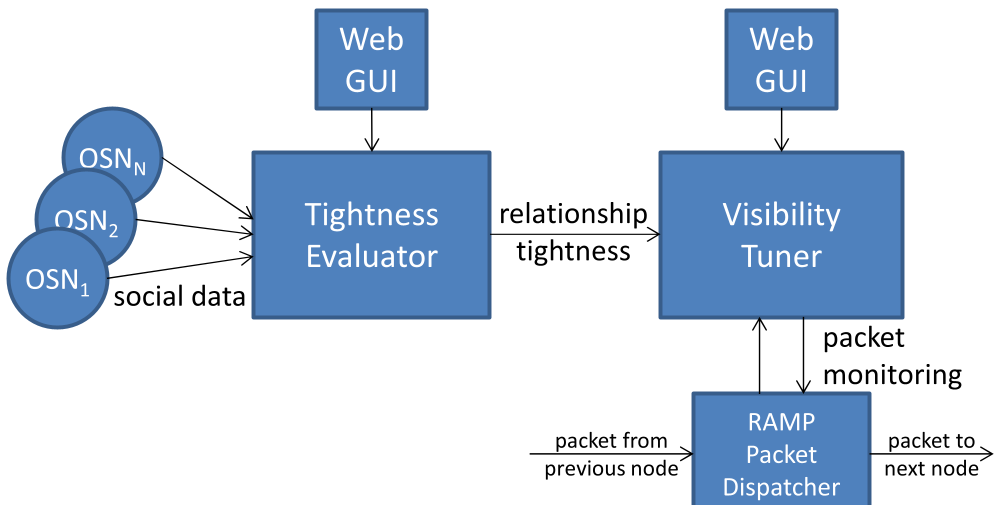 Figure 1: The proposed architecture featuring the Tightness Evaluator and Visibility Tuner.
The Visibility Grammar
The paper introduces a unique filtering grammar that operates in three distinct phases:
- Discovery (DF): Can they see that my Media Server exists?
- Browsing (BF): Can they see the list of files in my folder?
- Action (AF): Can they actually click "Download" or "Power On"?
This allows for granular rules, such as: "Allow loose friends to discover the service, but only tight friends can browse and access the files."
Experimental Validation
To build their model, the authors surveyed users to find which OSN parameters actually indicate a "Tight" relationship. Interestingly, Direct Messages held the highest priority for both Facebook and Twitter.
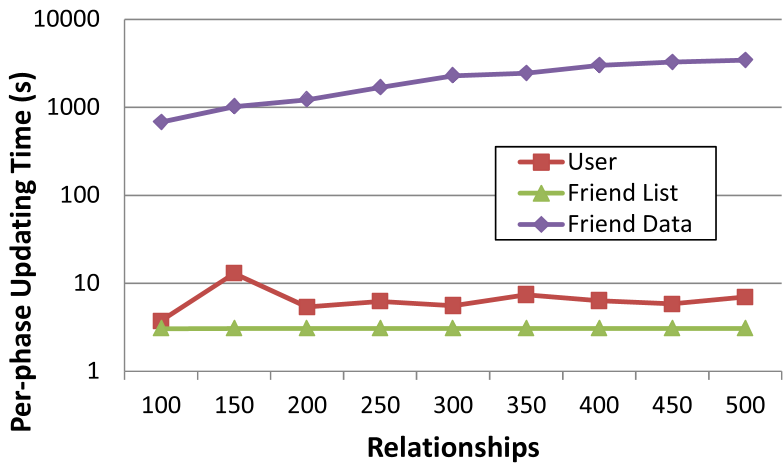 Figure 2: Performance of the OSN data gathering process across varying friend counts.
Key performance indicators:
- Accuracy: The automated decision tree achieved an 83% accuracy rate in matching human-assigned closeness.
- Throughput: For legacy UPnP "browse" packets, the filter handles 1000 packets/sec, which is more than enough for high-speed home media streaming scenarios.
- Scalability: While collecting data for 450 friends can take nearly an hour, this happens in the background (periodically), ensuring it doesn't interrupt the user experience.
Critical Insights: Beyond Static Rules
The beauty of this work lies in its Inductive Bias: the system assumes that digital interaction mimics real-world intimacy. While not perfect (you might have a "tight" relationship with someone you rarely message online), the system allows for User Feedback. If the ML model gets a relationship wrong, the user can manually re-classify it, and the system re-trains the decision tree to learn that user's specific social patterns.
Conclusion
This research bridges the gap between Social Networking and Network Infrastructure. By making privacy "socially aware," it relieves the burden of manual configuration from the user. For future home-to-home federations, this "set-it-and-forget-it" approach to visibility might be the key to reclaiming our digital data from the centralizing grasp of the Cloud.
Limitations
- Data Lag: Relationship changes aren't instantaneous; there is a window where access might remain open after a "social fallout."
- API Dependency: The system is at the mercy of OSN providers (like Meta or X) allowing access to interaction metadata.