
SCPS: Revolutionizing Physical Object Search with Social-Aware Intelligence
SCPS: A Social-Aware Distributed Cyber-Physical Human-Centric Search Engine
This paper introduces SCPS, a Social-aware distributed Cyber-Physical human-centric Search engine designed to locate physical objects carried by mobile users. It combines a Chord-based Distributed Hash Table (DHT) for decentralized indexing with a social-aware Bayesian network to predict user locations based on routines and exceptional social/environmental events, achieving state-of-the-art accuracy and scalability.
TL;DR
SCPS (Social-aware Cyber-Physical Search) is a decentralized engine designed to find physical objects (like keys or books) held by people in a wide area. Unlike previous systems that require expensive RFID tags or frequent GPS reports, SCPS uses Social-aware Bayesian Networks to "predict" where a person—and their object—is likely to be, even when their daily routine is disrupted by rain or a spontaneous meeting. It leverages a Distributed Hash Table (DHT) architecture to ensure the system scales to thousands of users without a central bottleneck.
The Scalability Wall in Physical Search
In the world of Cyber-Physical Systems (CPS), bridging the gap between digital queries and physical locations is a massive challenge. Prior work fell into two traps:
- Centralization Trapped: Systems like Snoogle or MAX use a central server. As the number of objects and queries grows, the server becomes a bottleneck, leading to massive query drops.
- The "Routine" Trap: Most social-based routing assumes humans are predictable creatures of habit. But what happens if it rains? Or you bump into an old friend? Traditional models break down when human behavior deviates from the norm.
Methodology: The Social-Aware Bayesian Model
SCPS’s core innovation is its ability to handle exceptions. It doesn't just look at where you usually are; it looks at why you might be somewhere else.
1. Hierarchical Architecture
The system is split into two layers:
- Upper Layer: Base Stations (BSs) form a Chord DHT. They serve as locators and holder indexers.
- Lower Layer: Mobile Nodes (MNs) and Sensors. They communicate with the nearest BS.

2. Bayesian Exception Handling
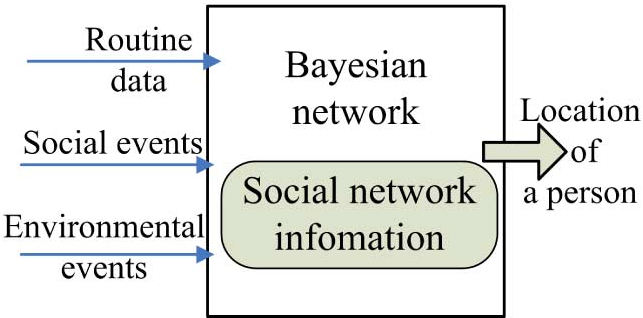
The authors use a Bayesian network that incorporates variables like Time, Environmental Events (e.g., rain), and Social Events (e.g., meeting friends).
- Routine: If no exceptions occur, the model predicts the standard location.
- Context-Aware: If a sensor reports "Rain," the model shifts the probability from the "Football Field" to the "Gym."
Experiments: Real-World Performance
The researchers used the MIT Reality dataset (cell phone and Bluetooth traces of 94 users) to validate SCPS.
High Accuracy, Low Drop Rate
While traditional statistic-based methods hit a wall at 31% accuracy, SCPS achieved an average of 82% accuracy in predicting where a person is at any given minute.
More importantly, as the query rate increased, SCPS maintained a near-zero Location Query Drop Rate (around 0.21%), whereas the centralized Snoogle saw drop rates jump to nearly 6%. This highlights the power of the DHT-based decentralized approach.
Efficiency vs. Accuracy
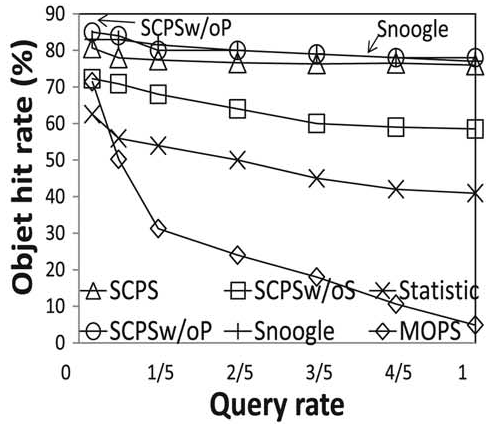
A critical trade-off in CPS is between overhead (battery/data usage) and hit rate (finding the object). SCPS achieves a hit rate comparable to systems that report locations every few seconds, but it does so without the constant data transmission, drastically reducing network overhead.
Critical Insight & Conclusion
The SCPS framework proves that human context is a data source. By treating social connections and environmental sensors as parameters in a probabilistic model, we can replace "brute force" location tracking with "intelligent prediction."
Takeaways:
- Decentralization is key: Moving away from central stations prevents single points of failure and bottlenecking.
- Predict, don't just Track: Bayesian logic allows a system to "fill in the gaps" when a user is offline or between reports.
- The Future: While SCPS is robust, future improvements in privacy (access control) and more complex social metrics (contact frequency) will be necessary for large-scale consumer adoption.
SCPS isn't just a search engine; it's a blueprint for a more localized, efficient way to manage the physical world through a digital lens.