
Social-Aware Dynamic Router Placement: Making WMNs "Work Together"
Social-aware dynamic router node placement in wireless mesh networks
This paper introduces a social-aware dynamic router node placement (Social-aware WMN-dynRNP) approach for Wireless Mesh Networks. It proposes a Social-based Particle Swarm Optimization (S-PSO) algorithm that leverages the community structures of mobile clients to optimize network connectivity and client coverage in real-time.
Executive Summary
TL;DR: Unlike traditional static placement, this research presents a Social-aware Dynamic Router Node Placement (dynRNP) strategy. By introducing a social-based Particle Swarm Optimization (S-PSO), the network can anticipate and react to the movement of user "communities," allowing routers to physically gravitate toward crowded areas to prevent service congestion.
Historically, Wireless Mesh Network (WMN) optimization treated users as independent dots on a map. This paper shifts that paradigm, positioning router placement as a social-aware task that mirrors the collective behavior of human groups.
Problem & Motivation: The "Heavy-Loading" Bottleneck
In current WMN deployments, two major pain points exist:
- Limited Capacity: Every router has a hard limit () on the number of clients it can serve.
- Community Clustering: Users rarely move randomly; they gather in stadiums, conference rooms, or transit hubs.
Previous SOTA methods (like standard PSO or GA) struggled because a single router would get overwhelmed by a community, while nearby routers remained idle simply because they weren't "aware" they needed to help. The authors' insight is simple: Routers in the same network component should behave like a social support system.
Methodology: The Social-Supporting Vector
The core innovation is the Social-supporting vector (). In a standard PSO, a particle (representing a router placement) moves based on its own best experience and the global best. The S-PSO adds a third force:
The Velocity Update Formula
The motion of the particle is governed by:
Where specifically directs "idle" routers (those serving 0 clients) to move toward "heavy-loading" routers (those at the limit) within the same topology.
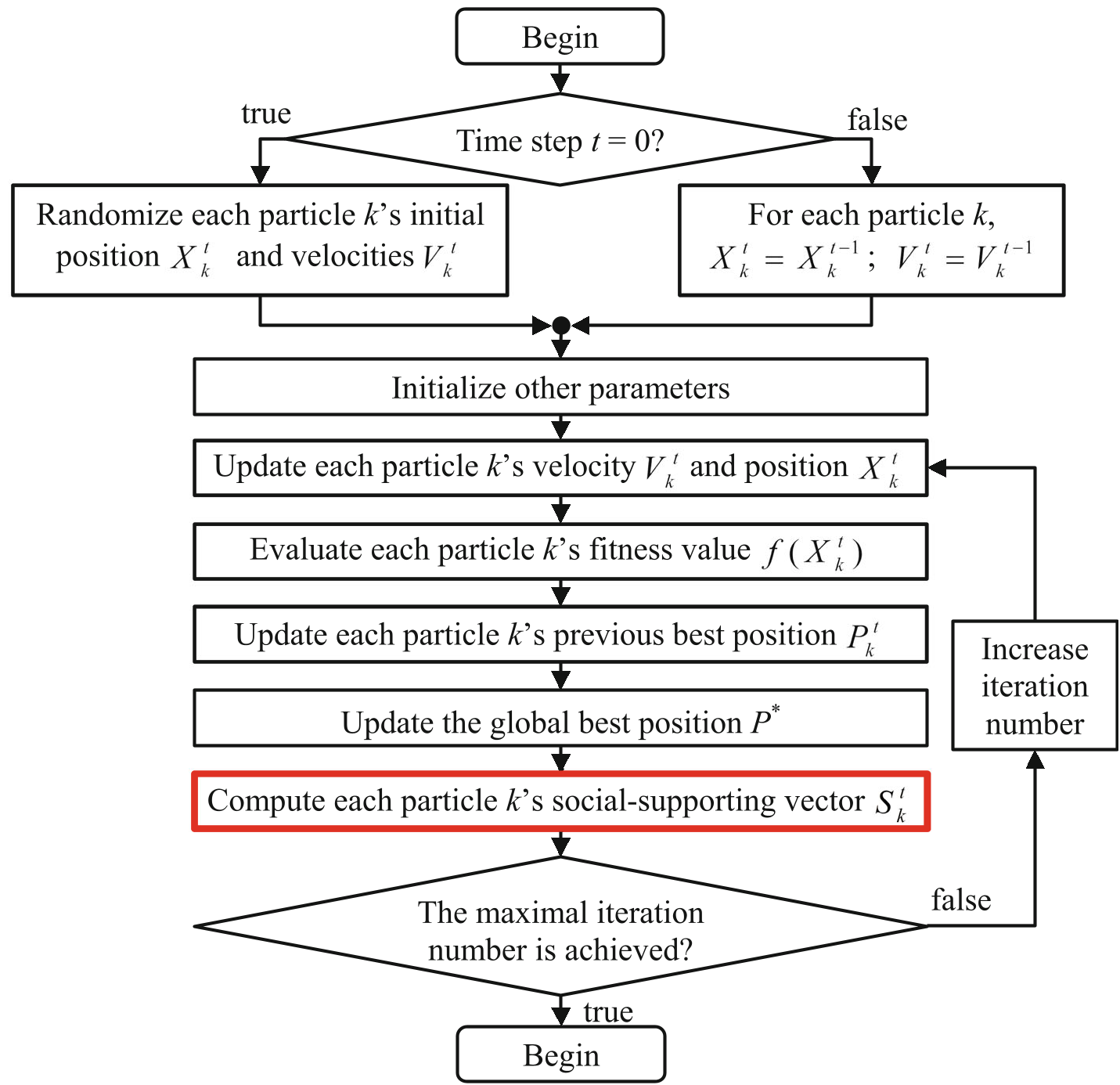 Figure 1: The S-PSO Flowchart illustrating the integration of social-supporting vectors into the iteration loop.
Experiments & Results
The researchers tested three scenarios:
- Simplified Dynamic: Pure community movement.
- Generalized Static: Communities + scattered independent users.
- Generalized Dynamic: The most realistic, where communities merge and disband over time.
Performance Gains
The S-PSO demonstrated a clear advantage in Client Coverage. By moving idle routers to support heavy clusters, the number of unserved clients dropped significantly compared to the 2013 PSO baseline.
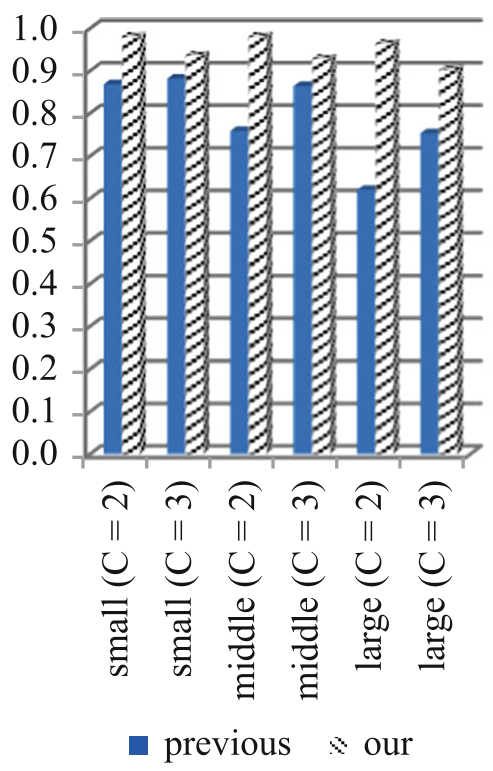 Figure 2: Fitness value comparison showing that S-PSO (ours) consistently achieves higher scores across Small, Middle, and Large scale networks.
Ablation Insight: Interestingly, in the "Generalized Static" scenario (where users don't move), the S-PSO performs similarly to standard PSO (). This proves the social-supporting vector is specifically a "dynamic engine"—it shines when the network needs to reconfigure itself rapidly to follow moving crowds.
Critical Analysis & Conclusion
Takeaway
The value of this work lies in its load-balancing intuition. By mathematically defining "support" as a vector force, the authors solved the NP-hard problem of dynamic coverage without requiring complex centralized coordination for every individual client.
Limitations & Future Work
- Real-world Traces: The trajectories used (merge/divide) are synthetic. Future research should apply real-world GPS datasets (e.g., from festivals or campuses).
- Cost of Movement: The model doesn't fully account for the "energy cost" or "handover latency" of physical routers moving too frequently.
Overall, this is a pioneering step in merging Social Network Analysis (SNA) with Physical Infrastructure Optimization.