
SMIC: Revolutionizing Federated IoT through Social-Aware Matching
A Social-Aware Approach for Federated IoT-Mobile Cloud using Matching Theory
The paper introduces Social Mobile-IoT Clouds (SMICs), a federated framework that leverages social relationships between IoT devices to facilitate collaborative resource sharing. By utilizing a Many-to-Many (M-M) matching theory approach orchestrated by Edge Nodes, the system establishes a trustworthy environment for offloading sensing, computation, and storage tasks among co-located devices.
TL;DR
As the Internet of Things (IoT) expands, the demand for local, low-latency resource sharing grows. This paper proposes Social Mobile-IoT Clouds (SMICs), a system where your smartphone doesn't just look for any nearby device to offload a task, but specifically looks for "friends"—devices with established social ties. By applying matching theory at the network edge, the researchers achieved significant improvements in task success rates and reliability.
Background: Why "Social" IoT?
The bottleneck for modern IoT isn't just hardware; it's trust. Why would a user allow their device to process a stranger’s data? Traditional Fog and Edge computing often treat nodes as generic resource providers. This paper shifts the paradigm toward the Social IoT (SIoT). By mirroring human social structures (Ownership, Co-location, Co-work), devices can navigate networks more efficiently and establish a baseline of reliability before a single packet is even sent.
Methodology: The M-M Matching Engine
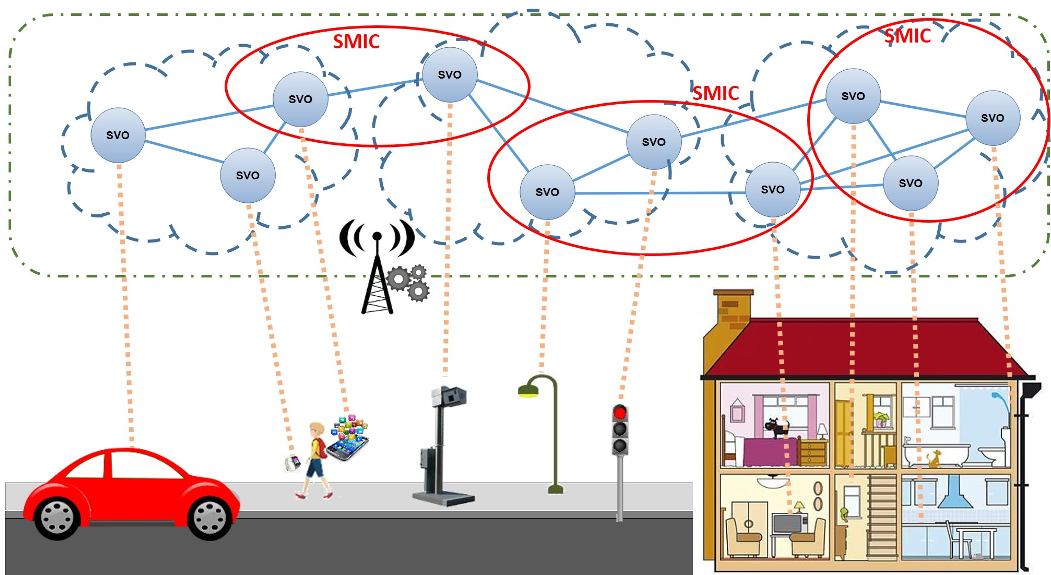
The core of the SMIC architecture is the Edge Node (EN), which acts as a matchmaker. Instead of a simple first-come-first-served queue, the EN maintains Social Virtual Objects (SVOs)—digital twins of physical devices that store their social links and preferences.
The Optimization Framework
The researchers formulated the resource allocation as a Many-to-Many (M-M) assignment game. Unlike simple 1-to-1 matching, M-M allows a single complex application to be split across multiple "friend" devices, and a single powerful provider to host multiple tasks simultaneously.
The objective function is defined as: Where is a performance matrix weighted by user preferences (Trust, Energy, or Mobility) and is the allocation matrix.
Experiments and Insights
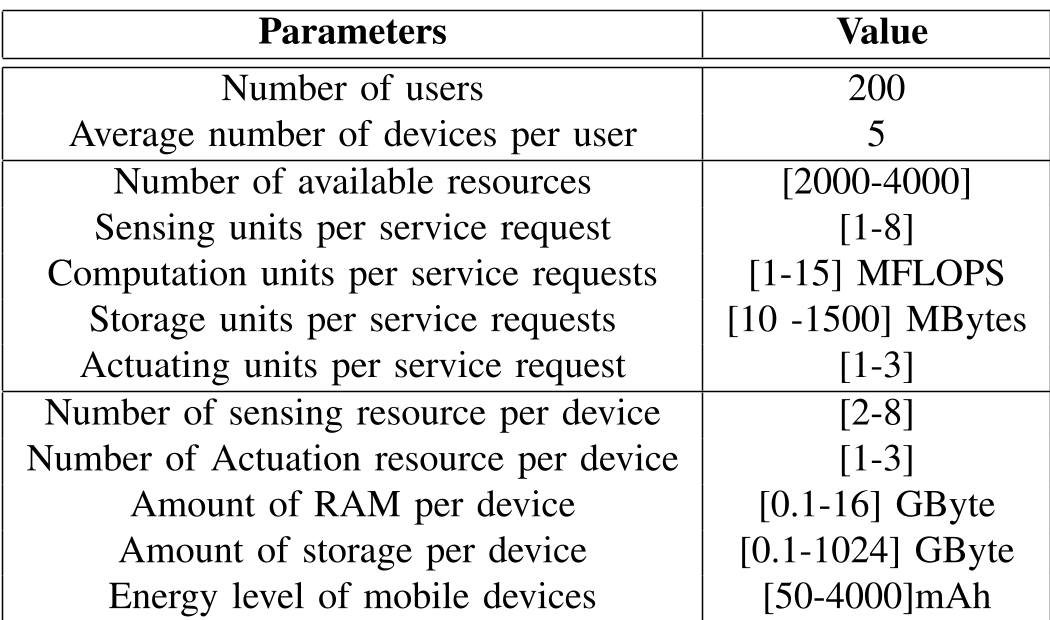
The study utilized the real-world Santander SIoT dataset, covering 1000+ devices. The researchers compared two execution strategies:
- On-Demand: Allocation happens the moment a request arrives.
- Periodic: The EN waits for a time-frame to collect multiple requests before optimizing.
Performance Trade-offs
The results show that while On-Demand is fast for low-traffic scenarios, Periodic Matching scales much better, as it allows the EN to optimize resources globally for all pending tasks.
Crucially, the study analyzed how different user "incentives" change network behavior:
- Maximizing Trust: Leads to 85% average trust in helping devices but consumes more local energy.
- Minimizing Task Failure: Reduces failures to 10% by avoiding highly mobile nodes that might move out of range.
Critical Analysis & Conclusion
This work provides a robust mathematical foundation for "socially-responsible" computing. By quantifying social relationships into a matching weight, it moves beyond the purely technical bottlenecks of CPU/RAM and addresses the human element of IoT deployment.
Limitations: The current model assumes the Edge Node is fully aware of all device presence times. In reality, devices may be "selfish" and misreport their availability.
Future Outlook: The next frontier for this research involves multi-edge coordination and the introduction of "truthful mechanisms" (Game Theory) to ensure devices report their resources honestly. As we move toward 6G, the convergence of social networks and edge clouds will likely become the standard for autonomous collaborative systems.
Main Takeaway: Social awareness isn't just for humans anymore; it's the key to making decentralized IoT clouds reliable and efficient.