
DRL-SIM: Optimizing Vehicular Crowdsensing through Social-Aware Reinforcement Learning
2709_Social-Aware Incentive Mechanism for Vehicular Crowdsensing by Deep Reinforcement Learning.
The paper proposes DRL-SIM, a multi-agent Deep Reinforcement Learning-based social-aware incentive mechanism for Vehicular Crowdsensing (VCS). By leveraging Proximal Policy Optimization (PPO), it optimizes the long-term sensing strategies of vehicles while considering both monetary payoffs and social network effects under dynamic pricing and channel states.
TL;DR
Vehicular Crowdsensing (VCS) is a critical pillar for smart cities, yet maintaining participant engagement remains a challenge. This paper introduces DRL-SIM, a framework that treats vehicles as autonomous agents in a social network. By combining Deep Reinforcement Learning (PPO) with Social Network Effects, the researchers have developed a system that maximizes long-term data quality and vehicle utility without requiring drivers to share sensitive private information.
Problem & Motivation: Beyond Simple Paychecks
Why do drivers share data? Most current systems assume it is purely for the money (Extrinsic Utility). However, this ignores the "virtual community" aspect of driving—Vehicular Social Networks (VSNs).
The authors identify three fatal flaws in prior SOTA:
- Context Blindness: Ignoring dynamic channel states (5G/LTE variations) and battery limits.
- Social Ignorance: Failing to account for how one driver's contribution motivates their "neighbors."
- Privacy Risks: Assuming a central platform knows everyone's social connections and internal battery states.
The motivation here is to design a mechanism where vehicles want to contribute because they benefit from the collective wisdom of their social circle, even when monetary rewards fluctuate.
Methodology: The Core Architecture
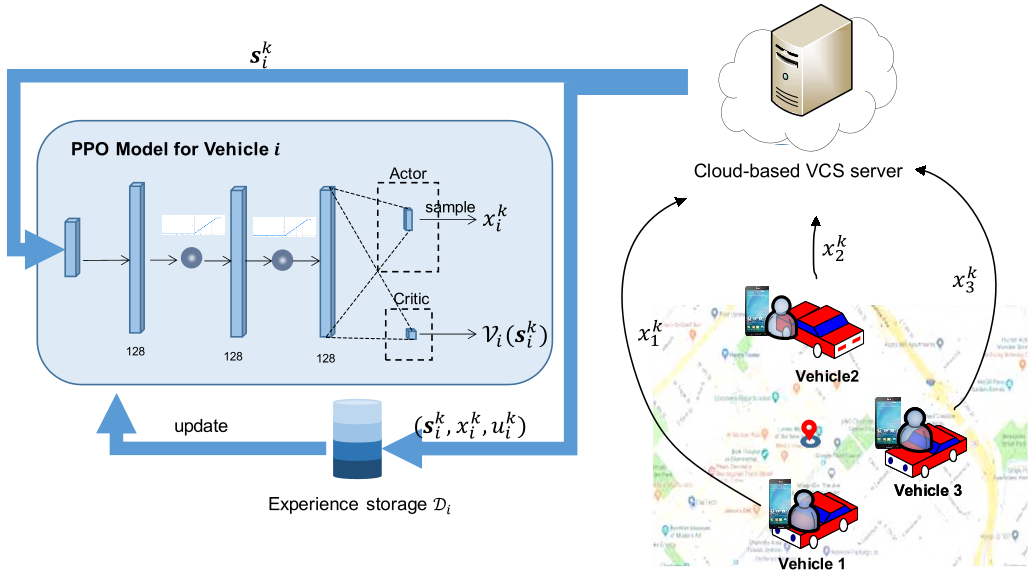
DRL-SIM transforms the incentive problem into a Markov Decision Process (MDP) solved via a Multi-Agent version of Proximal Policy Optimization (PPO).
1. The Utility Function
The utility is decomposed into:
- Extrinsic: Shared task payoff minus sensing/transmission costs (power and data).
- Intrinsic: The Social Network Effect, modeled as , where represents the influence of vehicle on vehicle .
2. Handling Incomplete Information
To preserve privacy, the authors use an Influence Matrix based only on in-degrees and out-degrees rather than the full adjacency matrix of the social graph. This allows vehicles to estimate the Nash Equilibrium without knowing the "who-knows-who" of the entire network.
3. Actor-Critic Structure
Each vehicle runs three sub-networks:
- Feature Network: Extracts logic from raw state (battery, channel, task payoff).
- Policy Network (Actor): Decides the sensing level.
- Value Network (Critic): Predicts the long-term accumulated reward to guide the Actor.
Experiments & Results: Slaying the Baselines
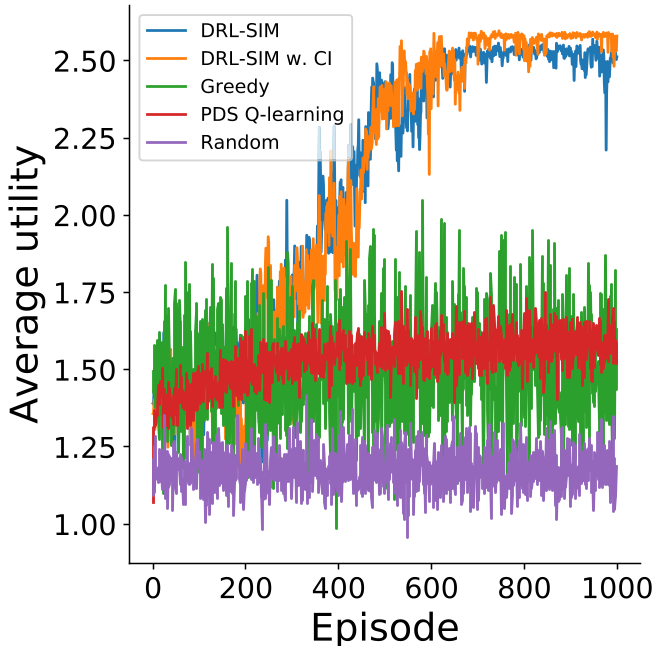
The researchers compared DRL-SIM against Q-Learning, PDS Q-Learning, and heuristic Greedy/Random approaches.
Key Findings:
- Convergence: DRL-SIM stabilizes around 600 episodes across three different channel models (Sine, Piece-wise, and Markov-chain).
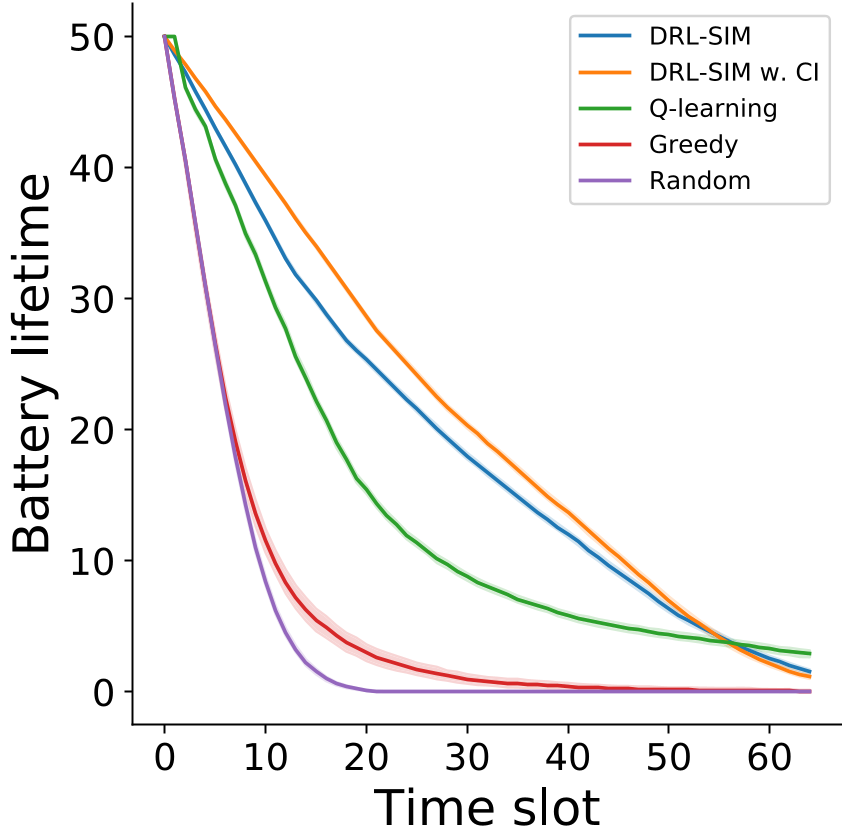
- Task Completion: DRL-SIM achieved a 99% completion ratio. In contrast, Q-learning failed toward the end of campaigns because it lacked the "foresight" to save battery for later tasks.
- Social Impact: As the social network density () increases, the intrinsic utility grows. DRL-SIM effectively balances this by "saving" sensing effort for high-payoff opportunities while maintaining a baseline social contribution.
Battery Management
One of the most impressive results is the battery lifetime. Greedy methods drain a vehicle's 50-unit battery in 30 time slots. DRL-SIM manages the budget over a much longer horizon, ensuring the vehicle remains a participant for the entire campaign duration.
Critical Analysis & Conclusion
DRL-SIM proves that social awareness is not just a "nice-to-have" but a strategic asset in vehicular networks. By leveraging multi-agent PPO, the system handles the continuous action space (sensing levels) much better than discrete Q-learning.
Takeaway: Future VCS platforms should stop looking at vehicles as isolated data-producers and start seeing them as nodes in a dynamic social ecosystem.
Limitations: The model assumes constant vehicle speed during training. Real-world "stop-and-go" traffic might require adding Gaussian noise or more complex Recurrent Neural Networks (RNNs) to capture temporal dependencies in channel states.