
WeChat Payment: How Social Interaction Redefined the Mobile Wallet Architecture
Social Aware Mobile Payment Service Popularity Analysis: The Case of WeChat Payment in China
This paper presents an extended Technology Acceptance Model (TAM) to analyze the popularity of WeChat Payment in China. It integrates social-aware variables—Social Interaction, Trust, Perceived Enjoyment, and Use Context—to explain how social networking features drive mobile payment adoption.
TL;DR
Why did WeChat Payment explode in popularity while other mobile wallets struggled? This research shifts the focus from purely technical utility to Social-Awareness. By extending the classic Technology Acceptance Model (TAM) with factors like Social Interaction and Perceived Enjoyment, the authors prove that in the Chinese market, a payment tool is not just a utility—it is a social extension.
Problem & Motivation: Beyond the "Utility" Trap
Most adoption models for IT systems (like the original TAM) assume users are rational actors seeking efficiency. However, mobile payment in the 2010s faced a "Trust Gap" and a "Habit Barrier." Previous methods couldn't explain how WeChat, a social app, rapidly overtook dedicated financial platforms. The authors hypothesized that the Social Factor acts as a bridge, transforming a cold financial transaction into a warm social interaction.
Methodology: The Extended TAM Framework
The researchers developed an augmented framework incorporating four external latent variables:
- Social Interaction (SI): Connection with friends/contacts.
- Trust (TR): Reliability and privacy security.
- Perceived Enjoyment (PE): Fun derived from activities like "Red Envelopes."
- Use Context (UC): The physical and software environment of usage.
Model Architecture
The following diagram illustrates the structural relationships tested in the study:
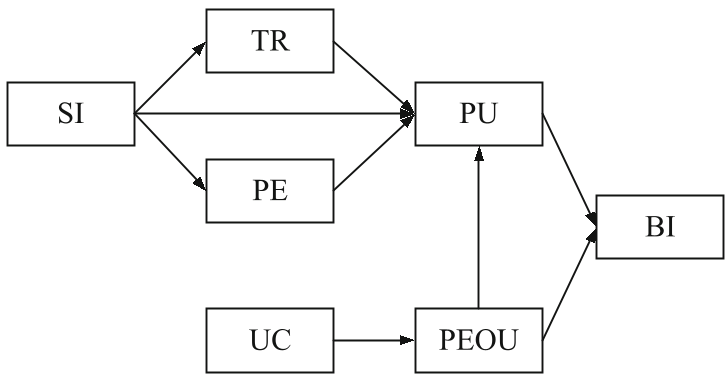
The logic is intuitive: Social Interaction doesn't just make the app "fun"; it builds Trust (if my friends use it, it’s safe) and enhances Perceived Usefulness (network effects).
Experiments & Results
The study utilized an online survey of WeChat users in China, applying Exploratory Factor Analysis (EFA) and Confirmatory Factor Analysis (CFA) to validate the model.
Key Findings:
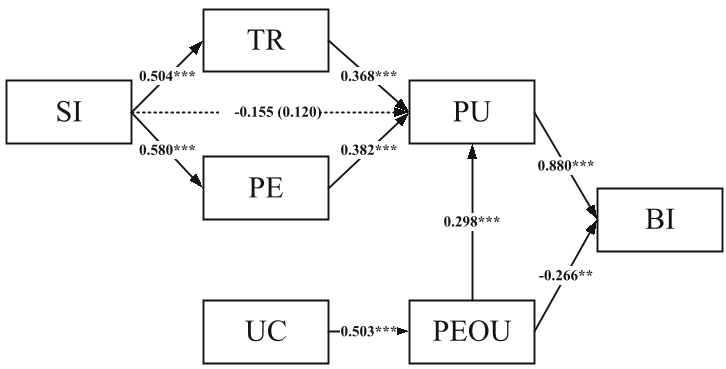
- The Utility Paradox: While Perceived Usefulness (PU) remains a strong predictor of Behavior Intention (BI), Perceived Ease of Use (PEOU) showed a weak and even negative correlation. This suggests that in finance, "too easy" might feel "unsafe."
- The "Red Envelope" Effect: Social Interaction significantly boosted Perceived Enjoyment. This proves that gamifying payments (sending digital money with wishing words) is a primary driver for adoption.
- The Trust Bridge: Social interaction among friends directly mitigates the perceived risks of mobile payments.
Quantitative Evidence
The Structural Equation Model (SEM) results confirmed the strength of these social paths:
| Metric | Result | Criteria |
|---|---|---|
| GFI (Goodness of Fit) | 0.947 | > 0.85 |
| CFI (Comparative Fit Index) | 0.994 | > 0.90 |
| RMSEA | 0.015 | ≤ 0.06 |
Deep Insight & Conclusion
The core takeaway for today's FinTech ecosystem is clear: Social context is an Inductive Bias for Trust.
WeChat's success wasn't due to superior encryption or faster processing speeds; it was because they embedded payments into the existing social fabric of the user's life. However, the study acknowledges limitations: the data is specific to Mainland China. Future research should investigate if these "Social-Aware" triggers translate to more individualistic cultures or if regional trust in central institutions changes the weight of Social Interaction.
In the era of Web3 and Decentralized Finance (DeFi), the lesson of WeChat remains relevant—technology adoption is driven less by "How it works" and more by "Who I use it with."