
Selective Foresight: Why Global Likes Fail to Predict Your Next Social Video
The potential of social-aware multimedia prefetching on mobile devices
This paper explores "Social-aware Multimedia Prefetching," a method to reduce mobile data costs and playback stalls by downloading OSN content over WiFi before consumption. Using a custom Android app (SonNet) to track 14 Facebook users, the study evaluates how social features like "likes," "comments," and "social proximity" influence video and photo consumption probabilities.
TL;DR
Mobile internet traffic is dominated by social media, yet cellular data remains expensive and volatile. This paper investigates whether we can predict what you'll watch on Facebook to pre-download it over WiFi. The surprising find? Vast popularity (likes and shares) is a terrible predictor for personal consumption. Instead, the "social distance" of the sender is the only signal that consistently matters.
The Motivation: The "Stall" Problem
For most mobile users, the "spinning wheel of death" during video playback is a result of cellular network inconsistency. Prefetching—downloading content in the background when connected to WiFi—is the logical cure. However, prefetching the wrong content wastes battery and storage. To build a "Social Predictor," we must first understand: What makes a user click "Play"?
Methodology: Entering the SonNet
The researchers built SonNet, a custom Android application that acts as a bridge between the Facebook Graph API and the user. Unlike standard studies that look at aggregate CDN logs, SonNet allowed for a "User-Centric" view.
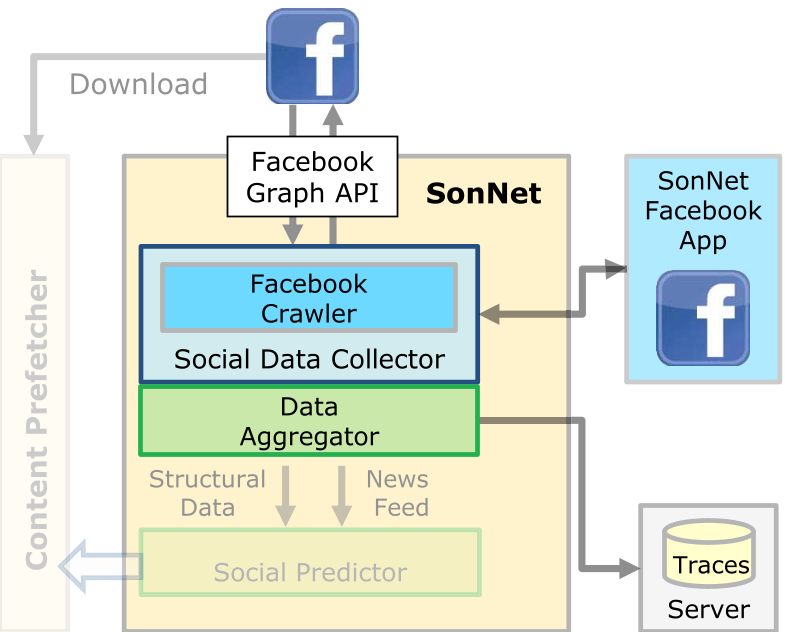
The system tracked:
- Metadata: Likes, comments, and shares of every post in the feed.
- Social Origin: Whether the post came from a "Close Friend," a group, or a page.
- User Interaction: Exactly which photos were enlarged and which videos were played.
The Popularity Paradox
One might assume that a video with 10,000 likes is more likely to be watched than one with 5. The data proves otherwise for individual feeds.
For videos, the median number of likes for watched content was only 5, compared to 53 for non-watched content. This suggests that users often ignore "viral" content pushed by the algorithm in favor of personal updates from their immediate social circle.
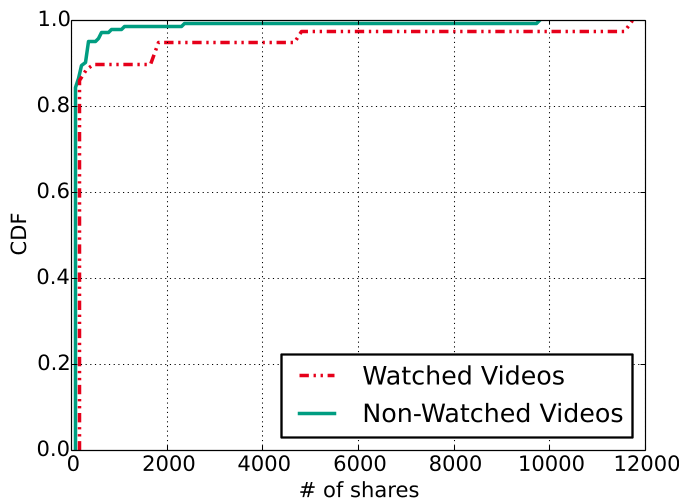 Figure 2: The CDFs show that for 80% of videos, typical popularity metrics have almost no correlation with the user's decision to watch.
The Winning Feature: Social Proximity
The study found that content shared by "Close Friends" and "Family" had a dramatically higher hit rate. Specifically:
- 85.7% of videos watched were from "Close Friends" lists.
- Social distance (measured via interest categories and friend lists) is a far more robust feature for Machine Learning models than any global engagement metric.
| Source Type | Photos Consumed | Videos Consumed |
|---|---|---|
| Close Friends | 70.1% | 85.7% |
| Family | 82.6% | 50.0% |
| Other Lists | 9.2% | 8.3% |
Data shows a clear preference for intimate social circles over general "Friends" or "Pages".
Critical Analysis & Conclusion
The takeaway for developers and researchers is clear: Don't chase the trend; follow the circle.
Limitations
- Small Sample Size: With only 14 participants, the results are a "pilot" and may subject to individual bias.
- Privacy Constraints: The use of SHA-1 hashing protects users but prevents some deeper analysis of the content of the videos (e.g., topic modeling).
Future Outlook
As Online Social Networks (OSNs) move toward more algorithmic "Discovery" feeds (like TikTok), the balance between "Social Proximity" and "Interest Graph" will shift. Future prefetching algorithms will likely need to combine the "Social Closeness" found in this paper with deep-learning-based "Interest Embeddings" to maintain high accuracy in the age of AI-curated feeds.