
Socially-Aware Privacy: Why Your Friends' Ties Matter More Than Your Data Statistics
Social-Aware Privacy-Preserving Correlated Data Collection
This paper investigates a privacy-preserving data collection framework focusing on sum query analysis. It introduces a two-stage Stackelberg game model that jointly accounts for data correlation and social interaction among individuals. The authors propose an optimal mechanism and a reporter selection algorithm that achieve SOTA data accuracy while maintaining privacy against adversaries exploiting network structures.
TL;DR
In the era of big data, your privacy is no longer just about your data—it's about who you know and how your data correlates with theirs. This paper (Mobihoc '18) mathematically proves that to collect accurate data, collectors must design privacy mechanisms that account for social relationships. By modeling the interaction as a Stackelberg game, the authors show that a "socially-aware" collector can achieve truthful data reporting by strategically adding noise to query results.
The "No Free Lunch" of Data Privacy
Most privacy frameworks, including standard -Differential Privacy, assume individuals are "islands" of information. In reality, if your brother shares his genetic data, your privacy is compromised regardless of your consent.
The authors identify a secondary, often overlooked factor: Social Altruism. Individuals in a network often care about the privacy of their peers. This means a data reporter's strategy is influenced by:
- Data Correlation: How much my data says about my friends.
- Social Strength: How much I value my friends' privacy relative to my own utility.
Methodology: The Architecture of Correlation
The paper utilizes two layers to model the ecosystem: the Data Layer (Gaussian Correlation Model) and the Social Layer (Social Strength Matrix).
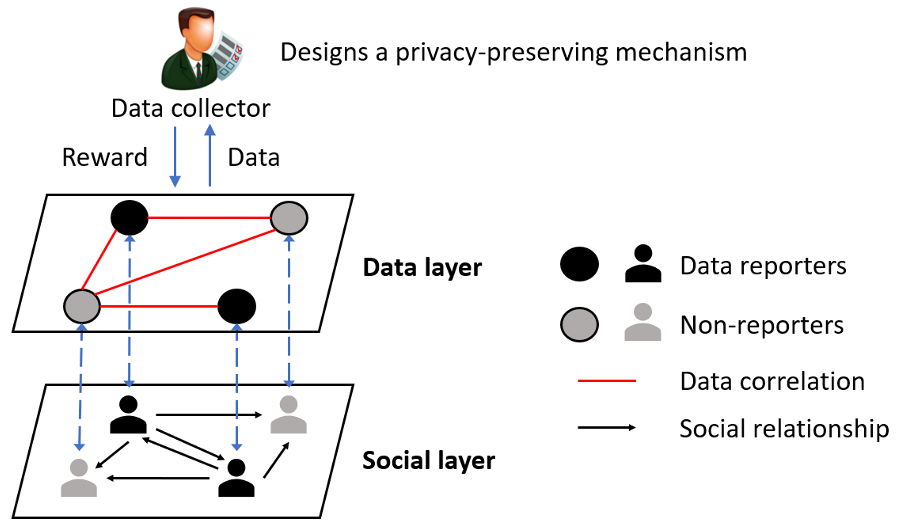
The Two-Stage Game
The interaction is modeled as a Stackelberg Game:
- Stage I (The Collector): Chooses a set of reporters and a noise variance .
- Stage II (The Reporters): Each reporter decides their own noise to minimize their privacy loss while maximizing accuracy benefits.
The breakthrough insight here is the Best Response Analysis. The authors find that reporters' decisions are coupled. If one person adds enough noise to protect the group, others don't have to. Specifically, there is a unique Nash Equilibrium where only the individual with the highest "joint concern" (modeled as ) adds noise, and the rest report the truth.
Optimal Strategy and Reporter Selection
For a collector, the goal is Truthful Reporting. Any noise added by reporters ruins data quality more than noise added by the collector. The optimal move for the collector is to set . This "pre-emptive noise" satisfies the most paranoid/altruistic reporter, ensuring everyone else hands over clean data.
To optimize this, the authors propose Algorithm 1, a greedy removal strategy. Instead of checking every possible combination of reporters (), it iteratively removes the reporter who forces the highest noise requirement until the maximum utility is reached.
Experimental Insights
Using randomized networks and real Facebook social data, the authors tested the impact of "Incomplete Information."
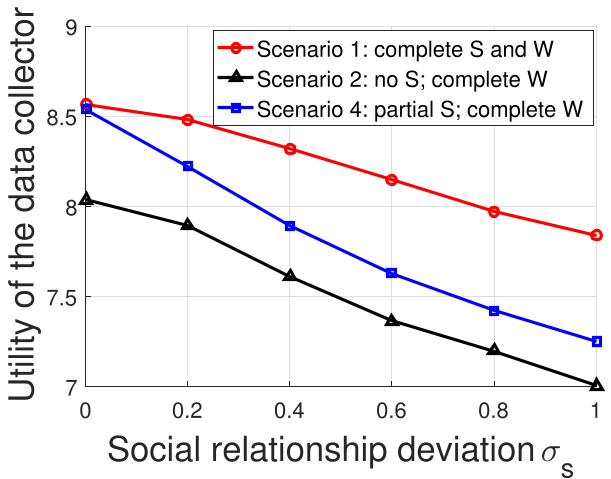
Key Findings:
- Social > Data: The collector suffers significantly more when they lack social network info than when they lack exact data correlation stats.
- Altruism Costs Performance: Higher social diversity (variance in how much people care about each other) forces the collector to add more noise, reducing overall system utility.
- The Truth Paradox: By being "socially unaware," collectors often select more reporters but get lower-quality (noisier) results.
Critical Analysis & Conclusion
Takeaway
The core value of this work is shifting the focus from statistical privacy to relational privacy. It provides a rigorous game-theoretic foundation for why data collection is as much a sociological challenge as it is a mathematical one.
Limitations
The model currently focuses on Sum Queries and assumes Gaussian distributions. In the real world, many data types (categorical, skewed distributions) and query types (Top-K, joins) might not follow these clean mathematical properties. Furthermore, the assumption that reporters have "complete information" about the network is a high bar for real-world applications.
Future Work
Expanding this to Bayesian Games (where information is incomplete for everyone) and exploring non-linear data analysis like Logistic Regression would be the natural next steps for this high-impact framework.