
Socially-Connected Privacy: Why Who You Know Matters for Your Data Privacy
Social-Aware Privacy-Preserving Mechanism for Correlated Data
This paper proposes a social-aware privacy-preserving mechanism for correlated data collection, modeled as a two-stage Stackelberg game. It introduces a theoretical framework that accounts for individuals' social ties and data dependencies to ensure truthful reporting while optimizing the data collector's utility.
TL;DR
In an era of hyper-connected data, your privacy isn't just about what you share—it's about what your friends share and how much they care about you. This paper introduces the first theoretical framework to jointly model Data Correlation and Social Relationships in a data collection game. The researchers discover that a data collector can achieve perfect data accuracy by strategically choosing who reports data and adding exactly enough "noise" to satisfy the most socially-concerned individual.
The "No Free Lunch" Problem in Data Correlation
Most privacy tools assume data points are independent. But in reality, if a relative shares their DNA, your privacy is compromised even if you share nothing. This is the Data Correlation problem. Adding to the complexity is the Social Layer: if I know my data leak might hurt my best friend, I am more likely to lie or add noise to my data.
Current state-of-the-art (SOTA) methods often view this as a purely technical problem of noise addition. This paper shifts the perspective: it's a strategic game between a collector (like Apple or a medical researcher) and reporters who are socially aware.
Methodology: The Two-Stage Game
The authors model the interaction as a Stackelberg Game:
- Stage I (The Collector): Chooses a subset of reporters and sets a global privacy-preserving noise level ().
- Stage II (The Reporters): Each reporter decides how much additional private noise () to add to their data to protect themselves and their social circle, given the correlation among their data.
1. The Data Layer (Markov Random Fields)
The paper uses a Gaussian correlation model to track how information flows between individuals. If person A and B are highly correlated, the "Privacy Loss" of B is affected by A's reporting strategy.
2. The Social Layer (The Factor)
The most groundbreaking part of the model is the introduction of —the social strength. A reporter doesn't just minimize their own privacy loss; they minimize a weighted sum of the privacy losses of everyone they care about. This leads to a unique identifier for each person: , which captures their total social-privacy concern.
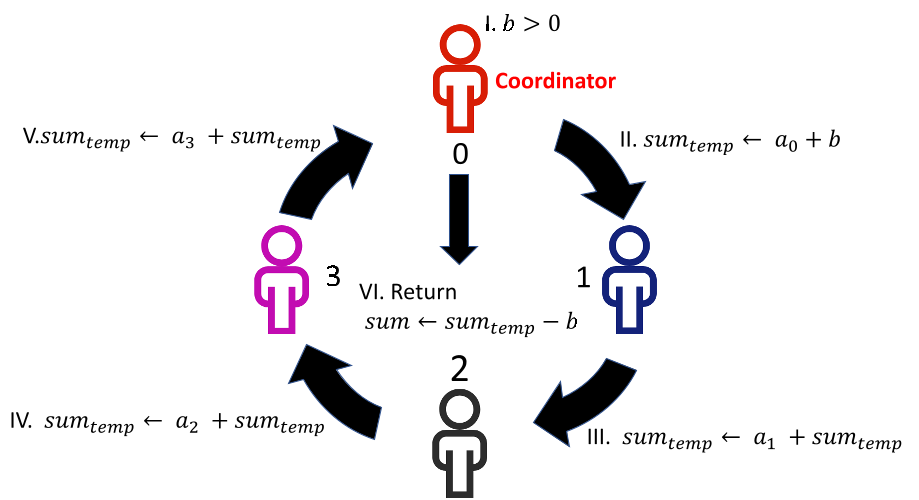 Figure 1: The distributed approach for reporters to reach Nash Equilibrium without revealing their private parameters.
Key Finding: The "Critical Reporter" Phenomenon
The mathematical analysis yields a surprising result: At a Nash Equilibrium, at most one reporter (the one with the highest value) will add noise. If the collector provides enough protection (), everyone reports truthfully. This allows the collector to target the "weakest link" in the social privacy chain to ensure high-quality data.
Experimental Insights from Facebook Data
Using real-world Facebook social graphs, the authors found:
- Data Correlation vs. Social Strength: High data correlation makes collectors selective (hiring fewer reporters). Conversely, strong social ties encourage collectors to hire more reporters.
- The Information Gap: The collector performs significantly better if they understand the social network than if they understand the data correlation. Social awareness is the "higher-order" bit in privacy utility.
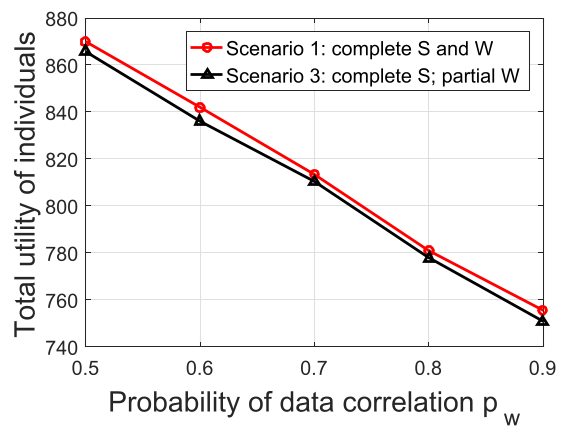 Figure 2: Impact of data correlation weights on collector and individual utility.
Critical Analysis & Conclusion
Takeaway
If you are building a data-driven service, don't just look at the stats of the data. Look at the social graph. The "altruistic" concern of your users for their friends' privacy is a primary driver of whether they will provide you with honest data.
Limitations
- Complete Information: The optimal collector strategy assumes they know the social strengths (), which is a high bar for real-world applications.
- Gaussian Assumption: While mathematically elegant, real-world data is often non-Gaussian, which might complicate the mutual information calculations.
Future Work
The authors suggest moving toward Bayesian Games where reporters have incomplete information about each other, mirroring real-world uncertainty in social circles.