
Social-Aware Rate: Rethinking D2D Content Sharing Through Social Homophily and Submodularity
Social-Aware Rate Based Content Sharing Mode Selection for D2D Content Sharing Scenarios
This paper introduces a novel "Social-Aware Rate" framework for Device-to-Device (D2D) content sharing, co-optimizing physical link quality and social cooperation incentives. It proposes a Multi-D2D (MD2D) sharing mode and formulates the selection problem as a submodular welfare optimization under matroid constraints.
TL;DR
To address the massive growth in multimedia traffic, this paper proposes a Social-Aware Rate mechanism that combines physical link performance with social similarity. By shifting from simple "one-to-one" matching to a "Mixed Matching" framework (including B2D, D2D, and Multi-D2D), the researchers achieve significant gains in system utility and user cooperation using distributed submodular optimization.
Background: The Limits of Altruism
In the world of Device-to-Device (D2D) communications, we often encounter a binary assumption: users are either "saints" (altruistic) or "mercenaries" (requiring monetary incentives). However, real human behavior is nuanced. People are more likely to share resources with those who have similar interests—a concept known as Homophily.
The core observation of this paper is that the randomness of content location and limited device storage makes the Matching Problem the primary bottleneck. If we can't align the physical capability of a link with the social willingness of the provider, the D2D ecosystem collapses.
Methodology: The Social-Aware Rate
The authors introduce a breakthrough metric: the Social-Aware Rate ().
1. The Interaction Formula
Instead of just looking at the Shannon capacity (), the system calculates: Where is the Cosine Similarity of interest profiles (e.g., Music, Sports, News). If a provider and demander share no interests, the effective rate drops to zero, reflecting the lack of incentive to cooperate.
2. Multi-D2D (MD2D) Sharing
Moving beyond 1:1 pairing, the paper introduces MD2D, where one demander can fetch content fragments from multiple providers simultaneously. This is visualized in their network model:
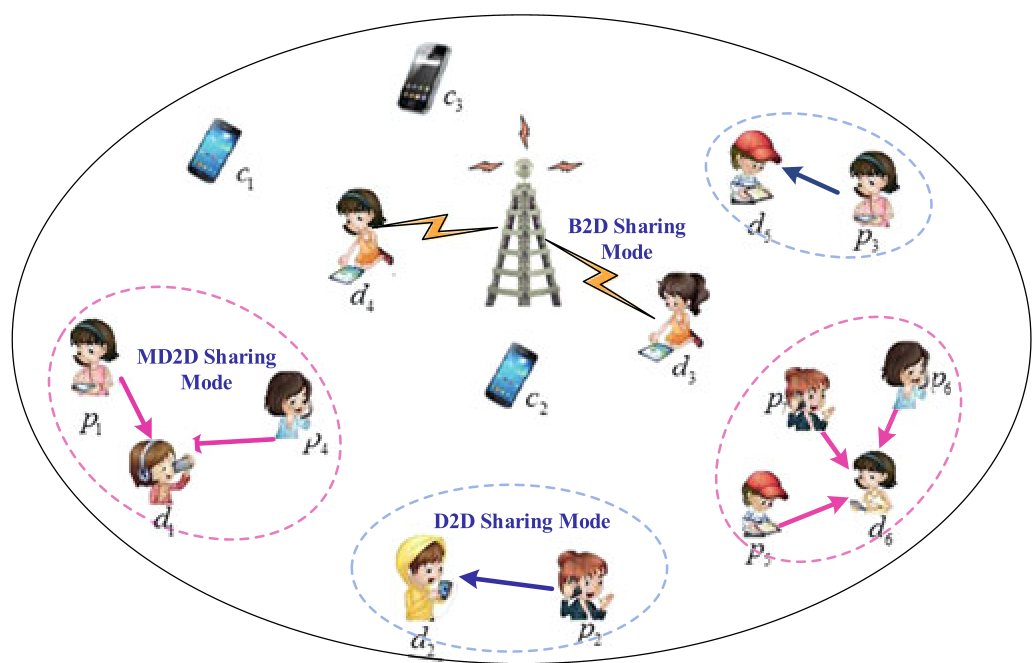 Figure 1: Coexistence of B2D, D2D, and MD2D modes in a single-cell network.
The Mathematical Engine: Submodularity
The "Mixed Matching" problem (selecting which mode for which user) is NP-hard. However, the authors prove two critical properties:
- Lemma 1: The constraints form a Partition Matroid.
- Lemma 2: The utility function is Submodular.
This is a "Goldilocks" find in optimization: it means that a simple Greedy Algorithm can achieve a guaranteed approximation ratio (at least or ) of the optimal solution while remaining computationally feasible for mobile devices.
Experimental Insights
The researchers tested three greedy variants (Algorithms 1, 2, and 3) against a Benchmarking Branch-and-Bound (B&B) approach.
Performance Gains
The inclusion of MD2D modes consistently shifts the throughput frontier outward. Specifically, when providers are plentiful, MD2D allows demanders to aggregate bandwidth across several "socially close" peers.
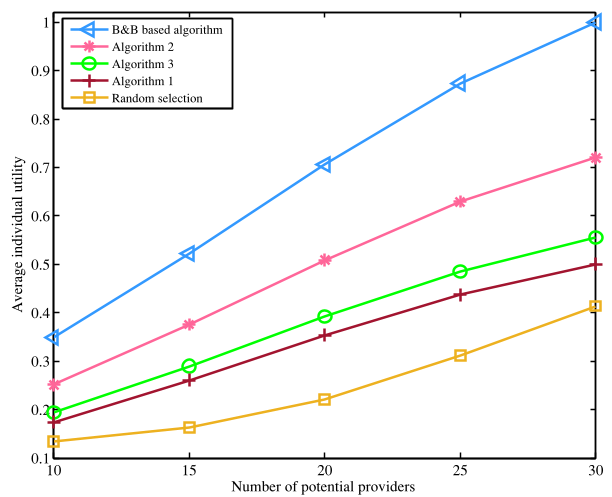 Figure 2: Performance comparison across different N_d values and provider densities.
Key Takeaway from Results: The social-aware objective outperforms pure link-rate selection by ~34%. Why? Because pure link-rate selection often picks providers who have no social incentive to participate, leading to higher failure rates in practical cooperation.
Critical Analysis & Conclusion
This work elegantly bridges sociology and information theory. The use of Matroid Theory to simplify the sharing mode selection provides a robust mathematical framework for future 5G/6G local services.
Limitations:
- The model assumes a static Interest Profile. In reality, user interests shift.
- The overhead of maintaining the interference-aware resource reuse map could be high in highly mobile scenarios.
Future Outlook: The true value of this paper lies in its "Distributed Algorithm Framework." By allowing devices to choose algorithms (standard greedy vs. randomized) based on their current battery and CPU status, it paves the way for truly autonomous, social-aware edge networks.