
TailGate: Exploiting the "Social Pulse" to Slash WAN Bandwidth Costs
Social-Aware Replication in Geo-Diverse Online Systems
This paper introduces a social-aware replication framework for geo-diverse systems to efficiently distribute long-tail content. It proposes a scheduling algorithm and a practical system called TailGate that leverages social graph data and diurnal user activity patterns to optimize wide-area network (WAN) bandwidth.
TL;DR
Replicating long-tail content (like a niche family video) across global data centers is expensive and often wasteful. This paper introduces TailGate, a system that uses social graph information and time-zone differences to "flatten" traffic peaks. Instead of pushing content immediately, it schedules transfers during off-peak hours so the content arrives just before a user's friends log in, reducing bandwidth costs by up to 80% without sacrificing Quality of Experience (QoE).
The Economic Dead-End of the Long Tail
In the world of Content Delivery Networks (CDNs), the "Long Tail"—unpopular or user-generated content (UGC) with few views—is a nightmare.
- If you push it everywhere immediately: You create massive spikes on expensive WAN links for content that might never be watched.
- If you pull it only when requested: The first user experiences high latency (buffering), and if multiple users in one region request it during peak hours, you still hit bandwidth cost peaks.
Modern systems face a paradox: users are global (geo-diverse), but their social circles are often clustered. The authors argue that current replication strategies are "socially blind," leading to either wasted bandwidth or poor user experience.
The Core Insight: Time-Zones and Social Tethers
The researchers' breakthrough is simple but powerful: Leverage the "Freshness vs. Cost" tradeoff.
If Bob in Boston uploads a video at 6 PM (his peak), his friend Alice in London (where it's 11 PM) probably won't see it until her next morning. By waiting until it's 2 AM in Boston to replicate the data, the system uses "cheap" off-peak bandwidth. Because of the 5-hour time difference, the data arrives at the London Point of Presence (PoP) by 7 AM—well before Alice wakes up and checks her feed.
The Social-Aware Priority Metric
The paper defines a priority function () that ranks which updates to send first based on:
- Friendship Density: How many friends of the uploader are at the destination PoP?
- Read Probability: What is the likelihood those friends will check their feed in the next time slot?
- Object Size: Larger files are deprioritized unless the "social demand" is high to preserve bandwidth.
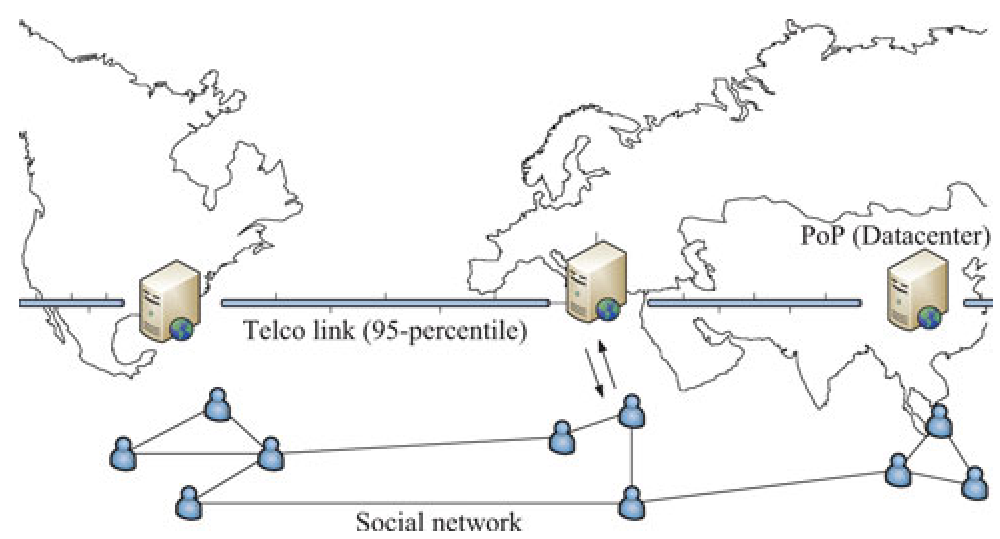 The geo-diverse architecture where PoPs serve local user groups while managing inter-PoP replication.
Methodology: From Algorithm to Practical System
The authors propose two solutions:
- Social-Aware Scheduler: An offline optimization tool that uses greedy algorithms to allocate bandwidth budgets between PoPs to minimize "staleness."
- TailGate: A real-world, online heuristic. It doesn't need hard budget constraints; instead, it looks for the "least loaded" time bin between the upload time and the predicted read time.
Experimental Validation
Using a massive dataset of 8 million Twitter users and 100 million content links, the authors simulated traffic across global PoPs (Boston, London, Tokyo, etc.).
Key Performance Wins:
- Cost Reduction: Under 95th-percentile pricing (where you pay based on peak usage), TailGate reduced costs by 80% compared to a naive FIFO push.
- The Long-Tail Benefit: The system was even more effective for unpopular content, as it avoided the "herd effect" of 95,000+ unnecessary pulls that standard CDNs suffer from.
- Latency: Even with imperfect social information, TailGate reduced latency by 10x compared to Pull-based solutions because the content was already "waiting" for the user at the local edge.
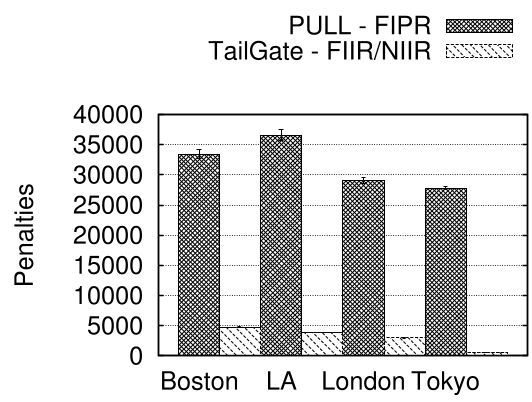 Comparison of 95th percentile bandwidth usage: TailGate consistently stays below traditional Push and Pull methods.
Critical Analysis & Outlook
While TailGate is a major step forward, it has a few constraints:
- Information Dependency: It works best when the system has access to the social graph. For third-party CDNs, this might require APIs that OSNs (like Facebook) are often hesitant to share.
- Storage: The paper assumes storage is essentially "free" compared to WAN bandwidth. While largely true, at the scale of Petabytes, the storage cost of "pushing" long-tail content to multiple PoPs still needs careful management.
Conclusion: This work proves that "intelligence" in the network pays off. By simply understanding who knows whom and when they sleep, we can make the global internet significantly cheaper and faster for the "Long Tail" of humanity.