
Bridging Social Trust and Physical Links: The OSRA Approach to D2D Resource Allocation
11281_Social-Aware Resource Allocation for Device-to-Device Communications Underlaying Cellular Networks.
This paper introduces a novel social-aware resource allocation scheme for Device-to-Device (D2D) communications underlaying cellular networks. It proposes the Optimal Social-community-aware Resource Allocation (OSRA) algorithm which leverages social properties like community structure and node centrality to optimize spectrum sharing and system throughput.
TL;DR
Device-to-Device (D2D) communication is a cornerstone of next-gen cellular networks, yet managing how these devices borrow resources from cellular users remains a bottleneck. This paper introduces a Social-Aware Resource Allocation framework that uses human social patterns—like community groups and node centrality—to intelligently assign spectrum, resulting in up to 50% faster data transmissions with significantly lower computational overhead.
Motivation: Why Social Context Matters
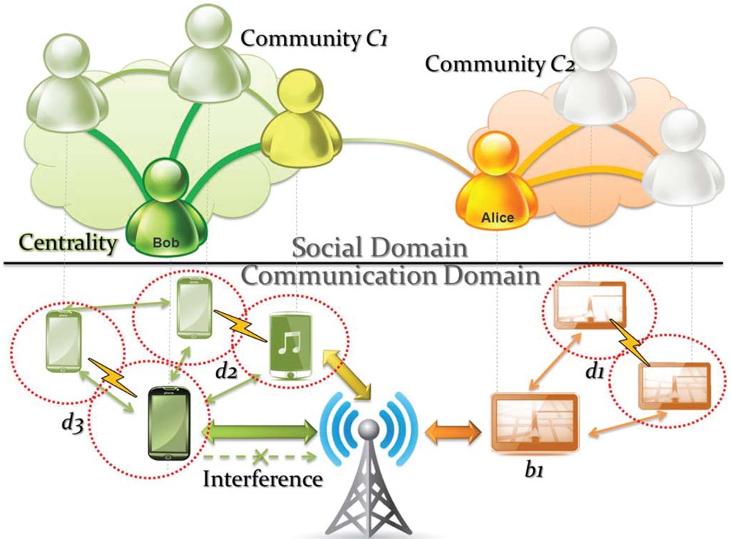
Most traditional D2D resource allocation models treat users as anonymous, moving particles. However, in the real world, devices are carried by humans. Human interactions are not random; they are governed by Social Communities (groups with mutual trust like colleagues or friends) and Centrality (varying levels of popularity/activity).
The authors argue that ignoring these social tiers leads to two main issues:
- Security & Trust: Users are hesitant to share resources or data with unknown entities.
- Inefficient Matching: Communication demands often follow social ties. By aligning spectrum allocation with these ties, we can achieve more stable and predictable network performance.
Methodology: The Physical-Social Graph
The core innovation lies in the projection of the network into two domains: the Communication Domain (physical proximity) and the Social Domain (trust and demand closeness).
1. The Physical-Social Graph
The researchers combine these domains into a single metric: . This ensures that a D2D link is only prioritized if the users are both physically close enough to communicate and socially connected enough to have a high demand for data exchange.
2. The OSRA Algorithm
To solve the resource allocation problem—which is inherently NP-hard—the authors propose the Optimal Social-community-aware Resource Allocation (OSRA) algorithm.
Rather than using brute-force exhaustion (), OSRA uses a "qualification and removal" logic (via Definition 3: Removable). It iteratively identifies and removes the least efficient potential cooperations while ensuring that all D2D pairs remain satisfied. This reduces the complexity to a linear scale , making it feasible for real-time deployment in base stations.
Experiments & Results
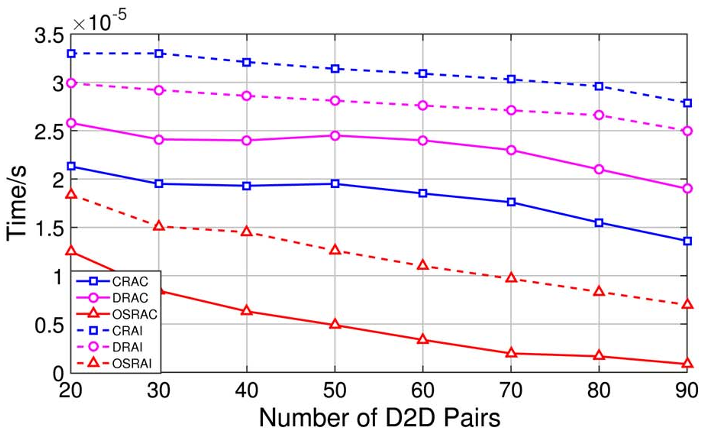
The study compared OSRA against two state-of-the-art baselines: Centralized Resource Allocation (CRA) and Distributed Resource Allocation (DRA).
Key Findings:
- Efficiency Gains: In isolated communities, OSRA consistently completed data transfers 20-50% faster than CRA/DRA as the number of available cellular users increased.
- The Power of Incentives: When communities were "connected" (allowing users to share resources with trusted outsiders), the transmission time plummeted by up to 82%.
Critical Insight & Conclusion
This paper effectively demonstrates that the Inductive Bias provided by social network properties can act as a powerful heuristic for solving complex combinatorial problems in wireless networking.
Takeaway: Future 6G systems shouldn't just look at signal-to-interference ratios (SINR); they must look at the "Social-SINR." By understanding who is communicating, the network can better decide how they should communicate. While the study assumes stable social structures, future work could look at how dynamic social changes (like temporary large-scale events) might impact these allocation strategies.