
Social-Aware D2D: Bridging Human Behavior and Spectral Efficiency
9577_Social-Aware Resource Allocation and Optimization for D2D Communication.
This paper provides a comprehensive survey and taxonomy of social-aware resource allocation for Device-to-Device (D2D) communication. It introduces a structured classification covering channel attributes, social characteristics (centrality, trust), and optimization objectives, highlighting how social ties significantly outperform social-blind methods in network utility.
TL;DR
Device-to-Device (D2D) communication is no longer just a physical layer challenge. This paper argues that the next leap in network efficiency comes from Social-Awareness—leveraging human relationships, social communities, and interaction patterns to optimize how spectrum and power are allocated. By moving beyond "social-blind" algorithms, researchers demonstrate performance gains of over 90% in network utility.
The "Social" Motivation
Why does a cellular network care if you are friends with the person next to you? Most D2D research assumes users are random nodes. However, in reality, data exchange is driven by social bonds. Traditional resource allocation often fails because it doesn't account for the fact that users in the same social community are more likely to share content, require high-definition multicast, or act as reliable relays for one another.
The core insight of the authors is that Social Centrality (how "important" a person is in a social group) and Social Trust can be used as constraints to solve technical problems like interference management and peer discovery.
Methodology: The Social-Physical Taxonomy
The paper breaks down the convergence of social networks and D2D into a rigorous taxonomy. It categorizes existing research based on how it bridges the Social Domain (behavior, relations) with the Physical Domain (channels, power).
1. Social Characteristics
- Trust & Reciprocity: Essential for relay-based D2D. Why would a stranger use their battery to relay your data?
- Centrality: Nodes with high social centrality are treated as "hubs" for resource distribution.
- Communities: Grouping users based on shared interests to optimize multicast video streaming (e.g., the SoCast system).
2. Solving Approaches
The authors map different mathematical tools to social-aware problems:
- Game Theory: Used to model cooperation (coalitional games) and competition (Nash Equilibrium) between users.
- Graph Theory: Used to model the social graph and find optimal paths for data dissemination.
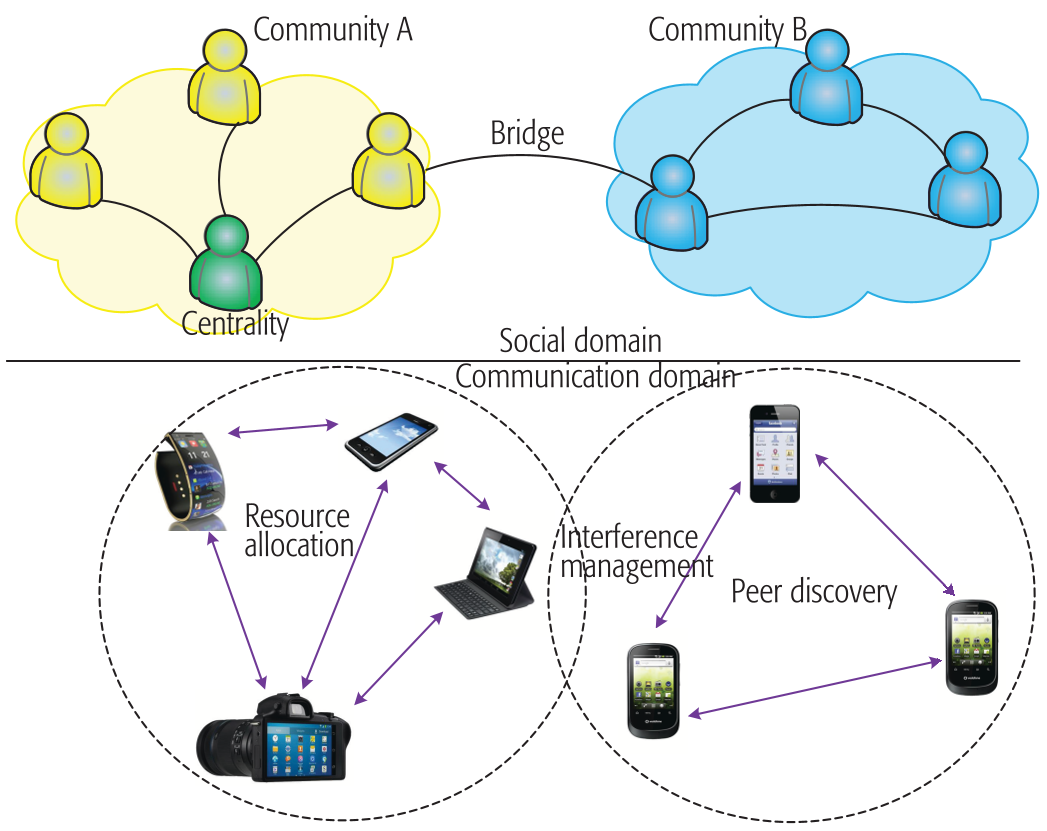 Figure 1: Illustration of Social links vs. Physical D2D links.
Experimental Insights: Massive Gains
The paper compares several "Social-blind" vs. "Social-aware" algorithms. One of the most striking results cited is a community-aware resource allocation framework that achieved a 93.54% performance gain over standard schemes.
Another highlighted method, OSRA (Optimal Social-community-aware Resource Allocation), demonstrates that leveraging community structures significantly reduces transmission time by ensuring that relay nodes are socially connected to the destination, which inherently improves link stability and data delivery rates.
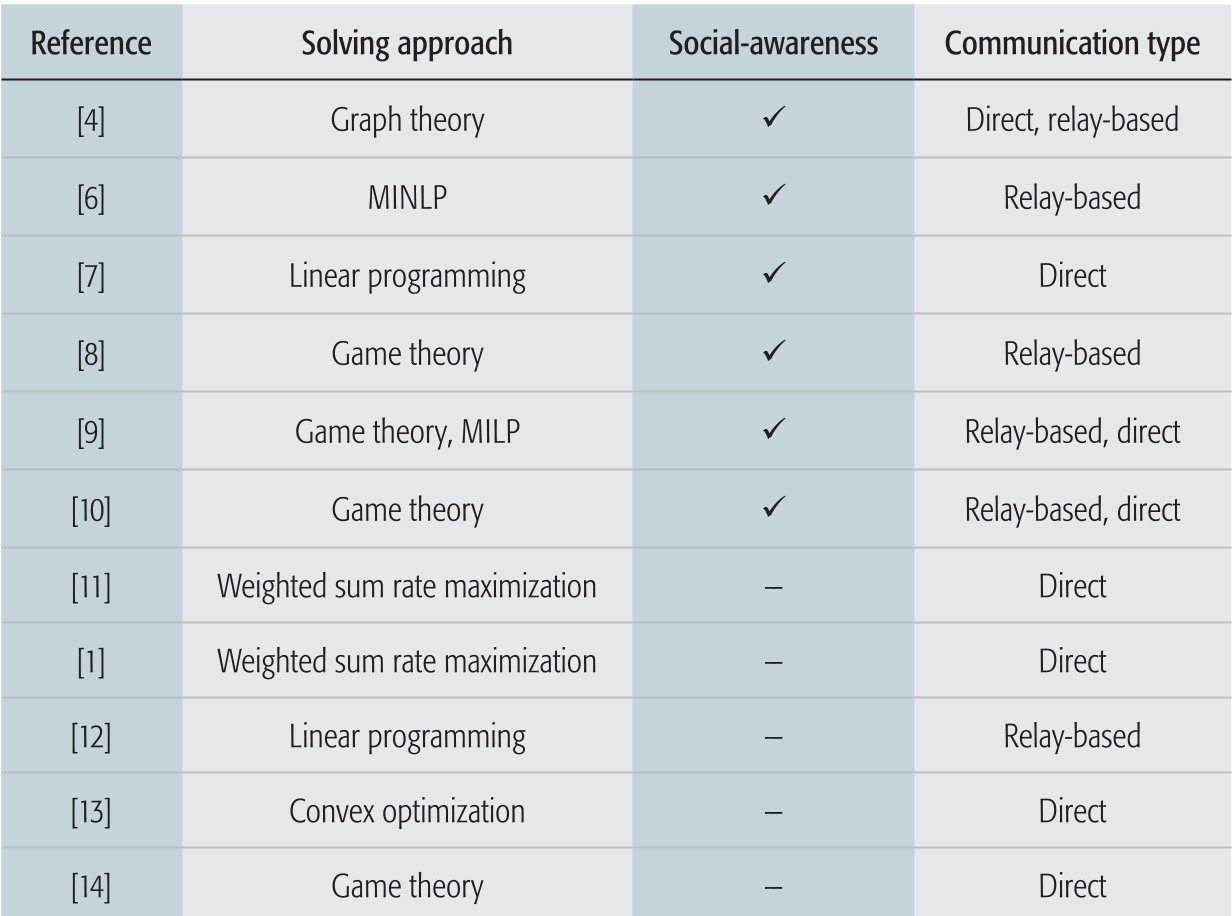 Table 1: Comparison of Solving Approaches (Game Theory, MINLP, etc.) and their use of Social-awareness.
Critical Analysis & Future Directions
While the benefits are clear, the authors honestly identify several "Open Research Challenges":
- Privacy vs. Awareness: You cannot have social-aware D2D without sharing social data. This creates a massive privacy paradox—how do we optimize the network without exposing the user's private social graph to the Base Station or peers?
- Complexity: Many of these game-theoretic and MINLP solutions are "computationally expensive." Implementing them in real-time on mobile devices with limited battery remains a hurdle.
- Estimation Accuracy: Social patterns change. A person's "centrality" in a morning commute is different from their centrality at a concert. Real-time Social Sensing is required.
Conclusion (Takeaway)
This work marks a shift from purely signal-centric networking to user-centric networking. For 6G and beyond, the most efficient way to manage 1,000 devices in a small area might not be just better filters or more antennas, but simply knowing who is friends with whom.
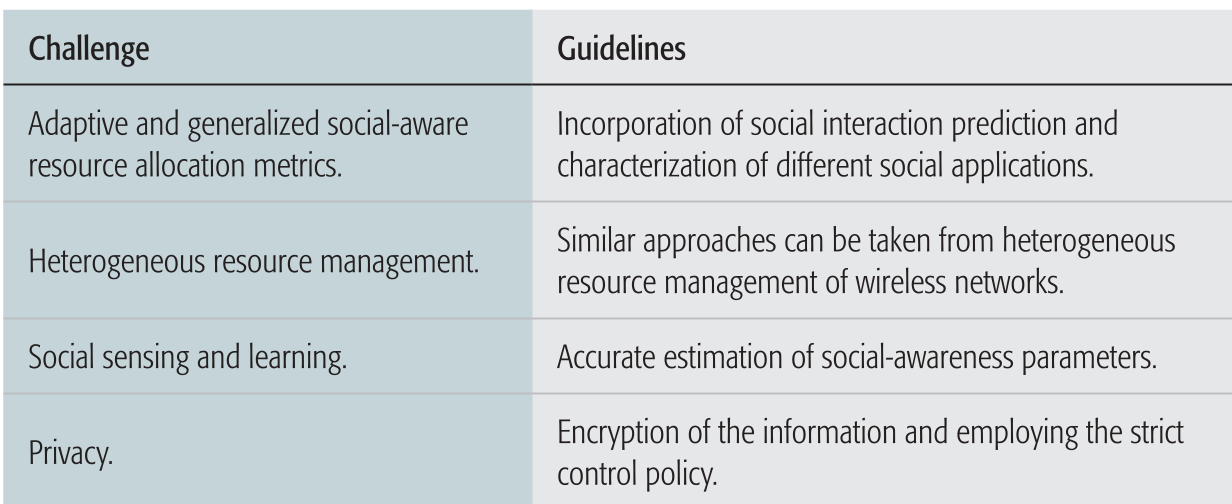 Table 2: Strategic guidelines for solving privacy and sensing challenges in D2D.