
MIEN: Revolutionizing Social-Aware Routing in Dynamic Networks via Adaptive Modularity
Towards social-aware routing in dynamic communication networks
The paper introduces MIEN (Modules Identification in Evolving Networks), an adaptive algorithm for social-aware routing in dynamic MANETs. It leverages a novel compact network representation to update community structures incrementally, achieving significant speedups over recomputing modules from scratch while maintaining routing efficiency (DLABEL).
TL;DR
Researchers from the University of Florida have developed MIEN (Modules Identification in Evolving Networks), a framework that allows Mobile Ad Hoc Networks (MANETs) to adaptively update their "social communities" in real-time. By using a compact graph representation, the algorithm achieves a dramatic reduction in computational cost, allowing mobile devices to maintain high-efficiency routing even as the network topology shifts.
The Dynamic Dilemma: Why Static Communities Fail
Mobile Ad Hoc Networks (MANETs) are chaotic. Nodes (carried by humans) move constantly, links break, and new ones form. However, human social behavior is remarkably stable; we tend to interact within specific groups or modules.
Social-aware routing exploits this by forwarding messages to nodes within the same community as the destination. The pain point is that while social structures change slower than physical locations, they still change. Existing SOTA methods like the CNM algorithm are too heavy to run from scratch every time a few links change, and doing so often results in "flickering" community assignments that disrupt routing stability.
Methodology: The Power of Compact Representation
The core innovation is the Compact Representation of the network. Instead of processing every individual node, the algorithm collapses existing communities into "super-nodes."
1. Structure Preservation
The authors prove a critical Theorem: The modularity () of the compact network is identical to the original. This means that a partition that is optimal in the reduced graph is also optimal in the full graph.
2. Adaptive Updates (MIEN)
When topology changes occur (nodes added/removed, links shifted), the algorithm doesn't throw away the previous map:
- Identification of "Suspect" Nodes: Nodes directly affected by the changes are extracted from their modules and treated as individuals.
- Localized Processing: The community detection algorithm (e.g., CNM) only runs on the compact graph plus these suspect nodes.
- Re-expansion: The results are mapped back to the original network.
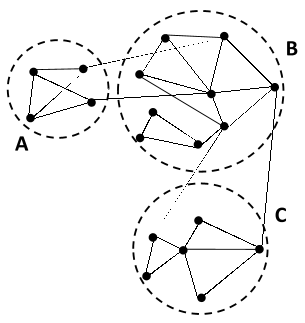 Fig 1: Illustrating how a complex network is condensed into super-nodes while maintaining the weight and self-loop logic required for modularity calculations.
Experiments & Performance Leap
The team tested MIEN against the standard CNM algorithm and various routing strategies (WAIT, MCP, LABEL).
Routing Efficacy
The dynamic strategy, DLABEL, bridged the gap between basic social routing and flooding:
- Delivery Ratio: Significantly higher than static LABEL routing as it accounts for users moving between classes/groups.
- Redundancy: Stayed significantly lower than the MCP (flooding) approach, proving its "social intelligence" saves bandwidth.
Computational Speed
On the ArXiv citation network (approx. 30,000 nodes), MIEN demonstrated a massive speedup. As the network grew, the time required for CNM increased linearly-logarithmically, whereas MIEN remained consistently faster due to the reduced size of the compact representation.
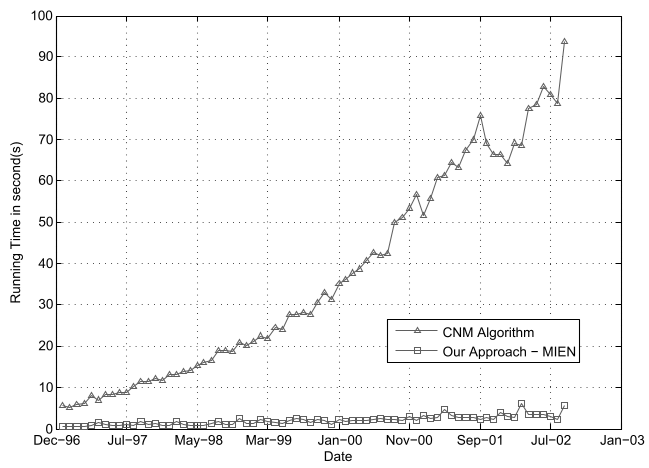 Fig 2: The running time gap between recomputing from scratch (CNM) vs. adaptive updating (MIEN) over a 6-year period of network evolution.
Critical Insight: Stability vs. Accuracy
One of the most profound takeaways is the Stability of MIEN. Recomputing modules from scratch often leads to radically different community assignments due to the heuristic nature of modularity maximization. MIEN, by using the previous state as a guide, produces a "smoother" evolution of communities. This is vital for routing, as it prevents mass updates to routing tables that would otherwise saturate the network with control traffic.
Conclusion and Future Work
The MIEN algorithm effectively turns the "bottleneck" of community detection into a manageable task for resource-constrained mobile devices. While the current implementation is centralized, the authors point toward a distributed version as the logical next step—a move that would allow every phone in a crowd to independently and collaboratively map the social environment.
Key Takeaway: In dynamic graphs, the community is not just a state, but a process. Maintaining it adaptively is the only way to achieve real-time Social-aware Routing.