
SASE: Leveraging Social-Awareness and Sequential Dynamics to Beat the Cold-Start Challenge
Social-Aware and Sequential Embedding for Cold-Start Recommendation
The paper introduces SASE (Socially-Aware and Sequential Embedding), a recommendation framework designed to tackle cold-start and data sparsity issues. By combining 1D-CNNs for sequential patterns and Node2vec for graph-based social features, it achieves state-of-the-art performance on Epinions, Ciao, and Flixster datasets.
TL;DR
The "Cold-Start" problem remains the Achilles' heel of recommendation systems. When a user has only a handful of clicks, traditional Collaborative Filtering (CF) falls apart. SASE (Socially-Aware and Sequential Embedding) provides a fix by looking at two things: what you recently did (Sequential Pattern) and who you hang out with (Social Network). By combining CNNs for sequence modeling and Node2vec for social graph embedding, SASE improves recommendation accuracy (AUC) by up to 15.9% in sparse data environments.
Problem & Motivation: The Sparsity Trap
Most modern recommenders rely on dense interaction matrices. However, real-world data is "long-tailed"—most users have very few interactions.
- The Sequential Gap: Early models like FPMC use Markov Chains, which often fail to capture complex, high-order dependencies in short sequences.
- The Social Gap: While we know friends share similar tastes ("homophily"), many models treat social data as a separate regularization term rather than a core feature of the embedding space.
The authors' insight is simple: if we don't know much about you, we should look at the patterns of your last few actions and the preferences of your social circle simultaneously.
Methodology: The Core Architecture
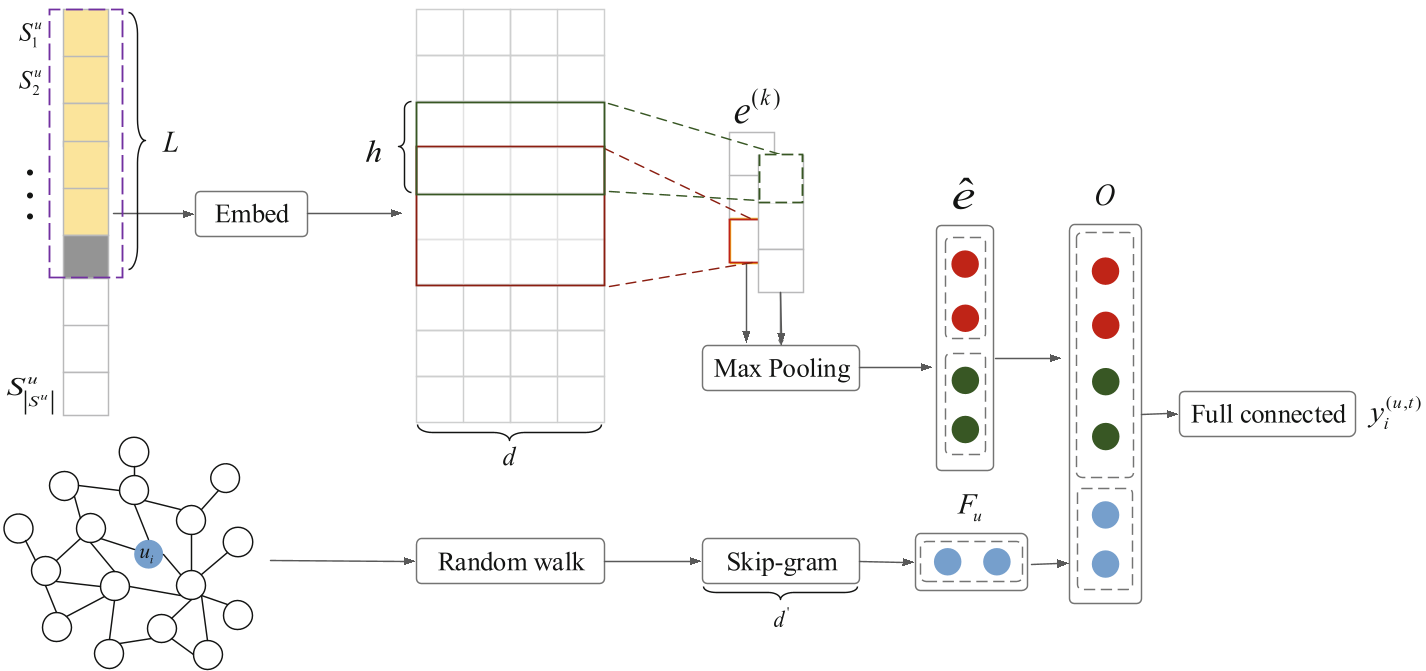
SASE bridges the gap between temporal dynamics and social manifolds through a two-pronged approach.
1. Capturing the "How": Sequential CNN
Instead of simple transitions, SASE treats the user's last items as an "image" of their current intent.
- Convolutional Filters: It uses filters of varying heights () to slide over the item sequence, capturing local patterns regardless of their exact position in the timeline.
- Max-over-time Pooling: This extracts the most salient feature from the sequence, effectively denoising the user's recent history.
2. Capturing the "Who": Node2vec Social Embedding
To solve the cold-start issue, SASE looks at the social graph ().
- Using Node2vec, the model learns a latent representation () for every user.
- This embedding captures the macro and micro signals of the social network, ensuring that even if a user has zero purchases, their position in the social graph provides a starting point for their preferences.
Experiments and Results
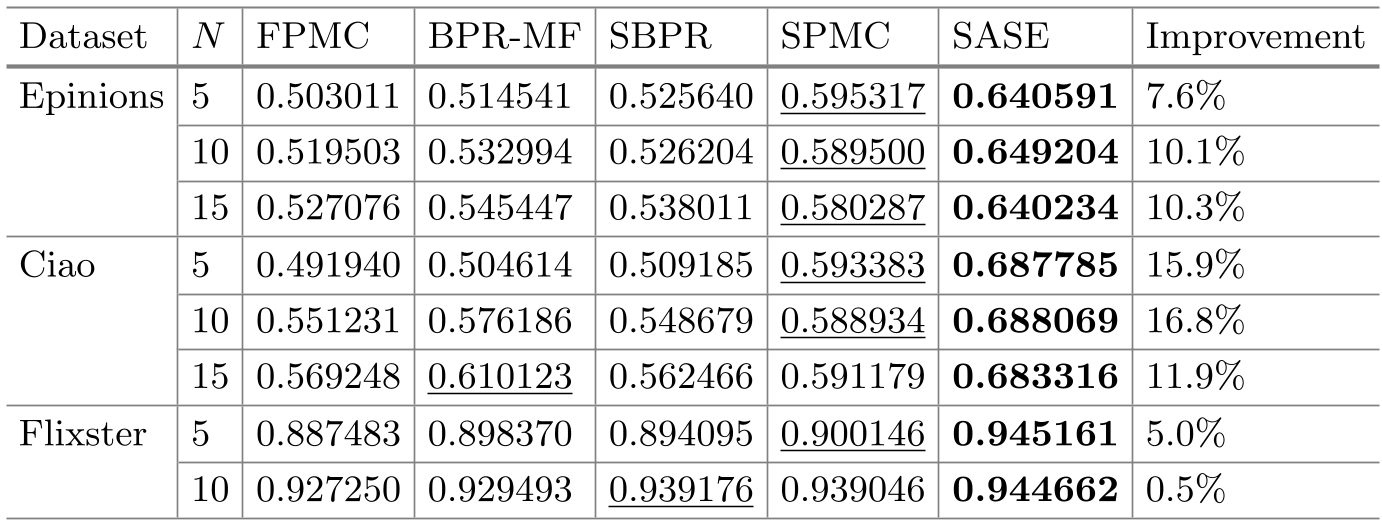
The model was tested against heavyweights like BPR-MF and SPMC on three major datasets: Epinions, Ciao, and Flixster.
Performance in Cold-Start (N=5)
The most impressive results came when users were limited to only 5 historical actions:
- Ciao: SASE reached an AUC of 0.687, a massive 15.9% improvement over the previous SOTA.
- Epinions: SASE improved by 7.6%.
- Flixster: Even on larger datasets, it maintained a 5% lead.
Hyperparameter Insight: The "Sliding Window"
The authors found that the optimal sliding window size () for the CNN is around 4. In highly sparse datasets, looking too far back into the past introduces noise rather than signal, confirming that "recent intent" is the strongest predictor for the next action.
Critical Analysis & Conclusion
Takeaway
SASE demonstrates that social graphs are not just "extra info"—they are foundational for handling data sparsity. By moves away from simple Matrix Factorization toward a hybrid of CNNs and Graph Embeddings, the model creates a richer representation of the user.
Limitations & Future Work
While SASE is powerful, it treats social links as static. In reality, social influence is dynamic (some friends matter more than others over time). The authors suggest that future iterations could include:
- Contextual Data: Incorporating location and action types (e.g., "like" vs. "purchase").
- Rating Information: Moving beyond implicit feedback to capture the intensity of user preference.
SASE stands as a robust evidence that the future of recommendation lies in the intersection of sequence and society.