
PSAR: Scaling Social Video Delivery through the Lens of Social Propagation
Propagation-based social-aware replication for social video contents
The paper proposes PSAR (Propagation-based Social-Aware Replication), a hybrid edge-cloud and peer-assisted framework designed for social video distribution. By leveraging social, geographical, and temporal localities, PSAR achieves SOTA performance in local download efficiency, improving the local download ratio by 30% and peer cache hit ratio by 40%.
TL;DR
The explosion of user-generated content (UGC) on platforms like X (Twitter) and TikTok has broken traditional video delivery models. This paper presents PSAR, a system that ditches standard popularity-based caching for a social-aware approach. By predicting how videos "travel" through social graphs, PSAR boosts local download speeds by up to 40% using a hybrid architecture of edge-cloud servers and peer-assisted (P2P) caching.
Background: Why Your CDN is Failing Social Videos
In traditional VOD (Video on Demand), a few "blockbuster" movies represent the majority of traffic. CDNs simply cache these hits at the edge. But in a social network:
- The Long Tail is Massive: Most videos are only watched by a tiny group of friends.
- Highly Volatile: A video goes viral and dies within hours.
- Edge-to-Edge: Traffic isn't flowing from a central studio to users; it's flowing from one user's living room to another's.
Standard algorithms like LRU (Least Recently Used) fail here because they only react to past events. By the time a video is "popular" enough to cache, its social propagation cycle might already be over.
The Insight: The Three Localities of Social Propagation
The authors analyzed massive traces from Tencent Weibo (20 days, 350k+ videos) and discovered three "laws" of social video:
- Social Locality: If you watch a video, your direct friends are the most likely next viewers. Most propagation happens within 10 social hops.
- Geographical Locality: Our digital friends are often our physical neighbors. Propagation is geographically clustered.
- Temporal Locality: Social sharing is a "burst" phenomenon; most re-shares happen within the first few hours of the original post.
Methodology: The PSAR Framework
PSAR uses a two-tier strategy guided by three mathematical indices:
1. Edge-Cloud Tier (The Safety Net)
Instead of caching all videos everywhere, PSAR uses:
- Geographic Influence Index (): Predicts how many different regions a video will eventually reach based on its current propagation tree size.
- Content Propagation Index (): Measures the "velocity" of the video. High-velocity videos get more bandwidth reserved at the edge-cloud.
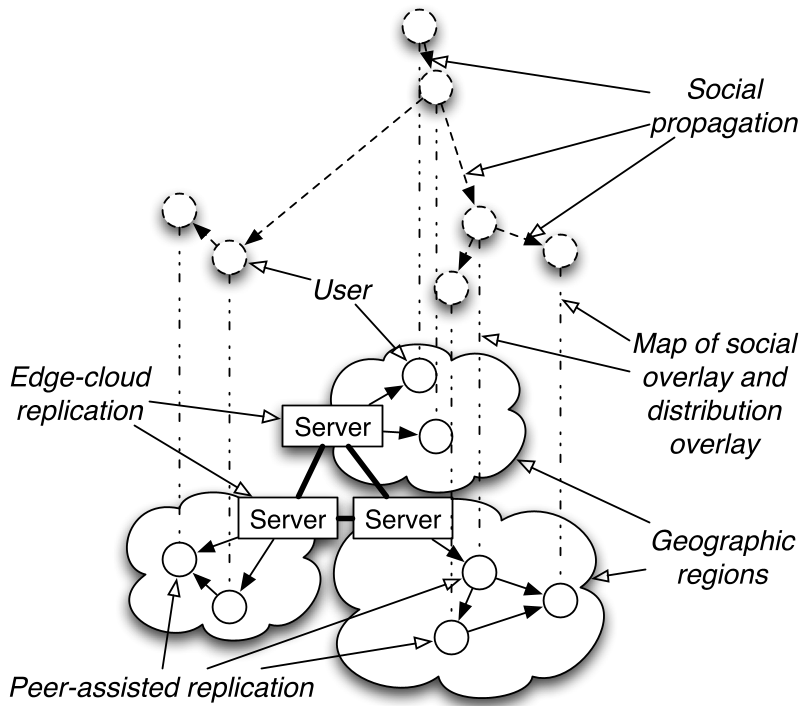
2. Peer-Assisted Tier (The Social Accelerator)
Peers don't just cache what they watched. They cache what their friends are likely to watch next.
- Social Influence Index (): A peer evaluates a video based on how many of their local friends haven't seen it yet but are likely to, given the social graph.
Experimental Results
The trace-driven simulation compared PSAR against Popularity-based, LFU, and LRU strategies.
- Local Download Success: PSAR achieved a significantly higher "Local Download Ratio." This means users found the video on a server in their own city 30% more often than with traditional methods.
- P2P Efficiency: The "Local Cache Hit Ratio" improved by 40%. Peers were effectively serving as mini-CDNs for their social circles.
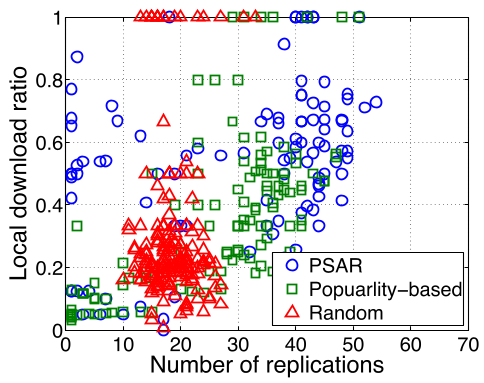 Figure: PSAR (solid line) outperforms LFU/LRU (dotted lines) as server capacity increases.
Critical Insight: From Reactive to Proactive
The genius of PSAR is moving from reactive caching (storing what was popular) to proactive replication (storing what will be shared). In the era of social media, the social graph is the ultimate "look-ahead" buffer for network architects.
Limitations & Future Work
While PSAR excels at organic propagation, it may struggle with "algorithmic discovery" (like the TikTok FYP), where social connections matter less than content-based filtering. Adapting to include interest-based similarity rather than just friend-lists would be a logical next step.
Conclusion
PSAR demonstrates that for social video, location and connection are as important as content. By aligning the delivery overlay with the social propagation overlay, we can build a much more efficient, lower-latency Internet.