
Beyond Average Satisfaction: Modeling Tolerance and Altruism in Social Group Video Recommendation
18820_Social-Aware Video Recommendation for Online Social Groups.
The paper introduces a social-aware group recommendation framework that utilizes "external experts" (followees) to infer preferences and models individual personality traits like tolerance and altruism. It achieves state-of-the-art accuracy in video recommendation, particularly for inactive users in dynamic social groups.
TL;DR
Recommending a video to a group isn't just about finding the "average" interest—it's a social negotiation. This paper introduces a framework that uses external experts to solve data sparsity and a tolerance-altruism model to simulate how group members compromise. By mapping social behaviors to psychological conflict modes, the system achieves significantly higher satisfaction than traditional collaborative filtering.
The "Inactive User" and "Equal Priority" Fallacies
Most group recommender systems (GRS) collapse under two conditions:
- Data Sparsity: If a group member is "lurk-only," the system has no history to build a preference profile.
- Psychological Blindness: Traditional logic like "Least Misery" (don't show what anyone hates) or "Average Satisfaction" assumes everyone has the same social weight and willingness to compromise.
In reality, if you are watching a video with a close friend, you are more likely to watch something they like (Altruism). If you are a naturally agreeable person, you might accept a genre you don't love just to keep the peace (Tolerance).
Methodology: The Social-Aware Engine
The authors break from the tradition of looking purely at internal history. Instead, they look outward and inward.
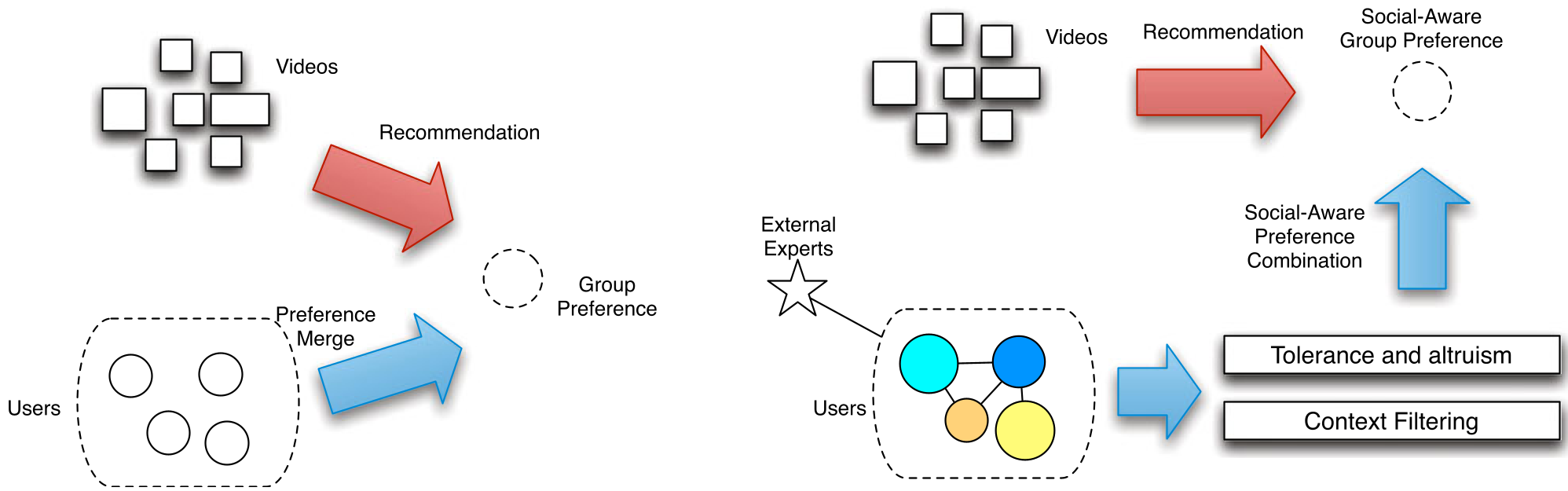
1. The Expert-Based Preference Model
To capture the interests of inactive users, the model analyzes their followees (external experts). The intuition is that whom you follow reflects your aspirations and interests more accurately than a sparse "viewing history."
2. Modeling Personality through Behavior
The core innovation is the mapping of social network features to the Thomas-Kilmann Conflict Mode Instrument (TKI).
- Tolerance (): Derived from features like social activeness and registration length.
- Altruism (): Calculated via the Jaccard similarity of common social ties. If users and share many friends, their willingness to accept each other's preferences increases.
The final group preference is a weighted combination of these factors, ensuring that assertive members' preferences are balanced by the "social glue" of altruistic members.
Experimental Results: Proving the Human Element
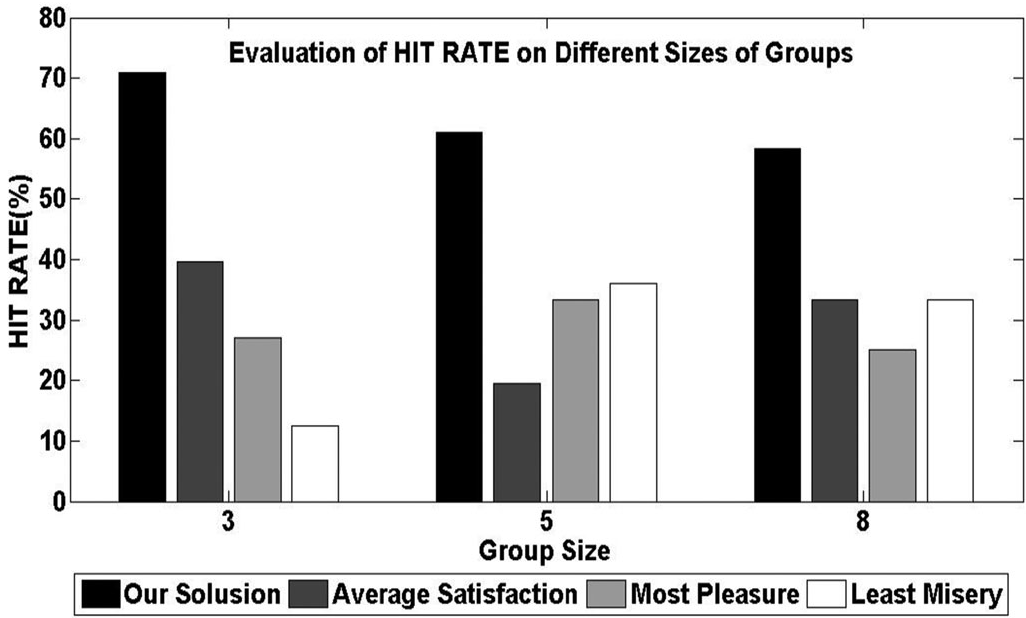
The authors tested their algorithm (TC-SF) against classic strategies like Most Pleasure and Average Satisfaction.
Performance vs. Group Size
As groups grow larger, finding a consensus becomes mathematically harder. However, the TC-SF model maintained a higher Hit Rate (HR) than baselines across all group sizes (3, 5, and 8 members), proving its robustness in complex social dynamics.
Solving the Inactive User Problem
Interestingly, the system showed the most significant gains in groups with low "social activeness." While standard CF-based models failed due to lack of data, the External Expert model successfully filled the gaps by looking at the users' social graphs.
Critical Insight & Conclusion
This work shifts the focus of GRS from Content to Context. By treating a group not as a "pseudo-user" but as a dynamic network of psychological profiles, it bridges the gap between data science and social psychology.
Future Outlook: While the use of public social data is powerful, privacy concerns regarding "personality profiling" remain a hurdle. The next evolution of this work will likely involve Federated Learning or Differential Privacy to protect user social graphs while still delivering personalized collective experiences.