
Social-Based Classification: Decoding the Meaning of Interactions in Dynamic Networks
Social-Based Classification of Multiple Interactions in Dynamic Attributed Networks
The paper introduces a social-based strategy for classifying nodes and dynamic interactions in attributed networks by leveraging concepts of brokerage and closure. Using a dynamic node-attribute multigraph model, the authors propose an algorithm that identifies seven edge classes and three node roles, achieving a 7.7x speedup over the state-of-the-art RECAST algorithm.
TL;DR
Researchers have developed a new framework to classify nodes and edges in social networks by merging social capital theory with temporal attribute analysis. By focusing on how actors persistently use attributes (like research topics or community ties) over time, the method uncovers nuanced social roles (Hubs vs. Sporadic nodes) and relationship strengths, outperforming the RECAST benchmark by 7.7x in speed.
Problem & Motivation: Beyond the Topology
Most social network analysis treats interactions as simple binary links (edges) between points (nodes). However, a "link" on LinkedIn is not the same as a long-term collaboration on a research paper.
The authors argue that existing methods overlook the social meaning of interactions. While topological metrics (like degree centrality) tell us that a node is connected, they don't tell us why. The motivation here is to use node attributes (e.g., keywords in a publication title) to distinguish between random encounters and meaningful, persistent social ties.
Methodology: The Core of Social Capital
The heart of this approach lies in two sociological concepts translated into algorithms:
- Closure: An actor’s ability to aggregate nodes with similar patterns (specialization).
- Brokerage: An actor’s ability to create bridges across diversified groups (knowledge transfer).
1. Dynamic Attributed Multigraph
Instead of a static snapshot, the authors model the network as a temporal sequence of multigraphs . They transform attributes into a bipartite-like structure where nodes connect to "attribute nodes," allowing them to measure Persistence—how consistently a node maintains a relationship with a specific attribute over time.
2. Identifying "Relevant" Attributes
Not every attribute matters. The authors use an Interquartile Range (IQR) outlier detection method (Algorithm 1) to filter "Relevant Attributes" (). If a researcher uses a specific keyword significantly more than others, that keyword becomes a signature of their social role.
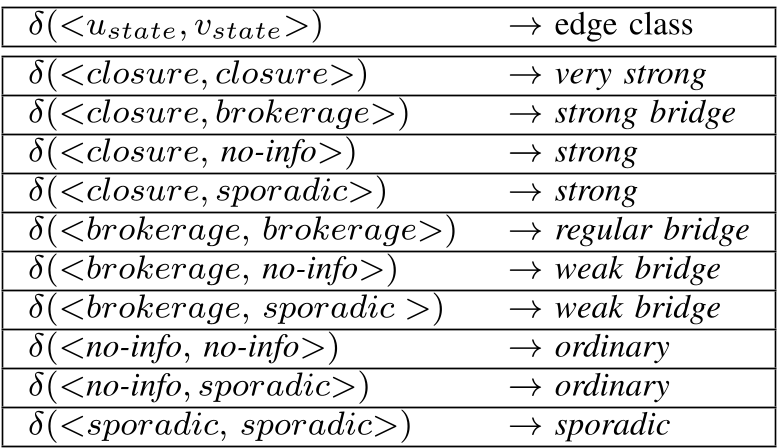 Table 1: Mapping Dynamic States to Edge Classes based on Closure and Brokerage.
Experiments & Results: Real-World Academic Networks
The method was tested on a massive dataset from DBLP (Computer Science bibliography), ranging from specific SIG communities to the entire DBLP corpus.
Key Findings:
- The "Hub" Role: Nodes classified as Hubs (authoritative in specific attributes) displayed exponentially higher PageRank and Centrality metrics compared to "Sporadic" or "Regular" nodes.
- Community Differences: Theoretical communities like STOC (Theory of Computing) have high Hub rates (41.3%), indicating specialized expertise, while applied communities like SAC have more Sporadic nodes (69.9%), reflecting a broader, more shifting participant base.
- Efficiency: By avoiding the "random graph generation" requirement of the RECAST algorithm, the proposed method achieved a processing time of ~42 seconds compared to RECAST's ~327 seconds.
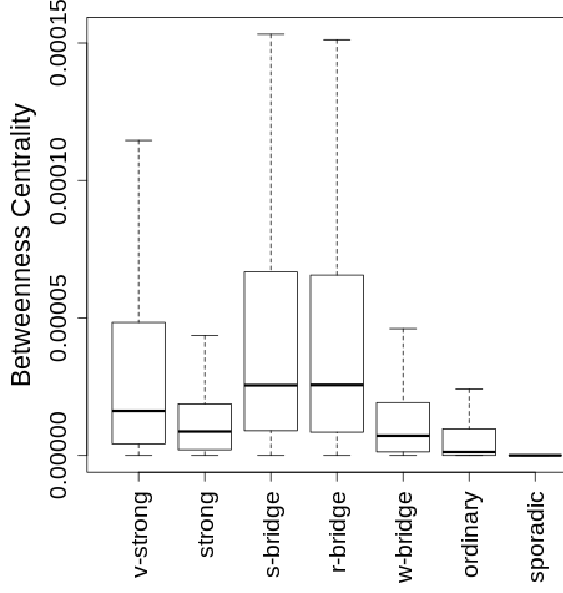 Figure: Validation of node classes against Closeness Centrality and PageRank. Hubs clearly dominate the social structure.
Critical Analysis & Conclusion
Takeaways
The paper successfully demonstrates that Attribute Persistence is a powerful proxy for social role. By defining "Very Strong" to "Weak Bridge" edges, it provides a much finer-grained lens for understanding network evolution than traditional binary classification.
Limitations & Future Work
While the 7.7x speedup is impressive, the method still requires a predefined set of attributes. A future evolution might involve using unsupervised embedding vectors (like Word2Vec or Bert) to handle attributes without manual feature engineering. Additionally, applying this to non-academic networks (e.g., Twitter or Financial transactions) would test its robustness against adversarial behaviors or "noise" attributes.
Conclusion: This work bridges the gap between sociology and data science, proving that the meaning of our data is often found in its temporal consistency rather than just its connectivity.