
Decoding Larval Sociality: Automated Motion Recognition via Gradient-Weighted Optical Flow
Social behavior analysis of Drosophila larvae via motion activity recognition
The paper introduces an automated framework for recognizing the social behavior of Drosophila larvae using low-cost video hardware. By combining a phase-based optical flow estimation with a gradient-weighted Histogram of Oriented Gradients (HOG) and a Support Vector Machine (SVM), the system achieves an overall classification accuracy of 82% for fundamental motion patterns.
Executive Summary
TL;DR: Researchers have developed a robust pipeline to classify Drosophila larvae behavior (crawling, turning) using low-cost, low-resolution cameras. By focusing on the dynamics of motion through gradient-weighted optical flow rather than static anatomy, they achieved an 82% accuracy rate, paving the way for scalable, unattended neuroscience experiments.
Academic Context: This work bridges the gap between high-end microscopic neuronal analysis and macroscopic behavioral studies. It serves as a practical methodology for labs with limited hardware budgets, prioritizing "low-fi" data processing over expensive imaging.
Problem & Motivation: The Challenge of "Low-Fi" Biology
In neuroscience, Drosophila larvae are tiny giants—simple enough to map their neurons, yet complex enough to show social behavior. However, tracking them usually requires high-end optics because they are small, translucent, and lack distinct visual landmarks.
The authors identify a critical gap: most labs use off-the-shelf webcams that suffer from low pixel counts and illumination noise. Standard computer vision often fails here because the larva might only occupy 0.1% of the frame. The research intuition was to ignore what the larva looks like and focus entirely on how the pixels move.
Methodology: From Contours to Motion Packets
1. Robust Tracking with Active Contours
To isolate the larvae, the system uses a local Chan-Vese active contour model. Unlike global thresholding, this method evolves a boundary (the green line in Figure 2) that "shrink-wraps" the larva based on regional intensity, allowing for continuous tracking even as the animal deforms.
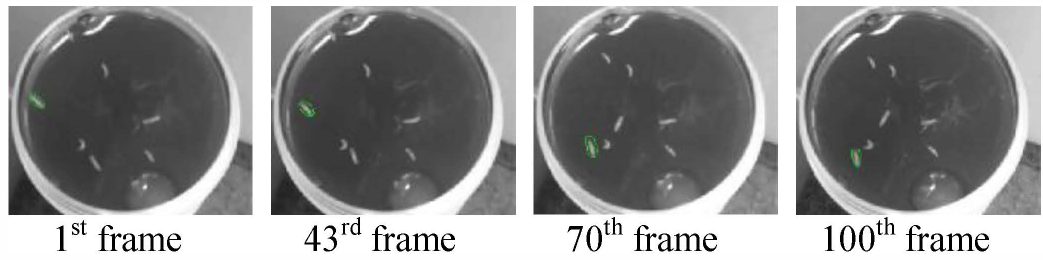 Figure 2: The tracking boundary (green) segments the larva from the petri dish background.
2. Gradient-Weighted Optical Flow
The core innovation lies in how motion is quantified. The authors use a phase-based optical flow approach (Gautama and Van Hulle). To combat pixel noise from cheap sensors, they introduced Gradient Weighting:
This ensures that motion vectors are only considered meaningful if they occur in regions with significant intensity gradients (the edges of the larva), effectively filtering out "false motion" from sensor hiss or lighting shifts.
3. Feature Extraction (HOG)
Motion is captured in "packets" of 31 frames. For each packet, the filtered flow vectors are quantized into an 8-bin Histogram of Oriented Gradients (HOG). This creates a compact signature for each behavior:
- Forward Crawl: Symmetrical motion vectors.
- Turns: Asymmetrical clusters of vectors favoring one direction.
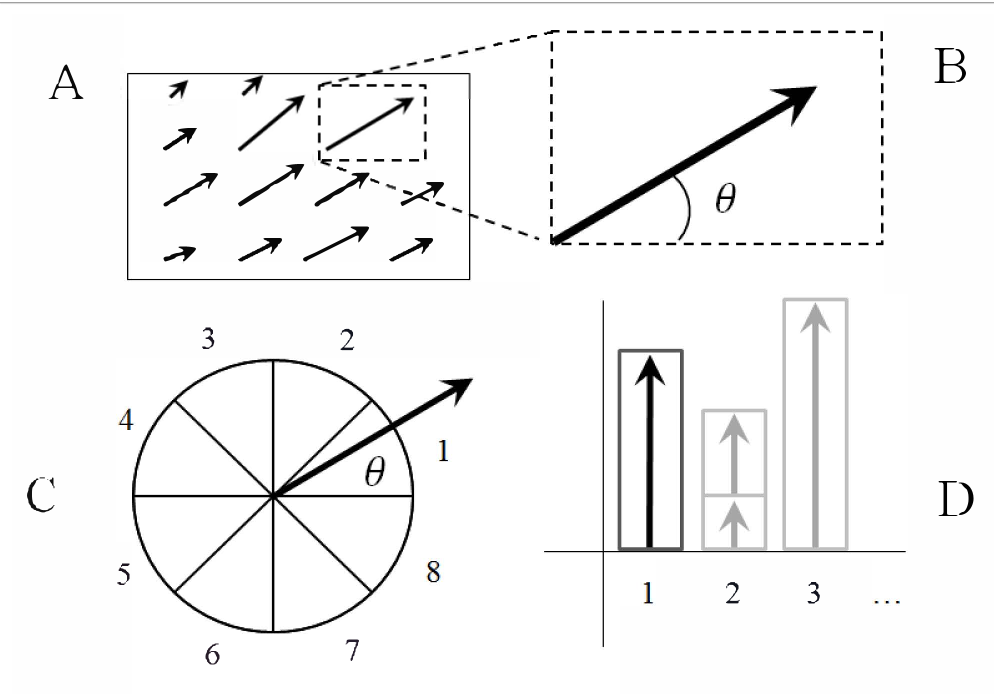 Figure 3: The extraction process from raw vector orientation to quantized histogram bins.
Experiments & Results: SOTA Performance on Budget Hardware
The framework was tested on three primary actions: Left Turn, Right Turn, and Forward Crawl. Using an SVM with a linear kernel and a "one-against-all" strategy, the results were impressive:
| Behavior | Accuracy |
|---|---|
| Forward Crawl | 93% |
| Left Turn | 90% |
| Right Turn | 66% |
The lower accuracy for right turns was attributed to a smaller training sample size in the dataset, leading to a harder time for the SVM to define the decision boundary. However, the 93% accuracy for crawling demonstrates that the gradient weighting successfully isolates biological motion from background noise.
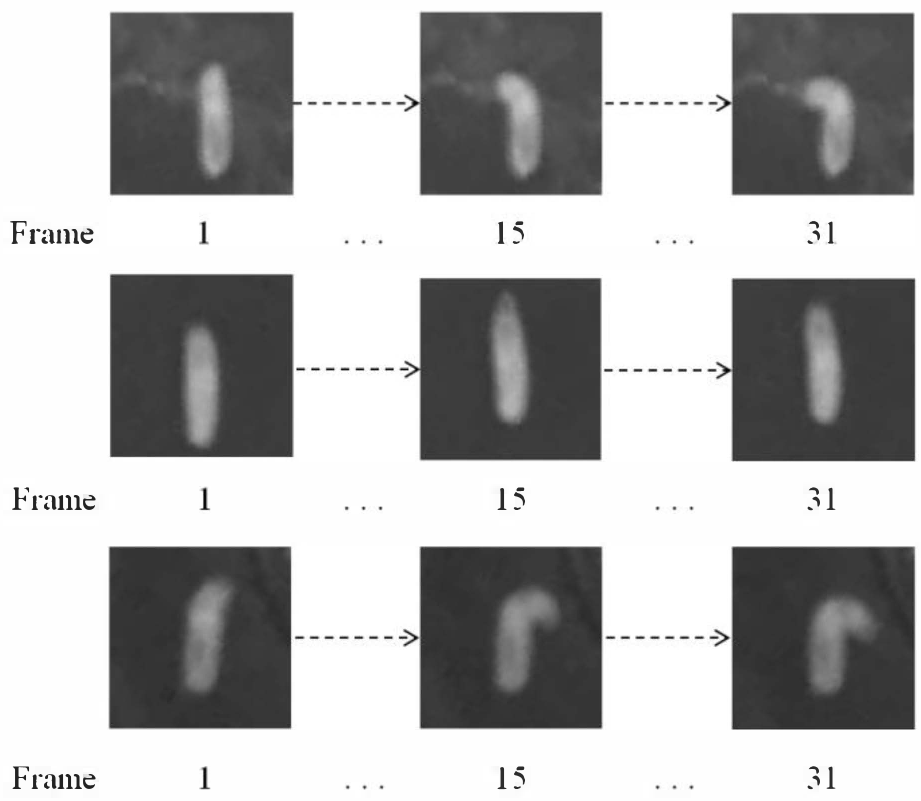 Figure 4: Distinct visual "packets" for turning and crawling behaviors.
Critical Analysis & Conclusion
Takeaway
The paper proves that "feature engineering" (weighting optical flow by gradients) can compensate for poor "data quality" (low-res video). By using a packet-based approach, the temporal context of behavior is preserved.
Limitations
- The Right-Turn Deficit: The model struggled with right turns due to data imbalance, a common issue in biological studies where certain phenotypes or behaviors are naturally rarer.
- Multi-Larva Collisions: The current tracking logic triggers a "manual intervention flag" during collisions. A truly robust system would need a way to resolve identity crossovers (e.g., using Kalman filters or ID-trackers).
Future Outlook
The authors aim to implement kernel variations in the SVM (such as RBF) to better separate similar motion patterns and scale the system for fully unattended, high-throughput social analysis. This work serves as a foundational step for "democratizing" behavioral AI in smaller research labs.