
CRIM13: Mastering Social Behavior Recognition via Trajectory Features and Temporal Context
Social behavior recognition in continuous video
The paper introduces CRIM13, a massive dataset of interacting mice, and a novel framework for social behavior recognition in continuous video. It combines weak trajectory features with spatio-temporal descriptors and utilizes a temporal Auto-context model to achieve a 61.2% recognition rate across 13 action categories.
TL;DR
Researchers from Caltech and Microsoft Research have released CRIM13, the largest expert-annotated dataset for mouse social behavior (88 hours, 8M frames). They propose a system that doesn't just classify actions but segments continuous video into meaningful "behavioral bouts" by combining agent-tracking trajectories with an iterative Auto-context model.
Problem & Motivation: Beyond the "Segmented Clip" Paradigm
Most action recognition research historically focused on "pre-segmented" clips—short videos containing exactly one action (e.g., "walking"). Real-world behavior is different: it is continuous, spontaneous, and often social.
The authors identify three roadblocks:
- Front-end Complexity: Tracking multiple subjects through occlusions.
- Definition Ambiguity: Distinguishing between short "movemes" and long-scale "activities."
- Dataset Scarcity: Lack of benchmarks where agents interact purposefully.
By studying laboratory mice, the authors create a controlled yet complex environment to model aggression, courtship, and solitary behaviors, providing a roadmap for future human social behavior analysis.
Methodology: The Fusion of Trajectory and Context
The core innovation lies in the move away from pure visual "energy" (spatio-temporal features) toward relational trajectories.
1. Weak Trajectory Features
Instead of just pixels, the model looks at the physics of interaction. It tracks the positions of both mice and calculates:
- Relative Distance: How close are the mice?
- Velocity & Acceleration: Is one mouse chasing the other?
- Angular Change: Are they circling each other?
A massive pool of weak features is generated by applying statistical operations (sum, variance, min, max) across different sliding window scales.
2. Temporal Auto-context
Behavior isn't a vacuum; "sniffing" often leads to "chasing." The authors utilize Auto-context to capture this.
- Iteration 1: Classify frames based on local visual and trajectory features.
- Iteration 2+: Use the probabilities from Iteration 1 as "context features." If the model is 90% sure the previous 10 frames were "Approach," it's more likely the current frame is "Sniff."
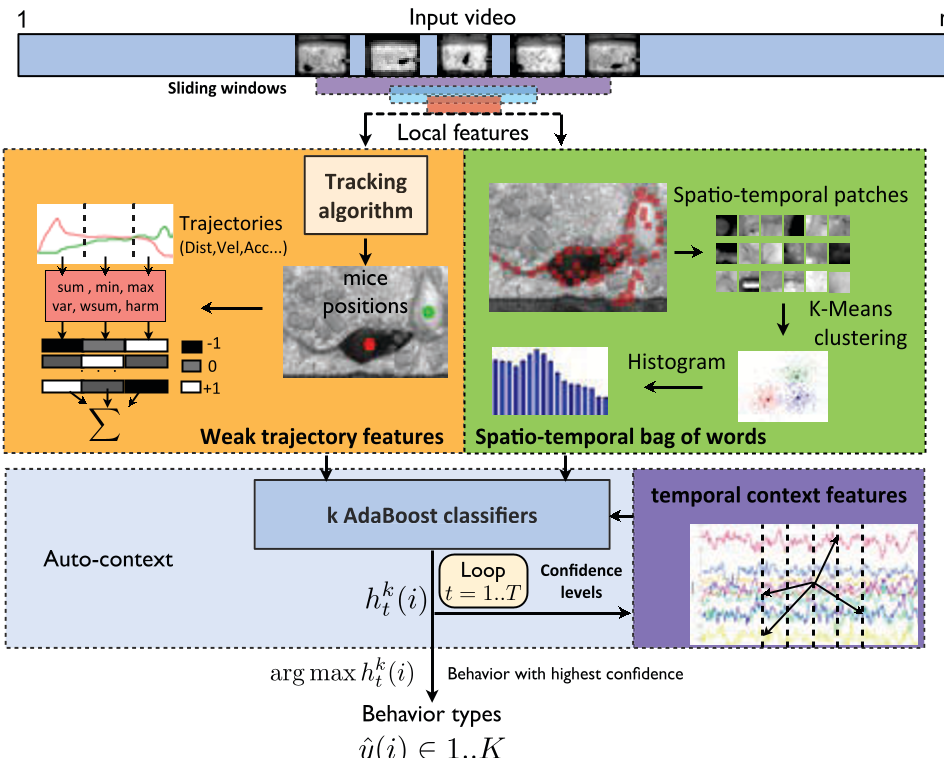 Figure 1: The dual-view input (Top/Side) and the iterative Auto-context pipeline.
Experiments & Results
The researchers tested their approach on 133 unseen videos. The results confirmed their intuition: Trajectory is king.
- Trajectory Features (TF) only: 52.3% accuracy.
- Spatio-Temporal Features (STF) only: 29.3% accuracy.
- Combined + Auto-context: 61.2% accuracy.
The 8-10% gain from Auto-context is the differentiator; it allows the model to "smooth" its predictions into realistic bouts rather than flickering between labels every few frames.
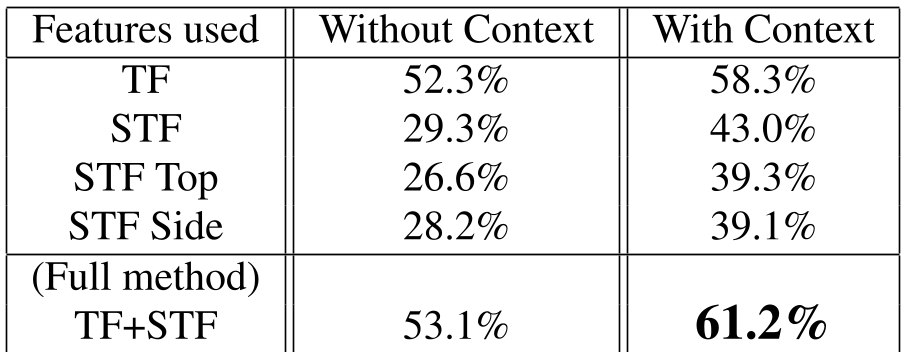 Table 1: Quantifying the impact of visual features vs. trajectory and context.
Expert Comparison
Interestingly, human experts agree with each other only about 70% of the time on this dataset. At 61.2%, the automated system is remarkably close to human-level performance, especially in categories like "chase," "approach," and "walk away."
Critical Insight: Why Trajectory Wins
In social behavior, who is moving where relative to the other is often more informative than the appearance of the pixels. For example, "Chasing" and "Walking away" might look visually similar in terms of limb movement, but their relative distance and velocity vectors are polar opposites. By distilling the video into agent trajectories, the model ignores visual noise and focuses on the intent of the agents.
Conclusion & Future Work
The CRIM13 dataset and the proposed method set a high baseline for automated ethology. While the system is robust, it still struggles with highly imbalanced data (rare behaviors like "copulation") and confuses subtle social cues that humans easily distinguish. The authors suggest that adding 3D pose estimation and more sophisticated multi-label classifiers (to handle simultaneous actions) are the next logical steps for the field.
Takeaway: To understand "social" actions, stop looking just at the agent; look at the gap between the agents.