
Sensor Nodes with a Social Life: Leveraging Closeness for WSN Efficiency
On social behavior of wireless sensor node
This paper introduces a novel paradigm by treating a Wireless Sensor Network (WSN) as a "Social Network," where sensor nodes emulate social interactions. The authors propose a "Closeness Property" algorithm that dictates data sharing based on hop distance, achieving over 30% reduction in communication overhead and significantly optimizing memory and battery utilization.
TL;DR
What if sensor nodes behaved like humans in a social network? This paper proposes a "Social Rule" for Wireless Sensor Networks (WSNs) where nodes maintain detailed information about "close friends" (nearby neighbors) and minimal data about "acquaintances" (distant nodes). By applying this social closeness property, the authors achieved a 30%+ reduction in communication overhead, significantly extending the battery life and memory efficiency of the network.
Background Positioning
In the landscape of WSN research, most work focuses on the physical or network layer—optimizing signal modulation or finding the shortest path. This paper takes a higher-level, biomimetic approach. It moves away from the "broadcast everything" mentality and introduces a social heuristic that governs what information a node deserves to know, positioning this work as a cross-disciplinary bridge between Social Network Analysis (SNA) and Distributed Systems.
Problem & Motivation: The Burden of Total Knowledge
In a standard WSN, nodes often struggle with the "curse of information." To process queries or route packets, they might attempt to maintain tables of attributes (battery status, sensor type, IDs) for many other nodes in the network.
- The Limitation: As the network grows (N increases), the memory required to store these attributes and the energy spent transmitting them in packet headers becomes unsustainable.
- The Insight: Humans don't know everyone's life story. We know the most about those geographically or socially closest to us. The authors hypothesized that by forcing sensor nodes to follow this Closeness Property, they could eliminate redundant data transmission without sacrificing the network's functional integrity.
Methodology: The Closeness Algorithm
The core proposal is a gradient-based information storage rule. Instead of a binary "know or don't know," the knowledge is quantized by hop count:
- 1-Hop Neighbors: Direct physical range. The node stores all attributes ().
- 2-Hops Away: The node stores () attributes.
- k-Hops Away: The node stores () attributes.
This creates a "social horizon" where information naturally fades with distance, reducing the payload size of any communication or query that needs to traverse multiple hops.
Theoretical Framework
The authors derive communication cost functions showing that even with a monotonically increasing cost of (nodes) and (attributes), the closeness algorithm introduces a subtractive term that grows with the number of hops, eventually upper-bounding the overhead.
Note: The algorithm ensures that more communication between two nodes "brings them closer" socially, dynamically increasing the attributes shared.
Experiments & Results: The Power of Density
The researchers simulated environments with 200, 300, and 400 nodes across a 500x500 area using a modified Dynamic Source Routing (DSR) protocol.
Key Findings:
- Overhead Reduction: The system consistently showed over 30% reduction in bytes transmitted.
- Density Advantage: As node density increased from 200 to 400, the "Closeness" algorithm became even more effective. This is counter-intuitive for traditional protocols (which usually slow down under density) but logical for social rules: more neighbors mean more opportunities for localized, high-intimacy communication.
- Attribute Scaling: The more complex the node (the more attributes it has), the higher the savings.
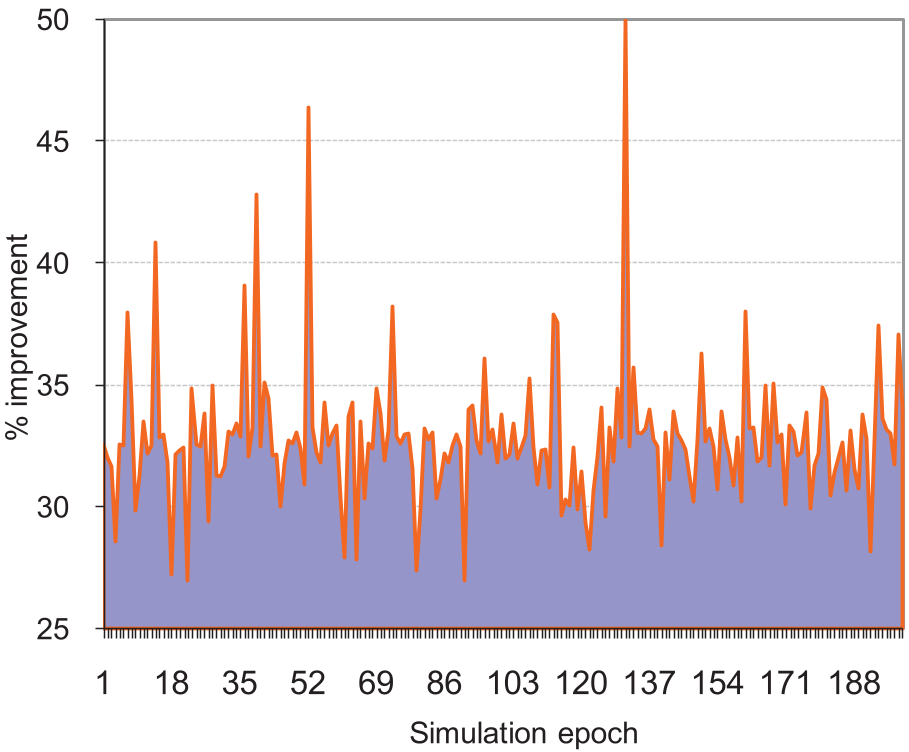 Figure 2: Performance improvement increases as the complexity (number of attributes) of the sensor nodes increases.
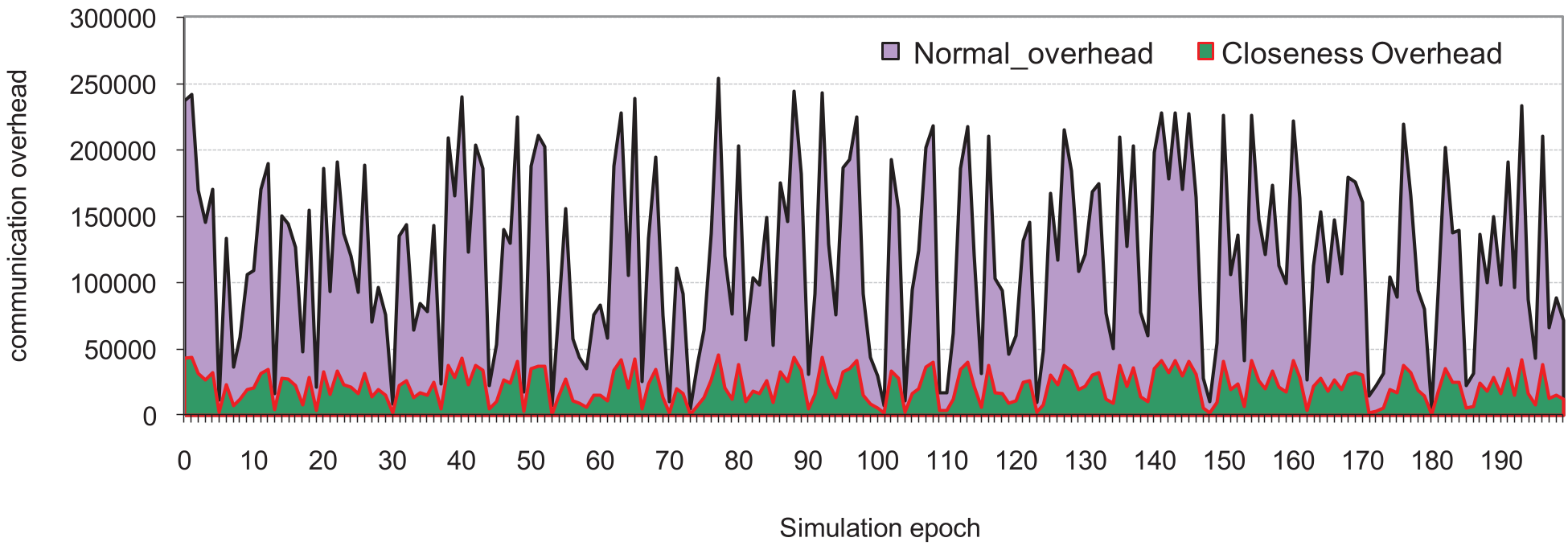 Figure 5: In high-density scenarios (400 nodes), the gap between the "Normal Case" and the "Closeness Algorithm" widens, showcasing superior scalability.
Critical Analysis & Conclusion
Takeaway
The primary contribution of this work is the validation of selective information dissemination. By leveraging the "Small World" phenomenon and the closeness property, WSNs can mimic the efficiency of human social structures to solve the physical constraints of hardware.
Limitations
- Dynamic Topology: While the paper mentions closeness can change over time, the experimental study largely focuses on a static random placement. The overhead of frequent "social updates" in highly mobile networks remains an open question.
- Attribute Importance: The algorithm treats all attributes as equally "droppable." In real-world scenarios, some distant information (like a "Critical Alarm" flag) should never be dropped, regardless of hop count.
Future Prospect
This opens the door for other social concepts—like trust (Security), influence (Leader Election), and community detection (Clustering)—to be ported into the silicon world of sensor networks.