
Do Social Bots (Still) Act Different to Humans? Deep Dive into Political Automation
Do Social Bots (Still) Act Different to Humans? – Comparing Metrics of Social Bots with Those of Humans
This study presents a comparative analysis of 771 social bots and 693 human accounts using a Twitter dataset from the 2016 U.S. Presidential Election. By evaluating metrics such as follower counts, retweet frequency, and link usage, the researchers highlight behavioral patterns that distinguish automated actors from real users in political discourse.
TL;DR
In the high-stakes arena of the 2016 U.S. election, social bots and humans operated under fundamentally different "playbooks." This research analyzes millions of tweets to prove that while bots are link-heavy and mention-light, they struggle to match the organic engagement (retweets) of real humans, despite their aggressive attempts to grow followers through sheer volume.
The Evolution of the Digital "Bot-Effect"
Social media has transformed from a platform for discussion into a battlefield for the "Bot-Effect"—a term coined to describe the subtle manipulation of public discourse via automated accounts. Whether it was Brexit or the Arab Spring, bots have been accused of astroturfing (creating a fake grassroots impression) and smoke screening (burying information under spam).
The core tension addressed by Stieglitz et al. is whether these bots, which are designed to mimic humans, still leave a "digital fingerprint" that distinguishes them from the people they attempt to influence.
Methodology: Separating the Signal from the Noise
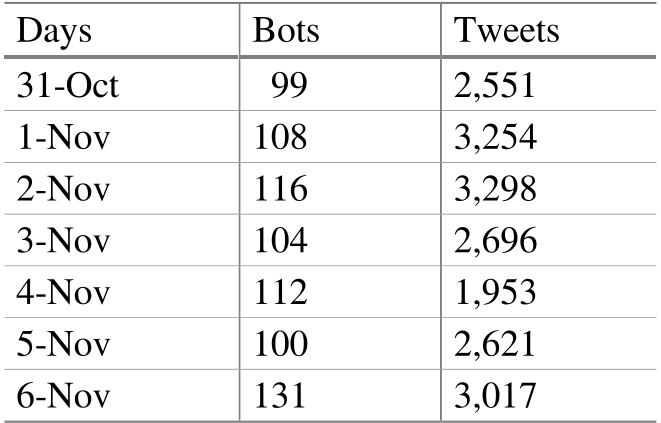
The researchers didn't just look at bots Tip-of-the-Iceberg style; they used a rigorous filtering process to extract a high-probability bot sample and a high-probability human sample from the same week of the 2016 election.
The Bot Identification Logic:
- Source Check: If the tweet came from "Twitter for iPhone," it was likely human. If it came from an unregistered API, it flagged the bot filter.
- The Ratio: Bots typically "friend" thousands in hopes of a follow-back. The authors set a threshold of a 150% friend-to-follower ratio to catch these aggressive recruiters.
- Activity: A minimum of 10 tweets per day was required to ensure the bots studied were active enough to have a potential impact.
Core Findings: The "Quantity Over Quality" Trap
The study’s results challenge some common assumptions while confirming others:
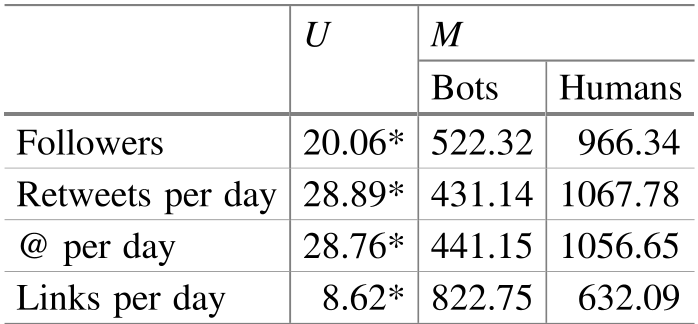
- The Engagement Paradox: Contrary to the idea that botnets amplify each other to massive heights, humans in this dataset actually had a higher average retweet count. This suggests that humans may be intuitively better at sniffing out bot content, or that human-generated content (often more emotional) is simply more shareable.
- Breadcrumbs in the Links: Bots are significantly more likely to include external URLs. They act as "traffic routers" rather than content creators.
- The Cost of a Follower: Perhaps the most insightful finding is the Follower-Tweet Regression. For bots, every ~2 tweets resulted in 1 new follower. This reveals the brute-force nature of bot growth: they don't grow by being interesting; they grow by being constant.
Critical Analysis: Why This Still Matters
The study utilizes the CASA (Computers as Social Actors) framework, noting that humans tend to treat computers like people if they exhibit social cues. However, the data shows that in a political context, the "social cues" of bots—such as their lack of @-mentions (which signifies a lack of genuine conversation)—are often enough to break the illusion.
Limitations & Future Outlook
The main limitation is the age of the data (2016). Modern bots, powered by Large Language Models (LLMs), are far better at generating "original" text and emotional nuance than the API-driven scripts of 2016. The "Mention-Ratio" and "Link-Ratio" might be narrowing as AI becomes better at mimicking the conversational style of real users.
Conclusion
Social bots still act differently, but the gap is likely closing. By understanding these structural metrics—follower ratios, link density, and the volume-to-growth correlation—researchers can continue to build defenses against computational propaganda. The key takeaway? If an account is constantly shouting links but never talking to anyone (mentions), you’re probably looking at a machine.