
Social Boundary: Mapping the Hidden Dividers Between Any Two Individuals
Social boundary of any two nodes in a social network
This paper introduces the concept of the "Social Boundary," a novel task focused on partitioning a social network into two disjoint social circles based on any arbitrary pair of nodes. The authors propose two distinct computational approaches: one utilizing Label Propagation and another based on a Perceptron network model to identify these hidden boundaries.
TL;DR
While we usually look at social networks as a collection of large communities, this paper asks a more granular question: If you pick any two people, where does the "boundary" between their social influence lie? By combining the Six Degrees of Separation theory with Label Propagation and Perceptron models, the authors define and identify "Social Boundaries"—hidden lines that divide a network into disjoint influence circles for any specific pair of nodes.
Problem & Motivation: Beyond Global Communities
In Social Network Analysis (SNA), we are familiar with "Community Detection"—identifying clusters where people are tightly knit. However, community detection is essentially a global structural analysis. It doesn't tell us how two specific individuals (nodes and ) divide the surrounding network between them.
The authors argue that social connections are driven by Social Influence and Homophily. Because of the "Small World" phenomenon, any two people are connected by a short chain. This proximity implies that their social spheres will inevitably intersect. The challenge is identifying the hidden "Social Boundary" that dictates which nodes "belong" to person A versus person B, especially when a node sits right in the middle, experiencing "competition" from both sides.
Methodology: Two Paths to the Boundary
The paper proposes two frameworks to solve this partition problem:
1. Label Propagation (The Efficient Approach)
This is a semi-supervised learning method. You start with node (labeled +1) and node (labeled -1). The labels spread to neighbors based on similarity.
- Pros: Simple, fast, and effective for clear-cut networks.
- Cons: Fails during "competition"—if a node is equally influenced by a +1 and a -1 neighbor, the model struggles to decide.
2. Perceptron Network Model (The Robust Approach)
To fix the competition problem, the authors treat the boundary as a classification hyperplane.
- The Intuition: Using an artificial neural network structure (Perceptron), the model uses a "bias unit" and weight training to resolve ties.
- The Logic: It views the network distance and connectivity as features to be classified into one of two circles. This approach can handle complex synthetic cases where simple propagation gets stuck.
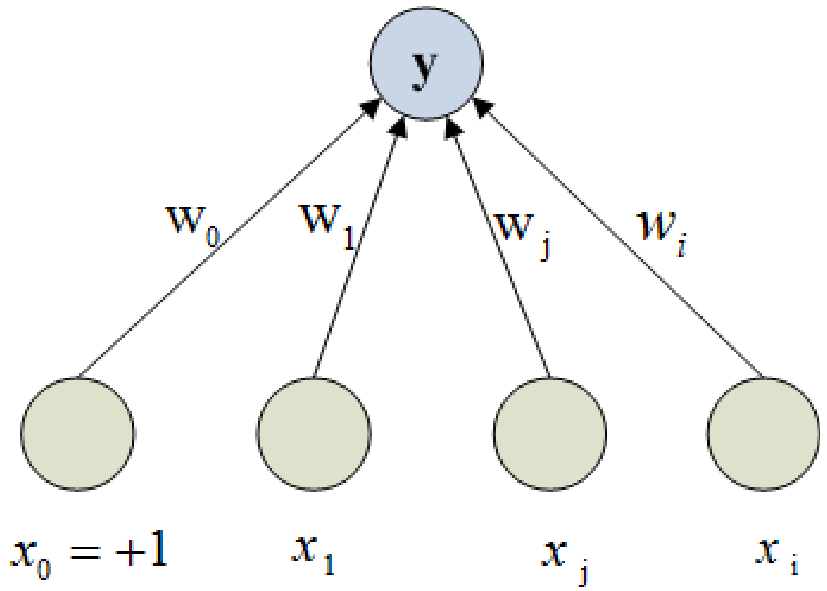 Figure 1: The Perceptron model used to resolve social classification.
Experiments: Real-World and Synthetic Validation
The authors tested their theories on the Zachary’s Karate Club network—a staple in social science.
- Karate Club Results: The model successfully visualized the social boundary between specific members (e.g., node 1 and node 19), showing how the club's influence is partitioned.
- Synthetic Logic: In cases of "competition" (where a node is connected to both opposing sources), the Perceptron model outperformed label propagation by using its inherent bias to make a definitive classification.
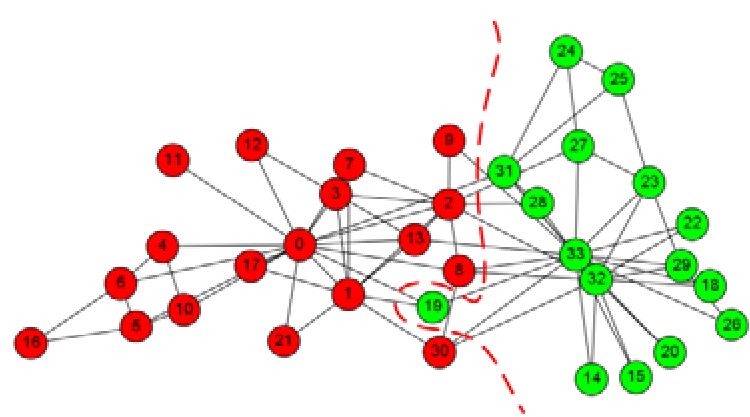 Figure 2: Social boundary between Node 1 and Node 19 in the Karate Club network.
Critical Analysis & Conclusion
The core contribution of this work is the shift from global structure to pairwise dynamics. It formalizes the "Social Boundary" not just as a mathematical partition, but as a reflection of human social influence.
Takeaways:
- Relevance: This is highly applicable for personalized recommendations. If we can define a user's "social circle" relative to a competitor, we can better predict information flow.
- Limitations: The current model assumes a simplified "one-time influence" rule (nodes are affected only once by neighbors). In real-world social media, influence is iterative and temporal.
- Future Direction: Integrating this with modern Graph Neural Networks (GNNs) could allow for identifying boundaries in massive networks with millions of nodes, where the "Six Degrees" theory still holds but the computation becomes a bottleneck.
Ultimately, the social boundary reminds us that in a network, your importance isn't just about what you know, but whose circle you reside in.