
Quantifying the "Glue" of Science: A New Instrument for Academic Social Capital
Assessing social capital in academic research teams: a measurement instrument proposal
This paper proposes and validates a multidimensional measurement instrument for Academic Social Capital within research teams. By integrating qualitative Delphi methods with quantitative Factorial Analysis, the authors establish a 20-item scale that categorizes social capital into relational, cognitive, and structural dimensions, designed to measure internal dynamics beyond simple co-authorship counts.
TL;DR
In an era of hyper-collaboration, the success of a research team isn't just about who is on the team, but how they interact. This paper moves beyond cold citation counts to propose a validated 20-item scale that measures the hidden dimensions of Academic Social Capital: Trust (Relational), Shared Language (Cognitive), and External Ties (Structural).
The Motivation: Why Quantitative Metrics are Not Enough
In modern academia, the "Triple Helix" of university-industry-government collaboration has made multidisciplinary teams the standard. However, multidisciplinarity is a double-edged sword. While it brings diverse perspectives, it often triggers coordination failures and communication silos.
The authors argue that prior work relies too heavily on Social Network Analysis (SNA). While SNA tells us that Researcher A co-authored with Researcher B, it doesn't tell us if they actually trust each other, share a common vision, or if the collaboration was a "forced marriage" of convenience. This paper seeks to capture the qualitative essence—the social capital—that makes teams thrive.
Methodology: Building the 20-Item Scale
The researchers didn't just pick questions out of a hat. They followed a rigorous, two-step academic validation process:
- The Delphi Method: They consulted 62 veteran Principal Investigators (PIs) to reach a consensus on what truly matters in a team. This led to a 20-item questionnaire.
- Factor Analysis: Using a massive sample of 1,798 Spanish researchers, they applied Exploratory Factor Analysis (EFA) to group these items and Confirmatory Factor Analysis (CFA) to prove the model’s statistical validity.
The Three Pillars of Academic Social Capital
The model identifies three distinct dimensions:
- Relational (The Heart): Focused on trust, mutual help, and interpersonal climate.
- Cognitive (The Mind): Focused on shared language, exchange of experiences, and synergistic goals.
- Structural (The Skeleton): Focused on the patterns of external connections and idea exchange with outside professionals.
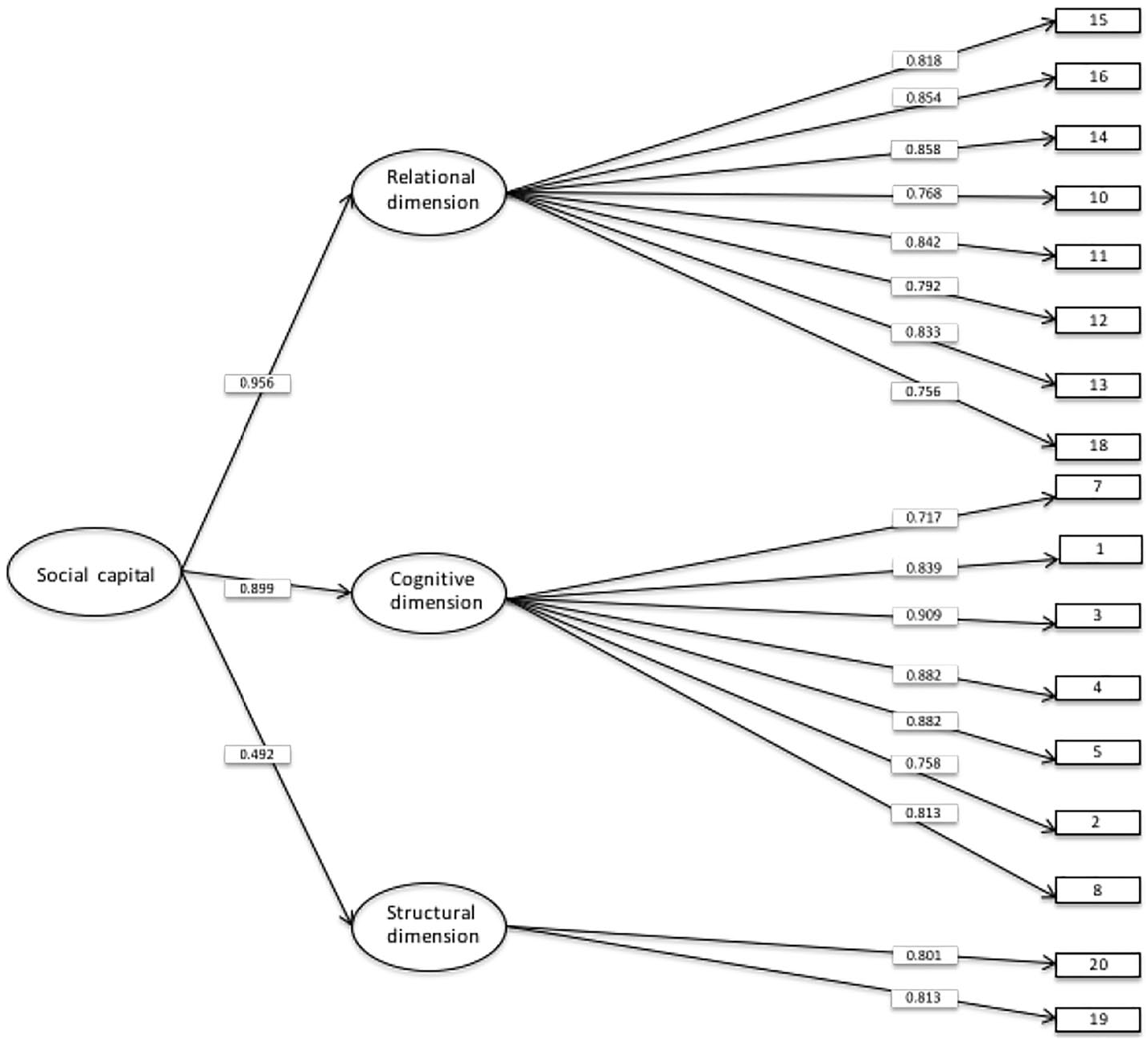 Figure 1: The validated second-order model showing how the three dimensions converge into Social Capital.
Critical Insights from the Results
The statistical heavy lifting (CFA) yielded some fascinating insights into the "mechanics" of a good team:
- Relational Social Capital is the Strongest Predictor: The items related to trust and interpersonal relationships had the highest factor loadings. In simple terms: a team that trusts each other is more "valuable" than a team that simply shares the same office.
- Scale Reliability: With a Cronbach’s alpha of 0.954, this instrument is highly reliable for future academic use.
 Table 3: The EFA results, highlighting how items like "Trust that others will help" and "Sharing advances" group into the three dimensions.
Practical Implications: How Can We Use This?
This isn't just a theoretical exercise. The authors propose a multi-level framework for using this tool:
| Level | Management Use | Evaluation Use |
|---|---|---|
| Research Team | Identify nodes of internal cohesion. | Assess ability to build networks for consortia. |
| University | Guide training policies for collaboration. | Evaluate group strategic alliances. |
| Funding Entities | Design programs that foster networks. | Screen applicants for "collaboration readiness." |
Conclusion and Future Outlook
The "Academic Social Capital" scale represents a shift toward the "Science of Team Science." By quantifying behavioral assets, we can finally treat scientific collaboration as a manageable resource rather than a black box of "good vibes."
Limitations: The study was conducted within the Spanish university system. While the sample size is large, the cultural nuances of "trust" and "interpersonal climate" may vary in other regions (e.g., East Asia or North America). Future research should apply this scale globally to see if the "Relational" dimension remains the undisputed king of team success.