
The Gendered Double-Edged Sword: Social Capital in Ugandan Entrepreneurship
Social capital of entrepreneurs in a developing country: The effect of gender on access to and requests for resources
This study investigates gender disparities in the social capital of Ugandan entrepreneurs, focusing on both the "network-mediated benefits" (access to resources) and "claims on group members" (requests for support). Using a large-scale survey of 608 urban and rural entrepreneurs, it demonstrates that gender significantly influences financial resource flows within personal networks in developing economies.
TL;DR
In developing countries, a social network is more than just a support system—it is a complex balance sheet of assets and liabilities. This study finds that while Ugandan female entrepreneurs struggle with formal financing, their informal networks are site-specific: men are the primary providers of capital, but they also face higher expectations to redistribute their wealth. Interestingly, urbanization does not "dilute" these traditional gender roles as much as previously thought.
Background Positioning
Moving beyond the "overemphatic" positive view of social networks, this paper places itself in the critical tradition of Economic Sociology. It questions whether Western social capital theories hold up in contexts like Uganda, where "Ubuntu" or communal values create heavy distributive pressures on successful business owners.
The "Liability" of Success: Problem & Motivation
Why do businesses in developing countries often fail to scale? One hidden reason is Social Pressure. In many Sub-Saharan contexts, an entrepreneur who makes a profit is immediately met with requests for school fees, medical bills, or community aid.
The authors argue that gender roles exacerbate this. Men are culturally expected to be "providers," potentially making them targets for more requests, while women—often lacking formal property rights—are systematically excluded from the circles where financial resources actually flow.
Methodology: Mapping Ego and Alter
The study utilizes a nested structure, analyzing thousands of specific "ties" (contacts) mentioned by 608 entrepreneurs. They use three "Name Generators" to map:
- Personal advice networks.
- Business advice networks.
- Request networks (who asked the entrepreneur for money?).
 Note: The study compares urban Kampala with rural Nakaseke to see if "modernity" changes these dynamics.
Key Findings: The Gender Paradox
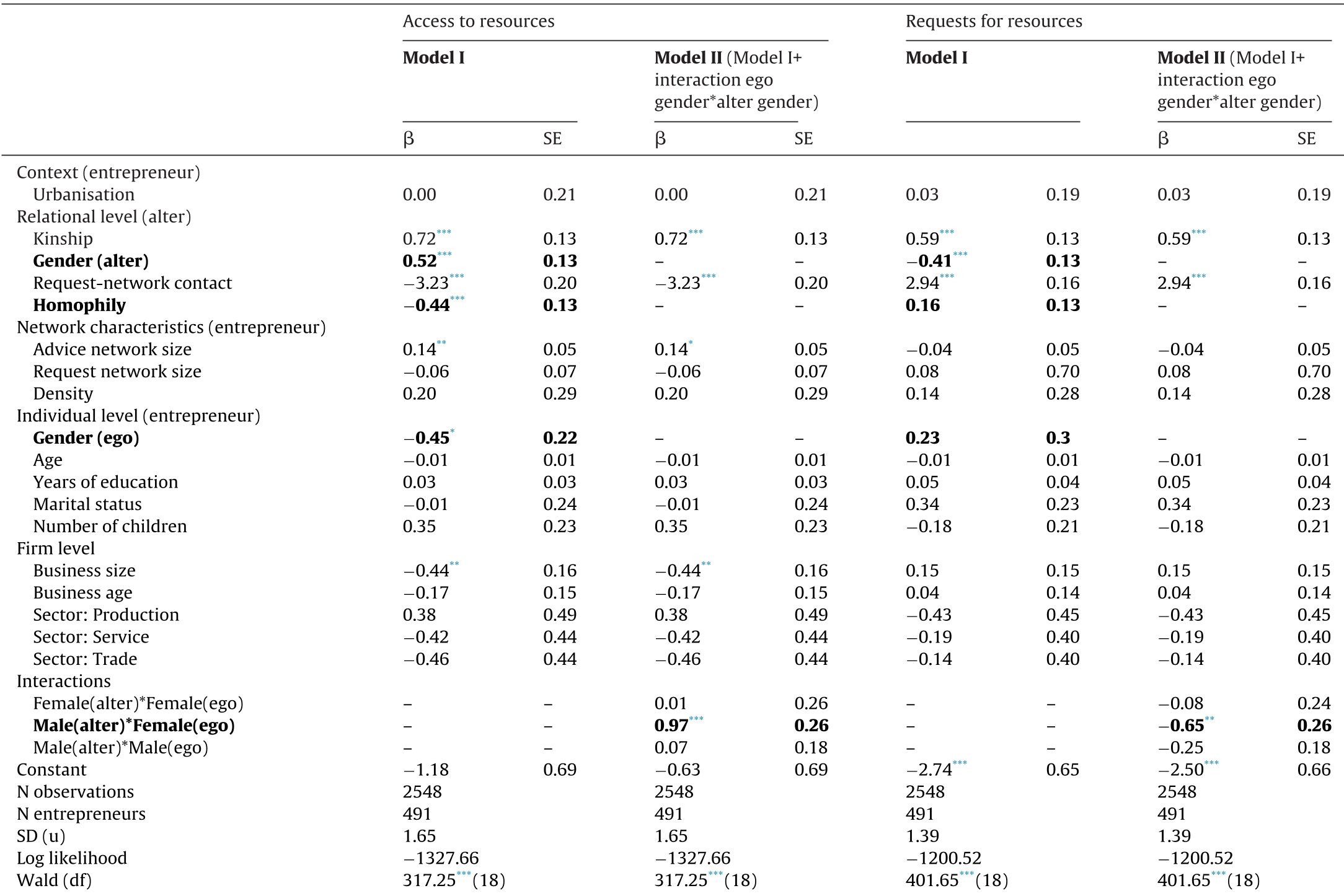
The empirical results from the multi-level logistic regressions reveal a striking paradox in financial social capital:
- The Male Provider Bias: Male contacts (alters) are far more likely to provide financial resources (68% higher odds) but also less likely to ask for money compared to female contacts.
- The Ego Disadvantage: When the entrepreneur is male (ego), they are actually less likely to receive help, likely because they are perceived as the ones who should be giving.
- The Family Trap: Kinship is the strongest predictor of both help and hindrance. Relatives are your best source of a quick loan, but they are also the most frequent source of financial drain.
Deep Insight: Why Urbanization Doesn't Help
Perhaps the most surprising finding is that the "Urban" environment of Kampala did not weaken traditional gender dynamics. The authors suggest a "Blurred Culture" hypothesis: because 65% of urban entrepreneurs are recent migrants from rural areas, they bring their communal obligations and gendered expectations with them to the city.
Critical Analysis & Conclusion
This research provides a sobering look at entrepreneurship in developing nations. Social capital is not a free resource; it is "borrowed" against future social obligations.
Limitations: The study relies on self-reported "potential" access rather than actual transaction volumes. It also uses a binary (Yes/No) metric for resources, which masks the size of the financial help or request.
Future Outlook: For development agencies, the takeaway is clear: providing a woman with a micro-loan is insufficient if she cannot legally or socially shield that capital from the "claims" of her extended network. True empowerment requires addressing the institutionalized gender roles that dictate who owns the money and who is "forced" to give it away.