
Leveraging Social Capital: The Next Frontier for Context-Aware Recommendations
Evaluation of Social Capital in Context-Aware Content-Provision Service
The paper introduces a context-aware information provision system that leverages "Social Capital"—the network of human relationships within an SNS—to deliver personalized content such as sightseeing and event info via mobile phones. Evaluated through a 4-month field trial with over 1,300 participants, the system demonstrates how social connectivity significantly enhances information propagation and recommendation relevance.
TL;DR
This paper explores an early yet visionary integration of Social Capital—the value derived from social networks—into mobile content-provision services. By combining GPS location data with SNS interaction histories, the researchers built a system that provides "the right information at the right place" based on who you know, not just where you are. A large-scale field trial in Aomori City, Japan, confirmed that social ties are more effective than static preferences for information spreading.
Problem & Motivation
In the mid-2000s, "ubiquitous computing" promised a world where information followed the user. However, early systems faced two massive hurdles:
- The Static Context Trap: Users rarely update their "interests" profiles, leading to stale recommendations. This paper found that static profile precision was a mere 41.4%.
- The Noise Problem: With sensors everywhere, how do we distinguish between a useful shop recommendation and digital litter?
The authors' key Insight was that trust is social. They hypothesized that "Social Capital"—the connections between users in an SNS—could serve as a natural filter for information, turning a generic map into a living community guide.
Methodology: Putting the 'Social' in GPS
The system architecture consists of a Ubiquitous Agent Server acting as a "metaprogramming" layer. It bridges the gap between the physical world (GPS coordinates, 2D barcodes) and the digital social world (SNS database).
Core Components:
- Static Context: User-selected categories (e.g., Gourmet, Sightseeing).
- Dynamic Context: GPS location (accurate within 400m blocks) and moving history.
- Social Capital: Automatic tracking of message exchanges, diary comments, and "friend" bookmarks.
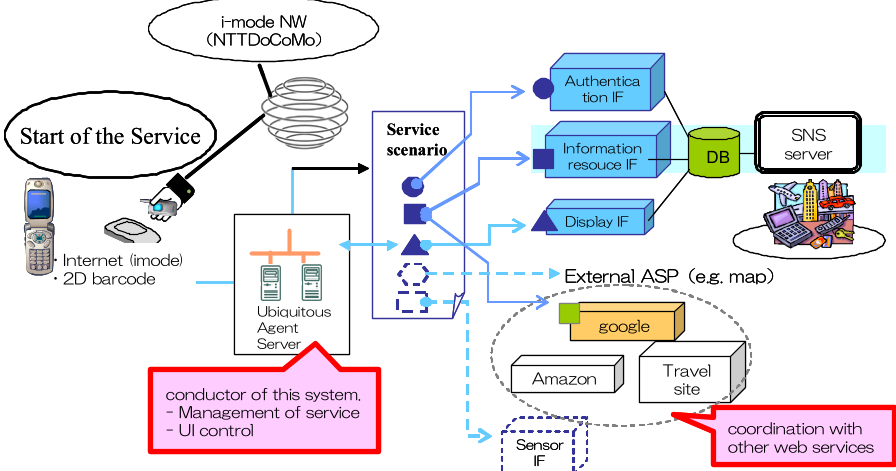 Figure 1: The Ubiquitous Agent Server processes location and social data to determine content output.
When a user triggers the system via their mobile device, the agent retrieves their profile and social history to sort content candidates. This isn't just a distance-based sort; it's a reputational sort.
Experimental Results: Why Friends Matter More Than Content
The 4-month trial produced several striking findings regarding how information actually moves through a city:
1. The Power of Social Connectivity
The researchers found a clear divide in user behavior based on social density. Users with a high number of friends (seven or more) were vastly more active.
- Linear Propagation: There is a clear linear relationship () between writing reviews and having those reviews viewed by others.
- Efficiency: Interestingly, writing more reviews didn't necessarily mean each review was seen by more people. Instead, reviews from those with dense social connections had higher individual impact.
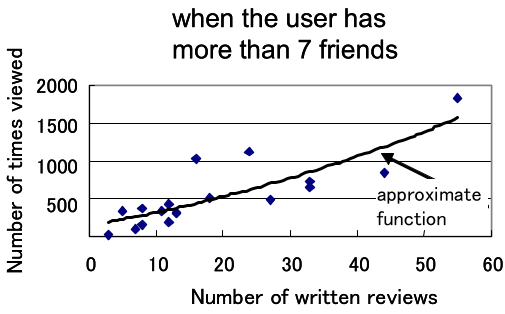 Figure 2: The correlation between review frequency and visibility, highlighting the "Social Capital" effect.
2. The Push-Pull Privacy Dilemma
The trial highlighted a critical UX paradox. While users wanted "Push" notifications (automatic alerts), Japanese privacy laws at the time required "Pull" actions (manual GPS updates). However, during a real-world flood emergency that occurred during the trial, users bypassed these hurdles to share disaster info, proving that the importance of Social Capital scales with the urgency of the information.
Critical Analysis & Future Outlook
The paper successfully proves that social relationships are a superior context compared to static user settings.
Strengths:
- Real-world Validation: Moving beyond lab simulations with 1,300+ participants.
- Early Insight into "Influencers": The study identifies that specific users (those with higher Social Capital) act as critical nodes for information circulation, a precursor to modern influencer marketing.
Limitations:
- Manual Friction: The requirement for users to "pull" information (due to privacy/battery constraints of the era) likely suppressed engagement.
- Cold Start: The system relies heavily on an existing SNS network; for new users without friends, the "Social Capital" advantage is nullified.
Takeaway: This research remains highly relevant as we move into the era of Spatial Computing. Whether it's AR glasses or autonomous agents, the most effective way to filter the "hyper-local" world is to look at the social graph of the person standing right there.