
Friendship-Event Networks: Why Social Capital Predicts Success Better Than History
Social Capital in Friendship-Event Networks
This paper introduces Friendship-Event Networks (FEN), a novel framework that integrates traditional social ties with event-based participation and organization. Focusing on academic collaboration networks (researchers, co-authorship, and conferences), it provides formal quantitative definitions for Social Capital and Benefit, demonstrating that an actor's social capital can outperform their publication history as a predictor of future event participation.
TL;DR
Is your success determined by your past performance or by the influence of your professional circle? This paper argues for the latter by introducing Friendship-Event Networks (FEN). By quantifying "Social Capital" as your connections to event organizers, the researchers found that these social ties are a stronger predictor of where you will publish next than your entire previous publication record.
Contextualizing the Social Graph
Modern social network analysis has moved beyond simple friendship graphs. While "who-knows-who" is interesting, it lacks the context of events—the specific arenas where power and influence are exercised. Whether it is a Senate subcommittee, a corporate board meeting, or an academic conference, events have organizers and participants. This paper formalizes this tripartite relationship (Actors, Friends, and Events) to bridge the gap between sociology and data mining.
The Core Insight: Quantifying Social Capital
The authors define Social Capital through a lens of "Good-will." Unlike human capital (your individual skills), Social Capital is a function of your ties to those in power.
1. The Methodological Framework
The researchers ground their theory in a Friendship-Event Network where:
- Actors: Researchers.
- Friendship: Defined by co-authorship.
- Events: Academic conferences.
- Organizers: Program Committee (PC) members.
They define Social Capital () for an actor in event as: Essentially, your capital is the count of your friends who are currently organizing the event.
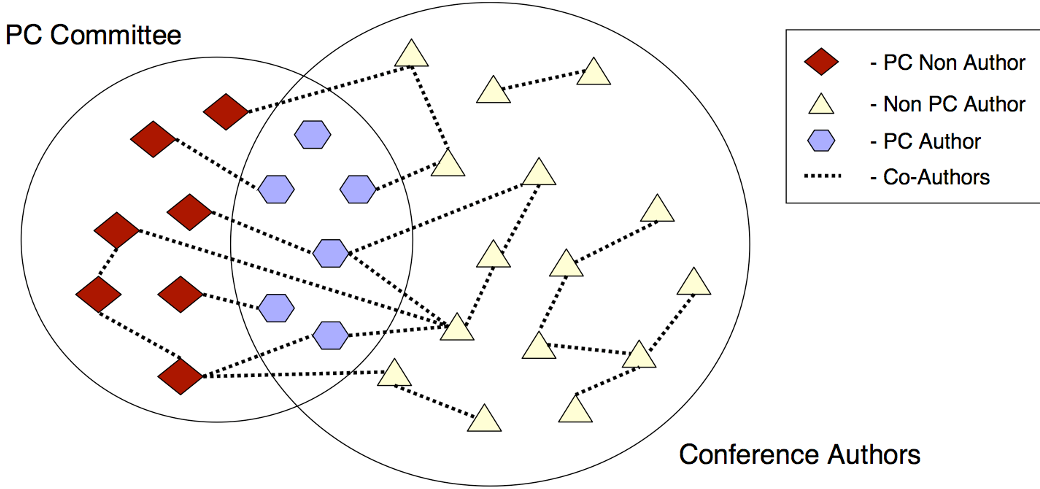 Figure 1: Anatomy of an Academic FEN. PC members (organizers) on the left, authors (participants) on the right, connected by co-authorship ties.
Predictive Power: Capital vs. History
The most striking part of the study is the competition between Publication History (what you did) and Social Capital History (who you were connected to).
The task was to predict which conference a group of authors would publish in. The researchers tested several aggregation methods (Min, Max, Mean, Total) for both history and capital.
Experimental Breakdown
Using a Support Vector Machine (SVM) with a radial basis kernel, the results were telling:
- Total Publication History: 75.6% accuracy.
- Total Social Capital History: 79.2% accuracy.
When aggregating all metrics, Social Capital History (83.4%) consistently outperformed Publication History (82.7%). This suggests that the structural "pull" of a researcher's network is a more robust signal than their individual momentum.
| Feature Set | Accuracy (%) |
|---|---|
| Publication History (PUB) | 82.67 |
| Social Capital History (SChist) | 83.39 |
| Combined (PUB + SC) | 88.70 |
(Source: Compiled from Tables 1 and 2 in the paper)
Why Does This Work? (The Intuition)
Why is capital a better predictor? The authors suggest that participation is rarely an isolated event. Organizers (PC members) often define the "scope" and "culture" of a conference. If you are deeply embedded in the network of current organizers, the "Benefit Given" by those organizers flows more naturally to you. It isn't necessarily about "bias" (though the authors acknowledge that possibility); it's about the flow of information and shared research interests that social ties represent.
Critical Analysis & Future Outlook
While the results are impressive, the study has limitations:
- Sparsity: Predicting if an author will publish at all (participation prediction) proved nearly impossible because the probability is so low.
- Domain Specificity: The model was tested on CS conferences. Would this hold in more "double-blind" or less collaborative fields?
Takeaway for the Future: This framework provides a blueprint for designing better professional systems. By understanding the "Benefit Given" and "Benefit Received" cycles, organizations can build program committees that are more diverse or, conversely, ensure that "Social Capital" doesn't become a barrier to entry for newcomers. In the age of AI and automated networking, quantifying these hidden ties is no longer a luxury—it's a necessity for understanding how industries actually function.