
Social Capital Games: How Individual Greed Shapes Global Social Structures
Social Capital Games as A Framework for Social Structural Pattern Emergence
This paper introduces Social Capital Games (SCG), a novel framework that models the emergence of social structures—such as small-world, community, and core-periphery patterns—as a result of agents maximizing their social capital. By leveraging Multi-Agent Reinforcement Learning (MARL) with Graph Neural Networks (S2V-DQN), the authors demonstrate that diverse structural "norms" emerge from individual strategic link-building.
TL;DR
Why do some networks look like clusters of tight-knit communities, while others have a "core" elite and a "periphery" of outsiders? This paper proposes Social Capital Games (SCG), a framework where agents use Multi-Agent Reinforcement Learning (MARL) to build links. It proves that the global architecture of society is an emergent property of how individuals value two types of "Social Capital": Bonding (trust/support) and Bridging (information/brokerage).
The Motivation: Moving Beyond Randomness
For decades, we’ve explained social networks using models like "Preferential Attachment" (the rich get richer). While effective, these models treat agents as passive nodes following math rules. In reality, humans are strategic; we build ties to gain influence or support.
The authors identified a gap: How can we bridge the gap between individual psychological motives and global network topology? To do this, they turned to "Social Capital"—the tangible and intangible benefits we get from our social circles.
Methodology: Social Capital as a Game
The authors categorize social capital into two mathematical definitions:
- Bonding Capital: Measured by Personalized PageRank. It represents "goodwill" and trust within a closed circle.
- Bridging Capital: Measured by Betweenness Centrality. It represents an agent’s power as a "broker" who connects different parts of the network.
The Learning Architecture
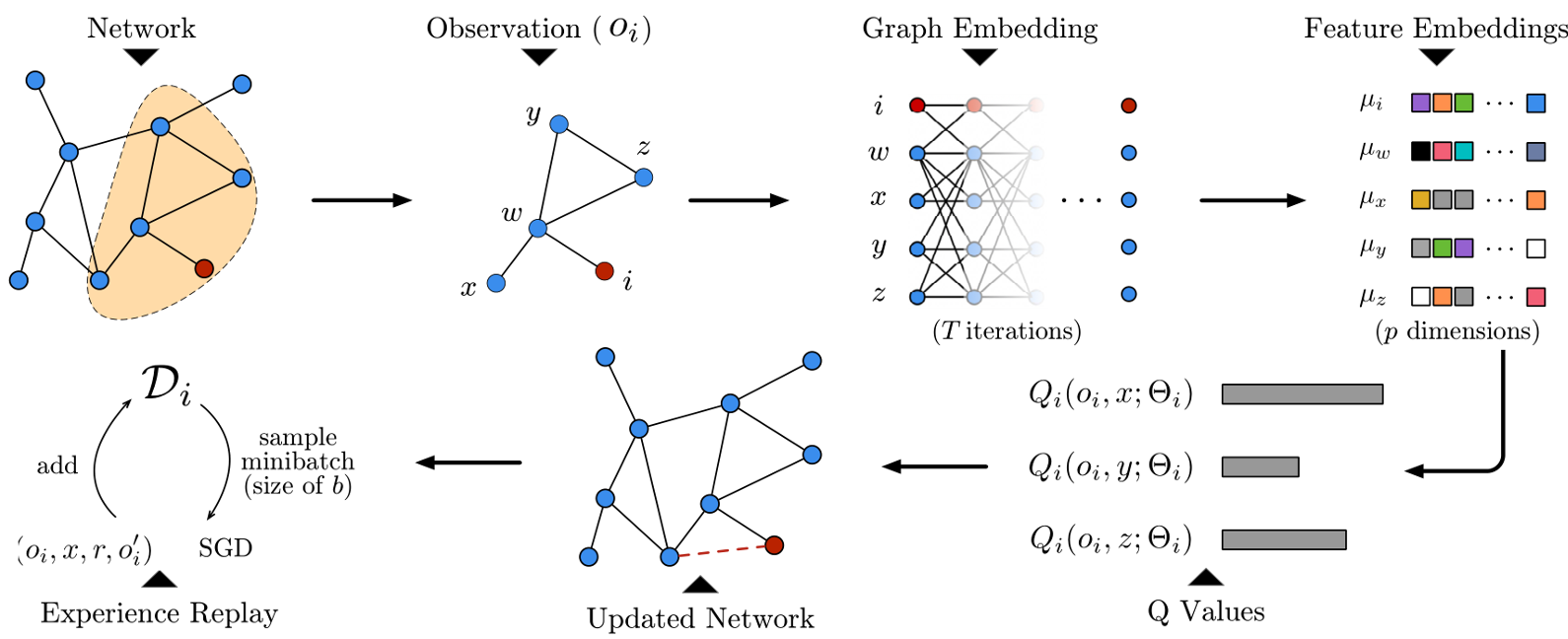
Agents don't have a "God's eye view" of the network. They only see their 2-level ego network (friends and friends-of-friends).
- Graph Embedding (S2V-DQN): Agents use
structure2vecto turn the complex graph around them into a vector (latent features). - MARL: They use Deep Q-Learning to decide which new link will maximize their future social capital.
Experiments: Emergent Patterns
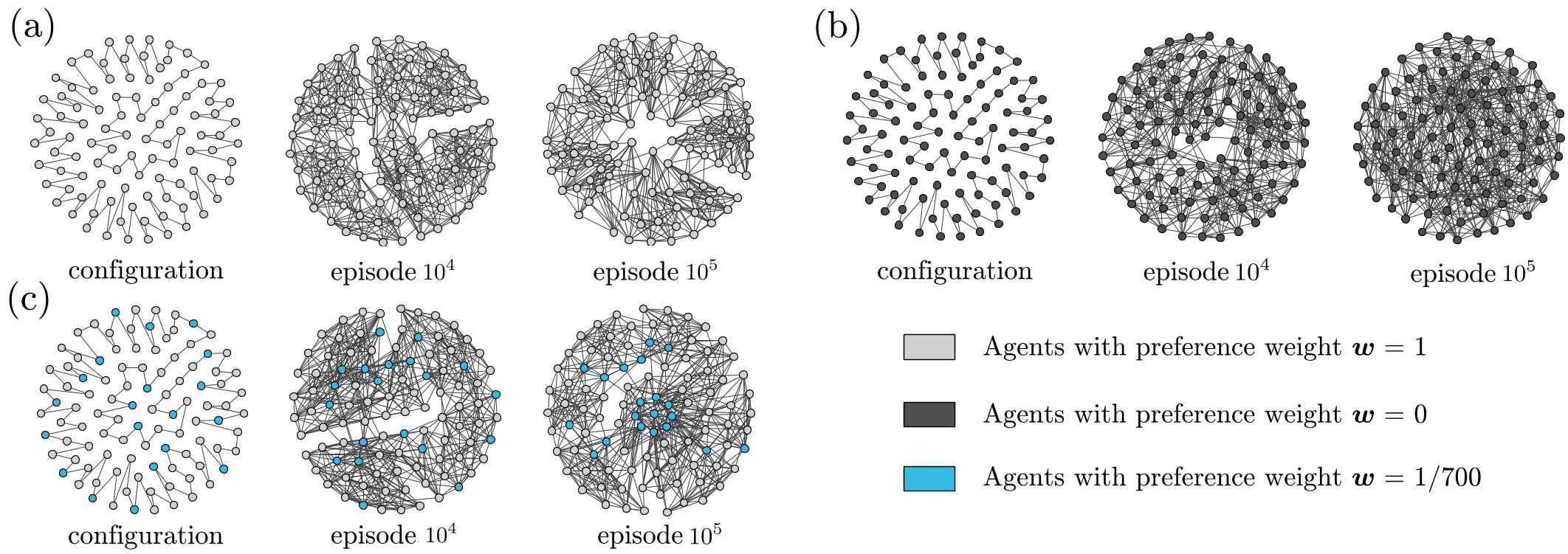
The study initialized 100 agents in a simple ring lattice (no structure) and let them play the game.
1. The Community Emergence
When agents only cared about Bonding Capital, they formed dense clusters. The modularity (a measure of community strength) surpassed random baselines, proving that the need for trust naturally segments society into "silos."
2. The Small-World Emergence
When agents prioritized Bridging Capital, they acted as "anchors" reaching across the network. This resulted in the famous "Small-World" property: high local clustering but incredibly short paths between any two people in the system.
3. The Core-Periphery Mystery
The most complex pattern—Core-Periphery—emerged only when a group of agents had "mixed" preferences. A few "ambitious" agents sought both bridging and bonding, gathering in the center to form a core, while "content" agents (bonding only) stayed at the periphery.
Critical Insights & Takeaway
The genius of this work lies in treating network structure as a norm. Just as we learn social etiquette, our "position" in a network is something we learn to optimize.
Key Insights:
- Local Vision, Global Order: Even with limited information, local optimizations lead to robust global patterns.
- Structural Heterogeneity: Core-periphery structures are the direct result of "preference polarization" in a population.
Limitations: Currently, the model only allows link addition. In the real world, we also break ties (edge removal). Adding "link decay" or "divorce" mechanisms would be the next step to simulate truly volatile social environments.
Final Takeaway
This research provides a unified computational bridge between sociology and AI. It suggests that if you want to change the "shape" of an organization or a digital community, you don't change the people—you change the reward structure of the social capital they seek.