
Escape from the Safety Net: Why Social Capital Can Be a Mobility Trap for the Unemployed
The role of social capital in the job-related regional mobility decisions of unemployed individuals
The study examines how social capital influences the interregional mobility decisions of unemployed vs. employed individuals using a Factorial Survey Module (FSM) within the German PASS panel study. It focuses on the "inhibiting" and "normative" roles of social networks after a job offer is received, moving beyond the traditional focus on job-finding.
TL;DR
Is a strong social network always a blessing? While social capital helps the unemployed survive joblessness, it often acts as an anchor that prevents them from moving for better work. Using a sophisticated experimental design in Germany, researchers Sebastian Bähr and Martin Abraham reveal that social conflict is actually a stronger driver of relocation than economic incentives for the long-term unemployed.
The "Mobility Trap" Paradox
In classical economics, the unemployed should be the most mobile group—they have the least to lose and the most to gain from a fresh start. However, empirical data often shows they are stubbornly local.
The authors argue that this is due to Social Capital. Unlike human capital (what you know), social capital (who you know) is often locally bound. For someone without a paycheck, friends and family provide "informal insurance"—emotional support, small loans, and childcare. Moving 400 miles away means liquidated this "insurance policy" exactly when you feel most vulnerable.
Methodology: High-Precision Experiments
The researchers utilized a Factorial Survey Module (FSM). Unlike traditional surveys that ask "Would you move?", this method presents respondents with 5 randomized "vignettes"—detailed scenarios of job offers with varying salaries, distances, and contract types.
The Double Hurdle Approach
To analyze the data, the authors used a Double Hurdle Model. This accounts for the fact that a "zero" response (unwilling to move) often represents a fundamental refusal to consider mobility, whereas a non-zero response reflects a nuanced cost-benefit negotiation.
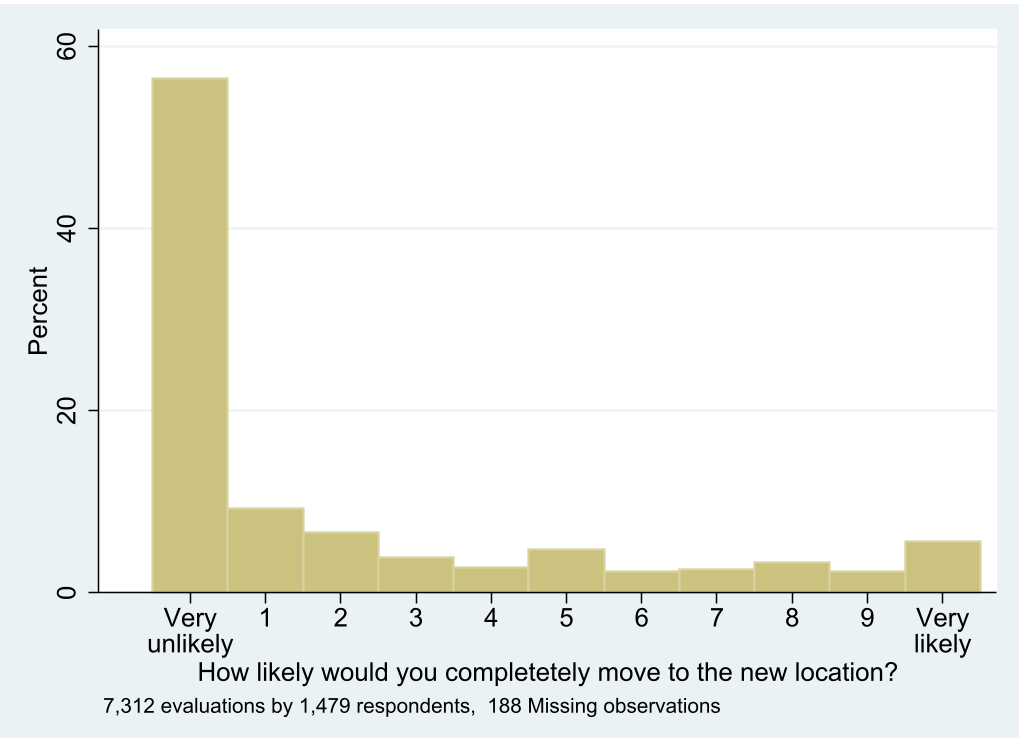 Figure 1: Distribution of willingness to relocate, showing the high concentration of "zero" responses characterizing the first hurdle.
Key Findings: The Mobilizing Power of Conflict
The study’s most striking insight isn't about the amount of social capital, but its nature.
- Conflict as a Catalyst: For the unemployed, high levels of conflict within the household or social network significantly increased the willingness to relocate. In this context, moving isn't just about a job; it’s an escape from a restrictive or negative environment.
- Duration Matters: Those unemployed for more than 48 months were the most sensitive to social factors. For this group, the local social context had become a "lock-in" environment.
- Income is Still King: Across all groups, the percentage increase in household income remained the strongest predictor of passing the "second hurdle" of specific job acceptance.
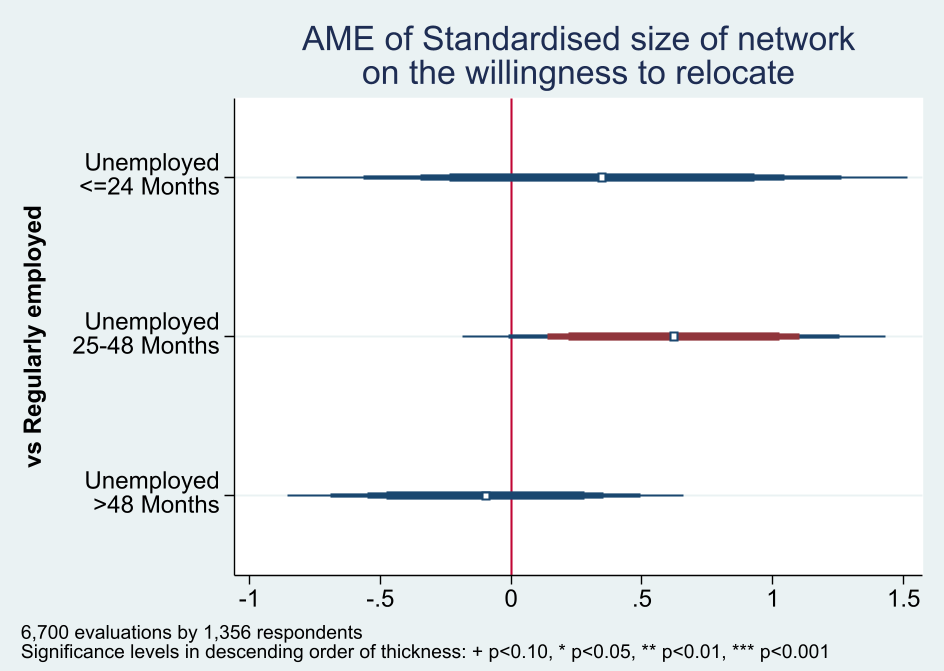 Figure 2: Marginal effects showing how conflict with the network (h2c) and household (h2d) significantly impacts different unemployment duration groups.
Critical Insight: Quality Over Quantity
Surprisingly, the size of a person's network had almost no impact on their decision to move. What mattered was the utility of those ties. If the network was primarily composed of other unemployed individuals, it created a "downward leveling norm"—a social environment that subtly discouraged "ambitious" deviant behavior like moving away for a better life.
Conclusion and Policy Implications
For employment agencies, this research provides a vital "reality check." Financial relocation subsidies might fail if the individual’s social safety net is too comfortable or if they feel socially obligated to stay.
However, the study also identifies a "window of opportunity": during periods of social friction or household transition, the unemployed are far more receptive to interregional job offers. Timing, it seems, is just as important as the salary on the table.
Limitations: The study assumes that social resources are local. If an individual has a dispersed network (e.g., friends in other cities), the "anchor" effect might be weaker.