
Social Capital vs. Economic Power: Who Really Helps Young Adults Leave the Nest?
Social capital and leaving the nest: Channels and housing tenures
This study investigates the impact of individual social capital and parental economic resources on the "nest-leaving" process of young adults in Sweden. Using a two-wave panel survey, the author demonstrates that while extensive social networks (social capital) significantly accelerate moving out, parental income primarily influences the specific housing tenure—steering offspring toward home ownership rather than facilitating the initial move.
TL;DR
In the quest for independence, is it who you know or how much your parents make that matters? A deep dive into Swedish longitudinal data reveals a surprising dichotomy: Social capital (your network) is the engine that gets you out the door, typically into informal rentals. Parental wealth, however, doesn't necessarily speed up the move—it just ensures that when you do leave, you move into a home you own.
The "Feathered Nest" Paradox
Leaving the parental home is a hallmark of adulthood, yet in many European cities, the "nest" is becoming increasingly sticky. We've long known that wealthy parents can provide a safety net, but researchers have debated the "Feathered Nest" hypothesis: Does high parental income make the home so comfortable that children stay longer? Or does it provide the "Gilded Cage" necessary to buy into expensive markets?
The author of this study, Anton B. Andersson, identifies a critical gap: Most studies overlook Social Capital—the resources embedded in our networks—as a distinct force from economic capital. In a market like Sweden, defined by rent control and a shortage of "first-hand" (formal) rental contracts, the informal "second-hand" market becomes the primary frontier for young adults.
Methodology: Measuring the Invisible Network
To quantify social capital, the study uses a Position Generator. Instead of just asking "how many friends do you have?", it asks if respondents know people in specific occupations (e.g., lawyers, mechanics, students). The more diverse your network, the higher your social capital.
This is then mapped against:
- Nest-leaving status (Living with parents vs. independent).
- Housing Tenure (First-hand rental, second-hand rental, or owned).
- Channel (Housing list vs. tips via contacts).
The Core Findings: Networks as Market Lubricants
1. Social Capital Accelerates the Move
The data shows that higher social capital is directly linked to an increased likelihood of moving out by age 22. Why? Because individuals with wider networks are more likely to hear about available "second-hand" rentals. In these informal agreements, transaction costs are high and trust is low; a personal referral acts as a "de-risking" mechanism for the landlord.
 Table 3: Note how "Tips via contacts" account for a staggering 61.3% of second-hand rental agreements.
2. Parental Income Changes the Destination, Not the Speed
Surprisingly, parental income had a null effect on the timing of nest-leaving. Having rich parents didn't make kids move out faster. What it did change was the type of home. High parental income shifted children away from the "rental lottery" and directly into home ownership.
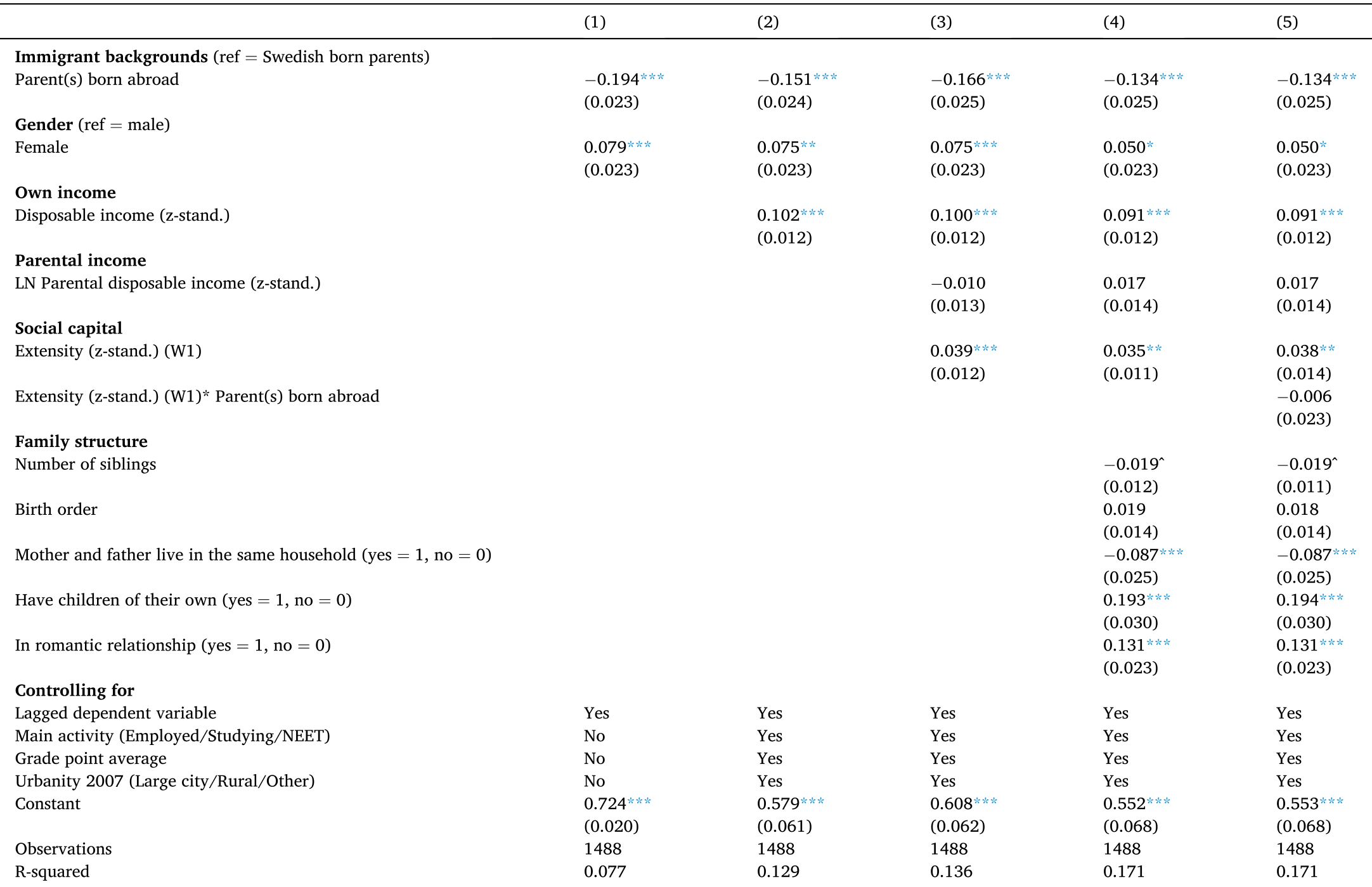 Table 4: Model 3 shows that while Social Capital (Extensity) is significant (p<0.001), Parental Income is statistically insignificant for the act of nest-leaving itself.
The Immigrant Disadvantage
The study also highlights a sober reality for the children of immigrants. Despite often having higher social capital in terms of network diversity (due to larger peer groups or transnational ties), they are significantly more likely to still live with their parents.
Curiously, this "lag" isn't due to a lack of social capital, but rather a lower usage of contacts to find housing. This suggests that even when immigrants have the "connections," informal channels may still be subject to landlord bias or discrimination, making formal channels (like waiting lists) more reliable but much slower.
Critical Insight: The Institutional Context
The study proves that the value of social capital is context-dependent.
- In a deregulated market, cash is king.
- In a regulated market (like Sweden), where you can't simply "outbid" someone for a rent-controlled apartment, "who you know" becomes the primary currency.
Conclusion
This research reframes the housing crisis from a purely economic problem to a sociological one. If we want to help young adults gain independence, we cannot only look at mortgage subsidies; we must look at the transparency of rental markets. As long as housing remains a "who-you-know" game, those with smaller or less influential networks will remain trapped in the nest, regardless of their individual merit or income.