
Social Capital in OSNs: Quantifying Influence Through Activity and Topology
Social Capital in Online Social Networks
The paper introduces a formal computational framework for quantifying "Social Capital" in online social networks (OSNs). It proposes a multi-dimensional metric integrating static profile attributes, dynamic user activities, and a recursive social position algorithm similar to PageRank to assess individual influence.
TL;DR
This research moves the sociological concept of "Social Capital" from abstract theory to mathematical reality. By proposing a composite metric that balances static user profiles with dynamic interaction data and a PageRank-inspired social position, the authors provide a framework for measuring—and stimulating—the value of individuals within virtual communities.
Context: Beyond the "Six Degrees of Separation"
Since Stanley Milgram’s small-world experiments, we have known that social networks are powerful structures. However, in the realm of Online Social Networks (OSNs), we lack a standardized way to measure an individual's "worth" or influence. While traditional sociology (Putnam, Coleman) defines social capital by its function—facilitating cooperation—this paper seeks a quantitative definition that can be integrated into Data Mining and Recommendation Systems.
The Problem: The Intangibility of Virtual Ties
Prior models of social networks often treated relationships as binary (either you are connected or you aren't). This fails to capture:
- Strength of Relationship: Not all "friends" are equal; frequency and type of communication matter.
- Static Potential: A user’s background (languages, education, interests) provides an "inductive bias" for their potential to bridge groups.
- Recursive Status: Being connected to a high-influence person should yield more capital than being connected to a peripheral user.
Methodology: The SK(x) Framework
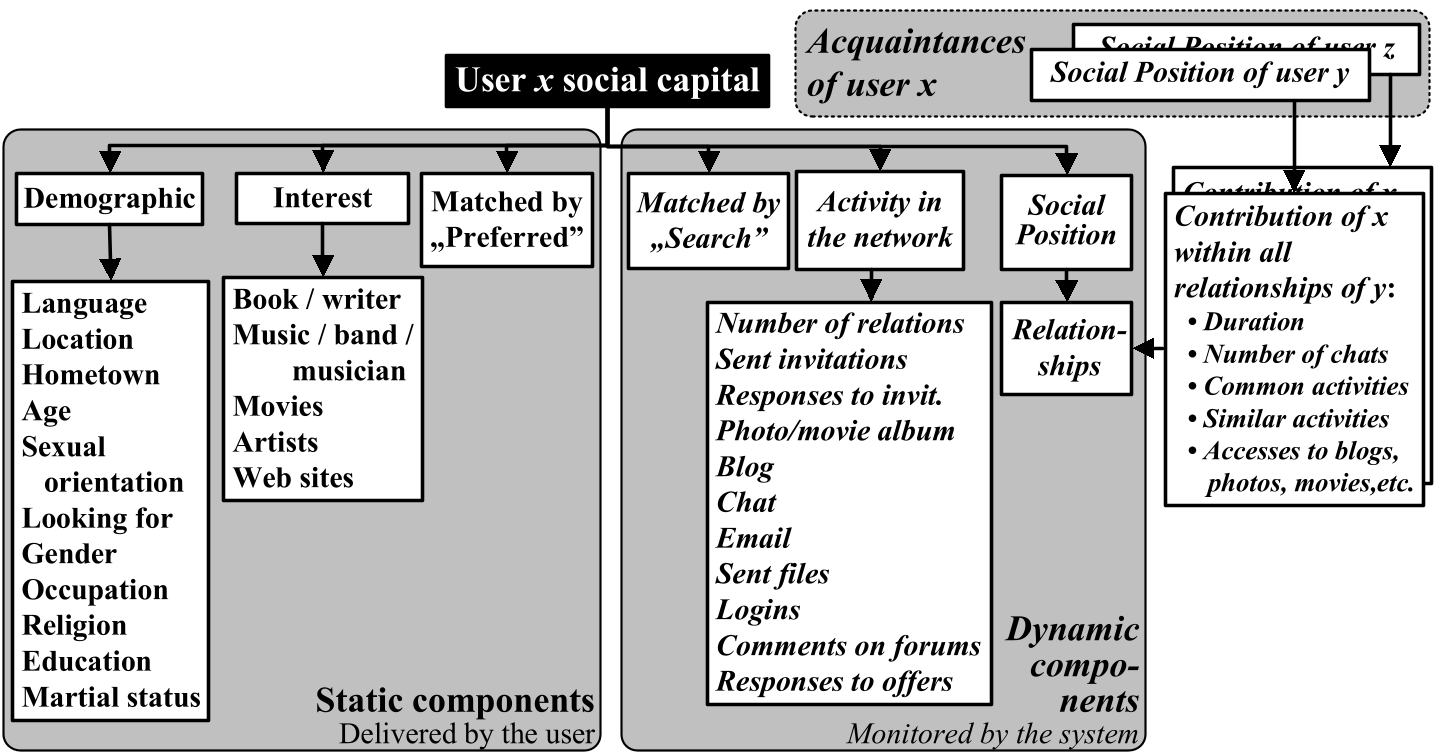
The authors propose that Social Capital () is the sum of four weighted components:
1. The Dual-Core Model
The capital is split into Static () and Dynamic components. While static data (like location or education) acts as the foundation, the dynamic side focuses on "Activity" and "Social Position."
2. Activity Component ()
This measures the relative frequency of a user’s actions (blog updates, comments, invitations) compared to the most active members. It effectively normalizes behavior across the network.
3. The Social Position Engine (Iterative Inheritance)
The most sophisticated part of the model is the Social Position (). Borrowing the logic of Google’s PageRank, it suggests that your status is a reflection of your acquaintances' status, weighted by their "contribution" to you.
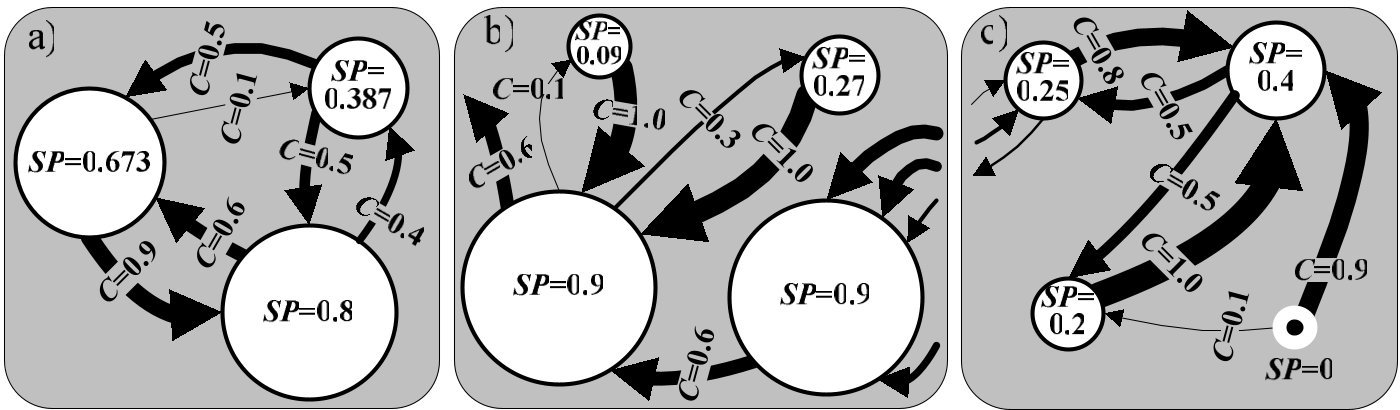
As shown in the figure, a high Social Position can be achieved in two ways:
- Having a large volume of medium-status acquaintances.
- Having a few "authoritative" friends who dedicate a significant portion of their interaction budget to you.
Experiments & Predictive Potential
The paper positions this model as a precursor to "Human Sensitive" information systems. By calculating , platforms can:
- Identify Clustering: Use Association Rules to find groups with similar capital levels.
- Stimulate Growth: Use recommendation engines to suggest "bridging" or "bonding" ties that maximize the total social capital of the community.
- Predict Churn: Since capital is depleted by silence, a drop in can serve as an early warning for user disengagement.
Critical Insight & Conclusion
The brilliance of this work lies in the Contribution Function . It recognizes that if a high-status person talks to 100 people, their "endorsement" of you is diluted. If they talk only to you, their full social weight reinforces your position.
Limitations & Future Work
While the framework is robust, the computational cost of iterative calculations on millions of nodes was a looming challenge at the time of writing. The authors suggest that future applications in Multi-Agent Systems (MAS) and more sophisticated recommendation frameworks will be the next frontier for this social calculus.
Takeaway: In the digital economy, your Social Capital is a dynamic currency—earned through consistent activity and high-quality associations, and lost through digital silence.