
Social Capital Beyond the Graph: Why Identity Bonds are the Missing Link in SNA
Social capital, social network and identity bonds: a reconceptualization
This paper proposes a reconceptualization of social capital by introducing the "Identity Bonding" perspective as a necessary complement to traditional Social Network Analysis (SNA). It argues that collective identity, rather than just interpersonal ties, acts as a primary driver for resource exchange and the formation of social networks in both physical and virtual communities.
TL;DR
While Social Network Analysis (SNA) treats social capital as a "piping" problem—focusing on the ties and nodes—this paper argues that the "water" (social capital) often flows without pipes through Identity Bonds. By integrating Social Identity Theory, the authors explain how shared identity allows strangers to collaborate and suggests that our current digital tools might be building massive networks that are, ironically, bankrupt in social capital.
The Problem: The Egocentric Trap of Social Networks
For decades, researchers have analyzed social capital through the lens of Social Network Analysis (SNA). In this view, your "capital" is the sum of your connections. We categorize these into:
- Strong Ties: Close friends/family (Bonding Capital).
- Weak Ties: Acquaintances/strangers (Bridging Capital).
However, authors Hao Jiang and John M. Carroll point out a critical flaw: SNA takes ties for granted. It assumes that for resources to move, a tie must already exist. This "egocentric lens" fails to explain why people help strangers on an online forum or donate to disaster relief—situations where no interpersonal "tie" exists. Furthermore, empirical data shows that having many "external ties" (bridging) doesn't always lead to the expected social benefits, suggesting that the network graph isn't the whole story.
Methodology: Reintroducing the 'Social System'
The paper bridges two diverging lines of sociological thought:
- The Social-Network Approach: Focuses on network topology, density, and centrality (the "Structural" view).
- The Social-System Approach: Focuses on norms, trust, and the mechanisms of collective action.
The authors introduce Identity Bonds—a concept rooted in Social Identity Theory (SIT). Unlike an interpersonal tie (which requires I know you), an identity bond only requires that we both perceive a shared commonality (e.g., being "alumni," "coders," or "parents").
The Conceptual Framework
The authors propose a sequential logic that moves beyond the static graph:
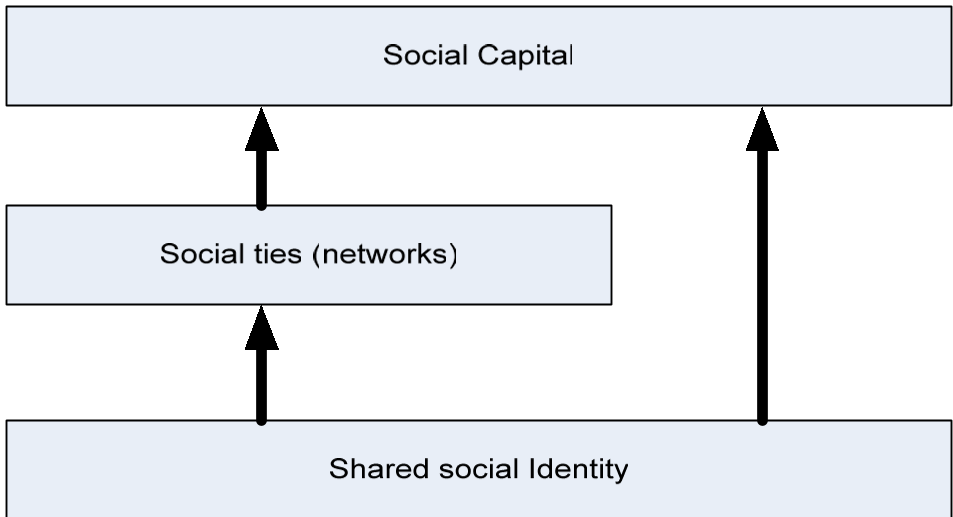
- Identities precede Ties: You don't just happen to have a network; you build ties because of a perceived shared identity or interdependent interest.
- Non-Tie Social Capital: Identity bonds allow for "Social Capital" to exist in the absence of a direct link. This explains the efficiency of "Communities of Practice."
Why This Explains the "Internet Paradox"
The paper offers a profound critique of modern Information Technology (KM systems, social media). In the early days of the internet, researchers noticed a paradox: people were more "connected" than ever but reported feeling more alienated (the "Rich get Richer" model).
The authors' insight is sharp: Information Technology is excellent at scaling Social Ties (hard-wiring people based on algorithms), but it is often terrible at fostering Identity Bonds. When we are connected to "friends of friends" without a shared cognitive ground, the social network grows, but the social capital (trust, reciprocity, norms) remains low.
Deep Insight: Limits and Future Work
The value of this reconceptualization lies in its challenge to the "connectivity for connectivity's sake" Silicon Valley mantra.
- Limitation: The paper is primarily theoretical/conceptual. It lacks a quantitative metric for measuring "Identity Bond Strength" in a way that rivals the mathematical elegance of SNA's centrality metrics.
- Future Outlook: The authors suggest we need "engineered communities" that don't just draw lines between people but actively invoke situational identities.
Conclusion: Takeaway for Tech Architects
Social capital is not just a structural property of a graph; it is a cognitive state of a collective. If you are building a Knowledge Management system or a social platform, stop looking at the "follower count" (the ties) and start looking at the "shared symbols" (the identity). As Jiang and Carroll conclude, identity is the "genetic" source of the network—without it, the pipes are empty.