
Beyond Digital Silos: How Social Capital and Co-Creation Power Cross-Hospital EMR Exchange
Social capital and transaction cost on co-creating IT value towards inter-organizational EMR exchange
This study develops a theoretical model combining Social Capital Theory (SCT) and Transaction Cost Theory (TCT) to evaluate the adoption of inter-organizational Electronic Medical Record (EMR) exchange systems. By analyzing 330 medical staff responses in Taiwan, it identifies how social ties and asset investment drive "value co-creation," ultimately achieving SOTA-level integrated performance across hospitals and clinics.
Executive Summary
TL;DR: This research tackles the persistent "silo" problem in healthcare by proving that the success of Electronic Medical Record (EMR) exchange depends less on the technology itself and more on the Social Capital and Value Co-Creation between institutions. Using a hybrid model of Social Capital Theory (SCT) and Transaction Cost Theory (TCT), the study demonstrates that when hospitals invest in shared relationships, they unlock "Joint Performance" that benefits patients and staff alike.
Academic Positioning: This work moves the discourse from "internal value creation" to "external value co-creation," establishing a SOTA framework for understanding inter-organizational IT value in the healthcare sector.
The Friction of Digital Transition: Problem & Motivation
Why do clinics and hospitals fail to share data even when the technology exists? The authors identify a critical gap: Prior research focuses on the "What" (benefits of EMR) rather than the "How" (the cost and social dynamics of exchange).
The hurdles are two-fold:
- Transaction Costs: High search, monitoring, and adaptation costs act as a deterrent.
- Asset Specificity: Current systems are often "relation-specific," meaning they don't play well with others without significant reinvestment.
Methodology: The Co-Creation Engine
The core insight of this paper is the Co-Creating IT Value construct. It categorizes IT value into four layers:
- Asset Layer: Shared hardware/software.
- Knowledge Sharing Layer: Exchange of clinical expertise.
- Complementary Capability Layer: Rerouting patients to the best-suited facility.
- Governance Layer: Control mechanisms that incentivize cooperation.
Conceptual Framework
The researchers tested how SCT (Social Ties, Reciprocity, Shared Vision) and TCT (Uncertainty, Asset Specificity) influence the willingness to invest in these layers.
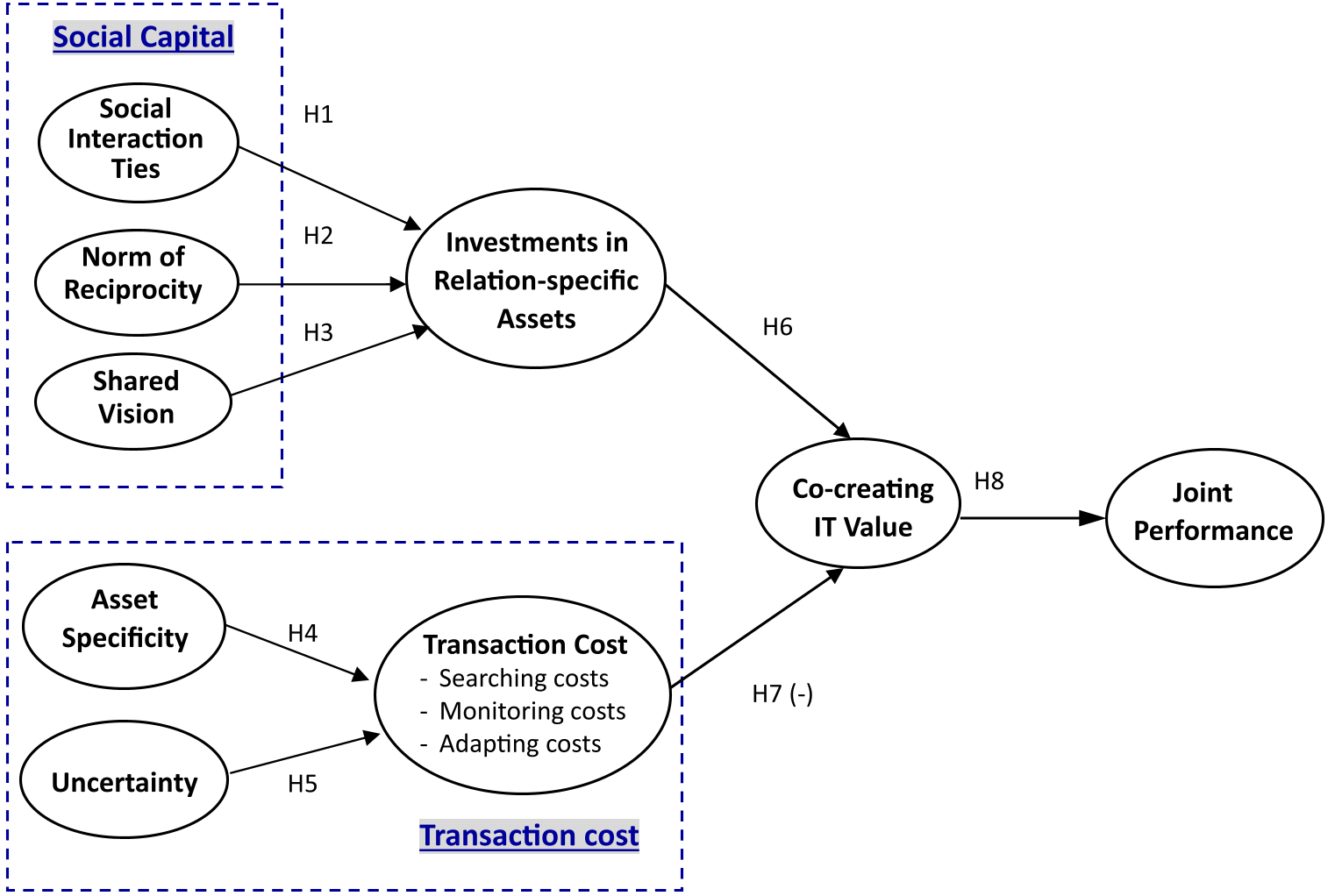 Figure 1: The hypothesized pathways from Social Capital and Transaction Costs to Joint Performance.
Experiments & Results: The Power of Relationships
Through a rigorous SEM (Structural Equation Modeling) analysis of 330 valid medical staff samples, the study revealed:
- Social Interaction Wins: Intensive communication frequency among members in different institutes significantly drives the willingness to invest in exchange technology (H1 supported, β=0.330).
- The Transaction Cost Paradox: Interestingly, transaction costs actually showed a positive relationship with co-created value (H7 result). The authors suggest that over time, the effort spent "searching and monitoring" transforms into institutional "capital" and deeper system understanding.
- Performance Impact: The path from Co-Created IT Value to Joint Performance was the strongest (β=0.820), indicating that the payoff for collaboration is exponential.
 Table 1: Summary of Path Coefficients and Significance.
Critical Insight & Conclusion
The "Social" in Digital Health
The most striking takeaway is that Norm of Reciprocity was not a significant driver (H2 rejected). In the medical world, reciprocity is considered an "inherent professional duty" rather than a variable incentive. Therefore, managers should focus on Shared Vision—aligning on patient-oriented care—to drive adoption.
Limitations & Future Work
The study is primarily localized to the Taiwanese healthcare system and relies on cross-sectional data. Future research should look at longitudinal effects: Does the "Transaction Cost" burden truly decrease as co-creation matures?
Conclusion: To achieve true interoperability, we must look beyond the database. We must build "Social Interaction Ties" among the humans who operate them.