
Leveraging Social Centrality: A New Paradigm for 5G D2D Multicast Efficiency
A Social Centrality-Aware D2D Multicast Scheme for Content Dissemination
The paper proposes a social-aware Device-to-Device (D2D) multicast scheme for efficient content dissemination in 5G networks. It introduces a multi-dimensional centrality metric and utilizes the Kuhn-Munkres (KM) algorithm for optimal resource allocation, achieving a 69.4% reduction in dissemination time compared to traditional D2D methods.
TL;DR
This research introduces a social-aware D2D multicast framework that uses Multi-dimensional Centrality to select cluster heads and the Kuhn-Munkres (KM) algorithm for resource allocation. By aligning network topology with social infrastructure, it achieves up to a 69.4% improvement in content dissemination speed.
Background & Motivation: Why "Social" Matters in 5G
As we move toward 5G and 6G, Device-to-Device (D2D) communication is the cornerstone of spectral efficiency. However, most existing D2D models treat devices as purely physical entities. In reality, devices are carried by humans with social ties.
The authors identify a critical gap: traditional resource allocation fails because it ignores link stability (based on trust) and node influence (centrality). If a node is physically close but socially disconnected, the "willingness" to share data is low, leading to inefficient or failed transmissions.
Methodology: The Core Innovations
1. Multi-dimensional Centrality ()
The paper moves beyond simple degree centrality. It measures a user's importance based on:
- Physical-Social Matrix (): Combines physical reachability with social closeness coefficients ().
- Content Possession: It prioritizes nodes that don't have the content but have high relay potential, or nodes that do have it and can reach many "content-hungry" neighbors.
The central formula defines this "relaying benefit":

2. Optimal Channel Matching via KM Algorithm
Resource allocation is modeled as a Bipartite Graph Matching problem. Multicast clusters and available channels are the two sets of vertices. The weight of the edges represents the total multicast rate.
- In-band Reuse: D2D clusters reuse uplink resources of cellular users.
- Optimization: The Kuhn-Munkres (KM) algorithm is applied to solve the matching in time, ensuring that the total system throughput is maximized while respecting the bottleneck (the user with the worst channel in a multicast group).
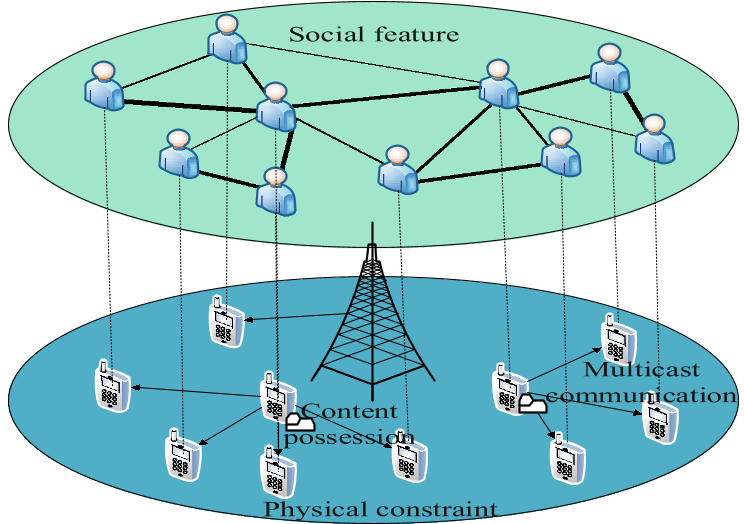 Fig 1: System model showing D2D multicast clusters underlaying a macrocell.
Experimental Validation
The authors simulated a macrocell with 1,000 users. The results highlight two key observations:
- Early-Stage Dominance: Multicast is exponentially faster than point-to-point D2D in the first 20-30 seconds of content dissemination.
- Social Factor: The "Social-Aware" version consistently outperforms the "Social-Unaware" version because it picks "influential" cluster heads that provide more stable links.
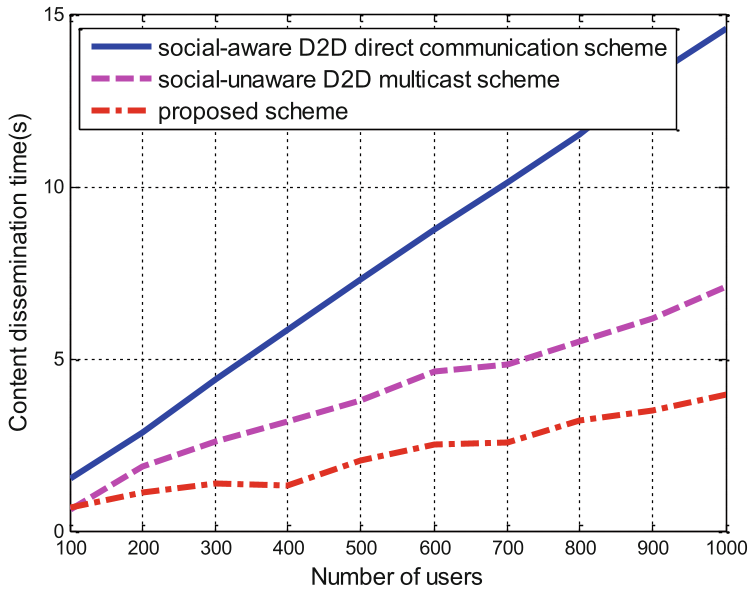 Fig 2: Comparison of content dissemination efficiency. The proposed scheme (solid line) saturates the user base significantly faster.
Critical Insight & Future Outlook
The brilliance of this work lies in the synergy between social network analysis and graph-based optimization. While many papers focus solely on physical SINR (Signal-to-Interference-plus-Noise Ratio), this scheme recognizes that a "stable" link is a social construct as much as a physical one.
Limitations: The current model assumes a static social matrix. Future work should address temporal social dynamics—how relationships and physical proximity change as users move throughout the day.
Conclusion
By integrating multi-dimensional centrality into the D2D multicast pipeline, this scheme provides a robust blueprint for 5G content delivery. Achieving nearly a 70% reduction in delivery time is not just a theoretical win; it's a massive leap for real-world application performance in crowded urban environments.