
Social-Chain: Redefining Trust via Blockchain in Pervasive Social Networking
1139_Social-Chain Decentralized Trust Evaluation Based on Blockchain in Pervasive Social Networking.
This paper introduces Social-Chain, a decentralized trust evaluation system for Pervasive Social Networking (PSN) using a novel blockchain framework. It features a lightweight consensus mechanism called Proof-of-Trust (PoT) that eliminates resource-intensive mining, achieving state-of-the-art efficiency on mobile devices.
TL;DR
Social-Chain is a decentralized framework designed for the "Pervasive Social Networking" (PSN) era—where strangers and acquaintances interact instantly via mobile devices. By replacing energy-hungry Proof-of-Work with a Proof-of-Trust (PoT) mechanism, it enables efficient trust evaluation on resource-constrained Android devices while securing the network against Sybil and bad-mouthing attacks.
Context Architecture: This work is a pivotal shift from permissioned clusters to open decentralized trust, setting a benchmark for mobile-native blockchain applications.
The Problem: The "Centralized" Bottleneck in a Decoupled World
Pervasive Social Networking (PSN) is everywhere—from urgent aids in disasters to instant data sharing in a neighborhood. However, evaluating if "Stranger A" is trustworthy currently requires a central server (like eBay or LinkedIn). In PSN, these servers are often unavailable or lack the necessary context.
Existing blockchains don't help much either:
- PoW (Bitcoin): Kills mobile batteries instantly.
- PoS (Ethereum): Incentivizes the "rich get richer" and relies on cryptocurrency which PSN might not use.
- PBFT: Communication overhead explodes as the number of users grows.
Methodology: The Core of Social-Chain
The authors suggest a brilliant intuition: If the purpose of the network is to build trust, let the trust itself drive the network.
1. Proof-of-Trust (PoT) Consensus
Unlike Bitcoin, where you mine by guessing numbers, in Social-Chain, you "mine" by collecting evidence of successful social interactions (Trust Evidence - TE).
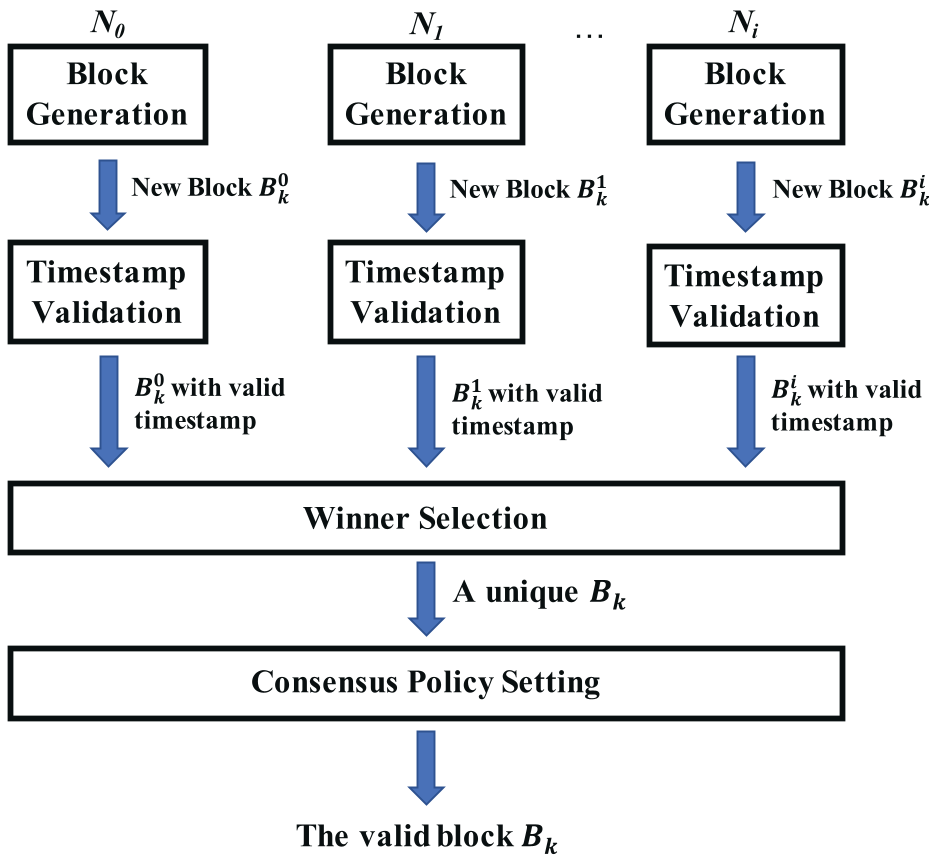
2. The Four Pillars of PoT:
- Block Generation: A block is ready when the volume of new trust evidence reaches a threshold ().
- Timestamp Validation: Uses a Verifiable Random Function (VRF) to pick a random "jury" of miners to certify that the block's time isn't faked.
- Mining Winner Selection: If two people finish at once, the one with the higher Social Trust or the earlier timestamp wins. This effectively kills "forking."
- Consensus Policy: Dynamic thresholds (ThrM and ThrT) ensure that the more reputable the voters, the fewer of them are needed to confirm a block.
3. Fighting "Bad-Mouthing"
The system uses a unique trust evaluation formula that factors in deviation. If a malicious node gives a rating that wildly differs from the community average, its "weight" is automatically slashed.
Experimental Evidence: Real-world Feasibility
The researchers didn't just write math; they built it for Windows and Android.
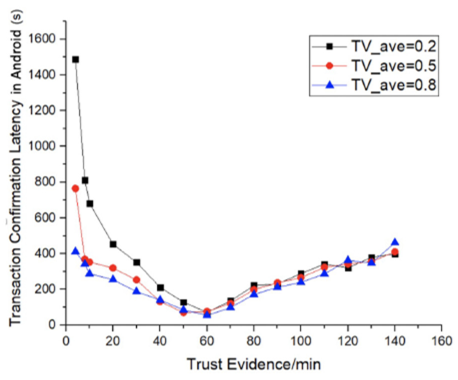
Key Findings:
- Resource Efficiency: On Android, the system uses only 140MB of RAM—less than most modern social media apps.
- Fork Resilience: Through the "earliest-timestamp + highest-trust" rule, the system maintains high consistency without the 10-minute wait time of Bitcoin.
- Security: Even if an adversary controls the highest-trust nodes (the worst-case scenario), the system maintains 36% fault tolerance. In a normal distribution of trust, this number is significantly higher.
Critical Analysis: Why This Matters
The most profound contribution of Social-Chain is its decentralization guarantee. By using a "Sequence Window" (), the protocol prevents a powerful node from dominating the chain. If you created one of the last blocks, you are ineligible to create the next one. This "cool-down" period ensures the network stays democratic.
Limitations:
- Throughput: At 1 evidence per second, it is not yet ready for global-scale "Visa-level" transaction volumes.
- Privacy: While it uses pseudonyms, the metadata of who interacts with whom is visible on the ledger—a potential concern for high-privacy social contexts.
Conclusion
Social-Chain successfully navigates the "Blockchain Trilemma" (Security, Decentralization, Scalability) specifically for the social mobile niche. By integrating trust evaluation into the heartbeat of the consensus mechanism, it creates a self-reinforcing loop where being an honest social actor is the only way to gain power in the network.
Takeaway: Future decentralized apps (DApps) should look at Social-Chain as a blueprint for "Utility-based Mining," where the protocol rewards the specific value the network provides (Trust) rather than wasted CPU cycles.