
Unified Structural and Attribute Similarity: Boosting Social Circle Discovery
Social Circles Discovery Based on Structural and Attribute Similarities
This paper proposes a modified Clique Percolation Method (CPM) to automatically discover social circles in ego networks. By integrating structural connectivity and node attribute similarities, the method enhances community detection accuracy and outperforms the traditional CPM algorithm on real-world Facebook datasets.
TL;DR
Managing burgeoning social networks manually is a daunting task. This paper presents a Modified Clique Percolation Method (CPM) that bridges the gap between raw network topology and user profile data. By loosening the strict requirements for merging social cliques and augmenting graphs with "Attribute Edges," the authors achieve a significantly higher F1-score in identifying ground-truth social circles on platforms like Facebook.
Context: Why Ego Networks are Tricky
An "ego network" consists of a focal node (the ego) and its immediate neighbors (the alters). Identifying social circles within this local view is an "overlapping community detection" problem.
Existing methods often fail because:
- Topology-only methods might group "Family" and "Work" friends together if they happen to know each other, ignoring their distinct roles.
- Attribute-only methods create loose clusters of people who go to the same university but don't actually interact.
- Original CPM is "too brittle"—it requires triangles to share an entire edge (two nodes) to be considered part of the same circle, often splitting a single friend group into multiple pieces.
The Core Innovation: Two-Fold Improvement
The authors argue that social ties are defined by both who you know and who you are. Their solution involves two primary modifications to the classical CPM pipeline.
1. Relaxed Merging Condition
In standard CPM (), two cliques (triangles) must share nodes to merge. The authors point out a "universal phenomenon" where social groups are often linked by "hub" nodes. By allowing cliques to merge if they share only one node, the algorithm prevents the artificial fragmentation of groups like "high school friends."
2. The Extended Graph (Attribute Edges)
Perhaps the most insightful part of the paper is the concept of Graph Augmentation. If two users share common attributes (e.g., same hometown, same major), an "attribute edge" (a dotted line in the diagram below) is added.
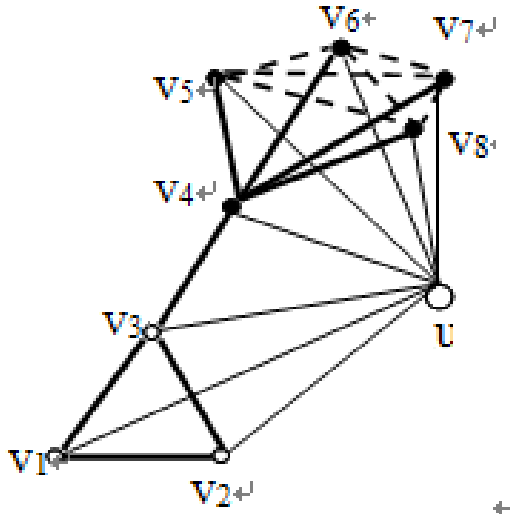 Figure: The extended graph integrates solid physical edges with dotted attribute edges to reveal hidden clusters.
This transforms the sparse structural graph into a dense, feature-rich graph where cliques can form even among friends who haven't "friended" each other yet but belong to the same social fabric.
Methodology in a Nutshell
The workflow follows these steps:
- Augmentation: Add edges between nodes where Attribute Similarity .
- Clique Finding: Detect all maximal complete subgraphs (cliques) of size .
- Clique Merging: Construct a "Clique Graph" where an edge exists if two cliques share node.
- Final Output: Connected components in the clique graph represent the identified social circles.
Experimental Results
The authors validated their approach using the Stanford Facebook dataset, comparing the F1-scores of three configurations:
- Standard CPM.
- Relaxed Merging (1-node overlap).
- Relaxed Merging + Attribute Edges.
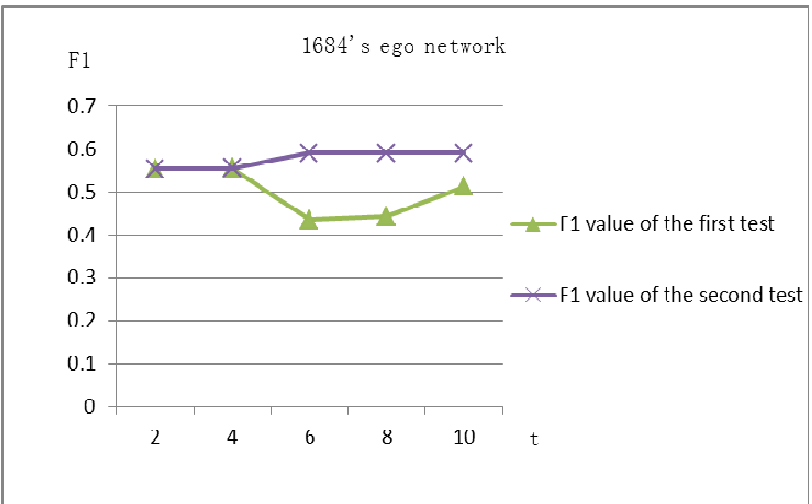 Figure: Comparison across different ego-networks shows the Modified CPM consistently yields higher F1 scores.
The results indicate that the "Hybrid" approach (Test 3) is superior. Furthermore, the sensitivity analysis of the parameter shows that as increases (requiring more shared attributes), the F1-score stabilizes, suggesting that even a small amount of attribute overlap provides significant structural signal.
Critical Insight & Conclusion
The brilliance of this work lies in its simplicity. Instead of building complex probabilistic graphical models, it leverages the heuristic intuition that attributes are proxy indicators for missing structural links.
Limitations: The method relies heavily on the availability and honesty of user profiles. If a user has a "private" profile or enters false data, the attribute edges could introduce noise.
Future Outlook: Integrating this with Graph Neural Networks (GNNs) could allow for a learned—rather than manual—threshold for , potentially making the social circle discovery even more robust to noise and sparse data.