
Social Cloud for Public eResearch: Transforming Facebook Friends into a Global Supercomputer
A Social Cloud for Public eResearch
The paper introduces a "Social Cloud for Public eResearch," a framework that integrates the Facebook social network with the BOINC volunteer computing middleware. It leverages social relationships and gamification—specifically through roles like Social Anchors and Compute Magnates—to incentivize personal resource donation and recruit new volunteers for scientific research.
TL;DR
Researchers at Victoria University of Wellington and the University of Chicago have developed a Social Cloud framework that bridges the gap between scientific research and the general public. By embedding the BOINC volunteer computing platform into Facebook, they use social relationships, "Interest Signatures," and gamified roles to turn idle home computers into a massive distributed supercomputer for humanitarian research.
Background: The Funding and Resource Gap
Scientific discovery is increasingly data-hungry. While commercial clouds exist, they are often prohibitively expensive for academic grants. Volunteer computing—where citizens donate their spare PC cycles—is a powerful alternative, but it has historically been "by techies, for techies." The Social Cloud for Public eResearch aims to shatter this barrier by moving the "Request for Resources" from obscure forums to the Facebook News Feed.
Problem: Why Don't More People Volunteer?
The authors identify several "Barriers to Entry" for the average user:
- Complexity: Installing and configuring middleware like BOINC is daunting.
- Discovery: How does a user find a project they care about (e.g., Malaria research vs. SETI)?
- Isolation: Traditional leaderboards compare you to 2 million strangers, providing little social gratification.
Methodology: The Social Engineering Engine
The core of this paper isn't just the code; it's the Social Engineering. The authors use the Facebook Graph API to create a "Social Cloud Overlay."
1. Interest Signatures (The Matching Algorithm)
To help users find projects, the system calculates an Interest Signature (). This is a point in -dimensional space representing research interests. The system calculates the Euclidean distance between a user and a project (): By minimizing this distance, the app automatically suggests projects that align with the user’s personal values or those of their friends.
2. Gamified Social Roles
To keep users engaged, the authors designed three specific "Labels":
- Project Champions: The "go-to" experts among your friends for specific research.
- Social Anchors: Users rewarded for recruiting "high-value" friends (those with few existing connections in the cloud).
- Compute Magnates: A role that exerts "social pressure," calculated by the total contribution of a user's entire sub-network.
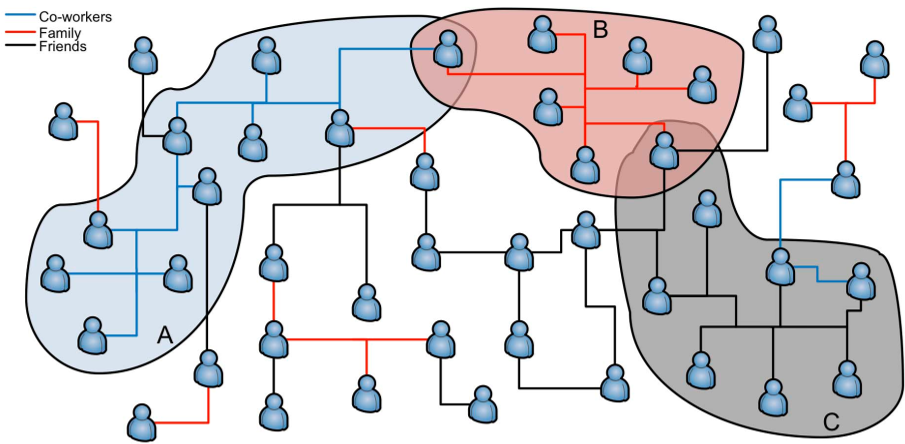 Fig 1: The Social Cloud leverages overlapping friend groups to create trust-based "Virtual Organizations".
Architecture: Transparent Integration
The system acts as a "Socially Aware Account Manager."
- Frontend: A Facebook App where users pick projects and view leaderboards.
- Backend: Interfaces with BOINC Project Servers via WebRPCs.
- Client: The standard BOINC client on the user's PC, which pulls configuration directly from the Social Cloud.
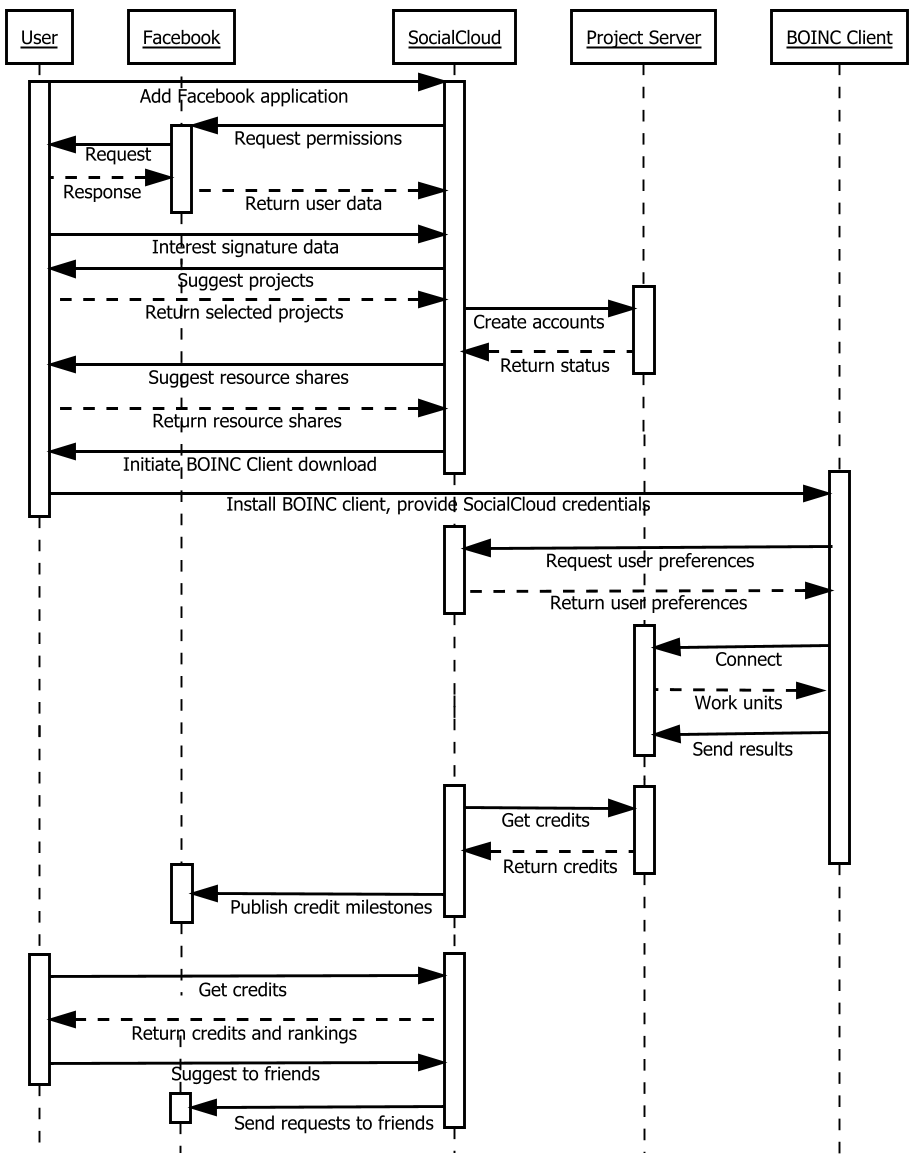 Fig 2: Sequence diagram showing the seamless flow from Facebook authentication to BOINC work unit processing.
Results and Impact
The impact potential is staggering. In 2011, BOINC had roughly 2.2 million users. At the same time, Facebook had 500 million.
- 0.5% Uptake: Would double the BOINC user base.
- 1.0% Uptake: Would triple the available processing power, potentially reaching tens of Petaflops.
The prototype (as shown in the UI screenshots) demonstrates that by showing users which projects their friends support, the "herd mentalilty" is converted into a force for scientific good.
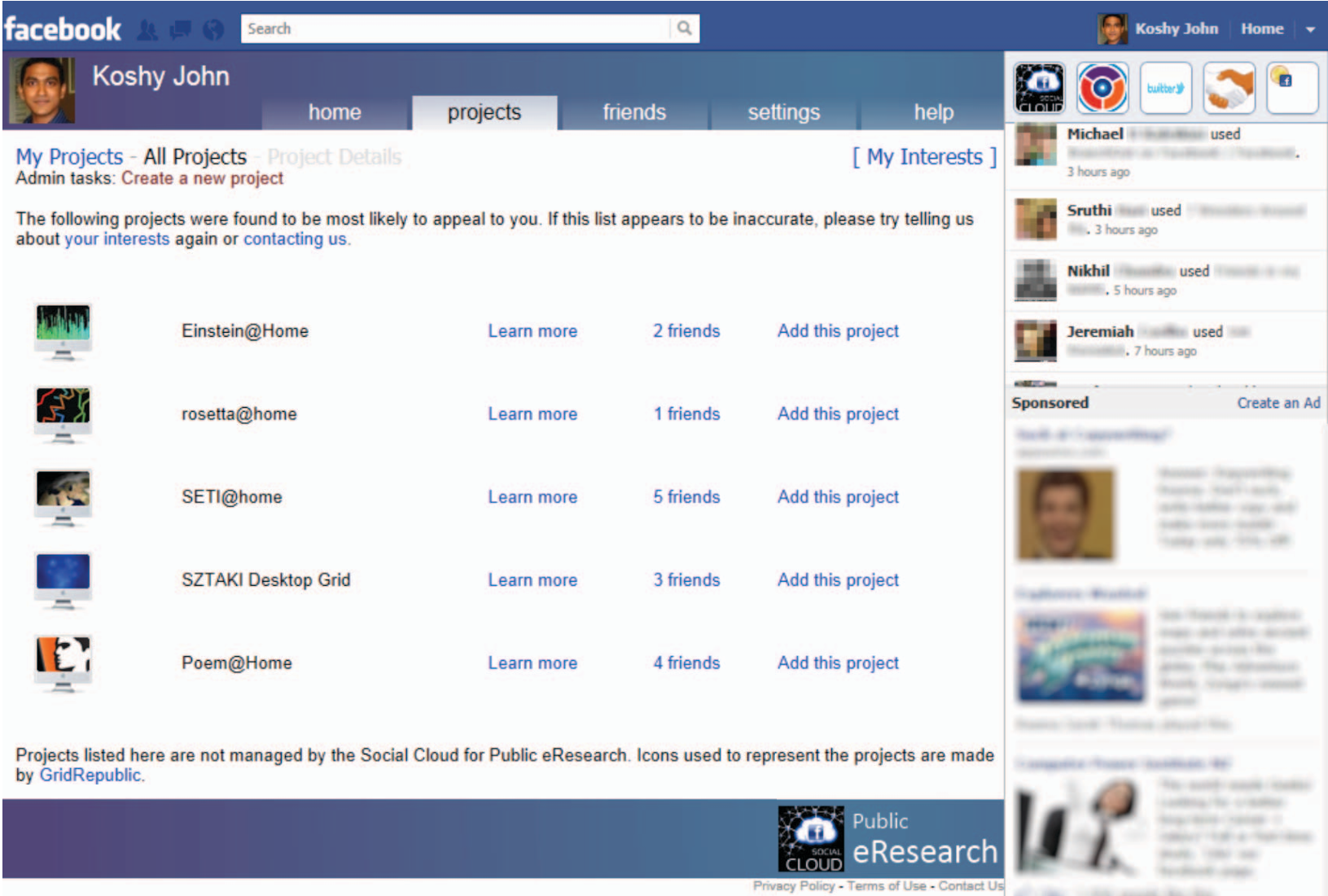 Fig 3: The user interface suggests projects based on "Signature Distance" and friend participation.
Critical Insight & Conclusion
This paper proves that distributed computing is a social problem, not just a technical one. By moving the management of volunteer resources into the social graph, the authors solve the discovery and retention issues that have plagued Grid computing for decades.
However, a modern critique would note the Centralization Risk: relying entirely on the Facebook Graph API makes the scientific infrastructure vulnerable to changes in social media platform policies (Privacy updates, API shutdowns). Nevertheless, the "Social Cloud" concept remains a blueprint for how we might one day crowdsource the cure for diseases through our everyday digital interactions.