
SCTA: Leveraging Social Intelligence for High-Efficiency Task Assignment in Flying IoT
Social Coalition-Aware Task Assignment in Flying Internet of Things
The paper introduces a social coalition-aware task assignment framework for Flying Internet of Things (Flying IoT). It utilizes the Social IoT (SIoT) paradigm to model interactions between autonomous UAVs through a cooperative coalition game, employing the Shapley value to identify optimal coalition leaders for efficient multi-hop task diffusion.
TL;DR
The paper introduces "SCTA," a social coalition-aware framework that transforms how UAVs (drones) receive and spread tasks in the Flying IoT. By treating drones as "social objects" and using the Shapley value from cooperative game theory, the system identifies the most influential drones to lead task diffusion, resulting in significantly faster and more reliable mission execution compared to traditional methods.
Background & Motivation: Moving Beyond Physical Connectivity
In traditional Flying IoT setups, the focus is almost entirely on the physical layer: Can Drone A talk to Drone B? While essential, this ignores the hierarchical and collaborative context of missions.
The authors argue that centralized control by ground stations is a bottleneck. Instead, they propose a Social IoT (SIoT) paradigm. Just as humans have social networks, drones can establish ties based on:
- OOR (Ownership): Who owns the drone?
- CLOR (Co-Location): How often are they in the same area?
- CTOR (Co-Target): Are they working on the same mission?
The core problem is Coalition Leader Selection: How do we pick the "best" drone to lead a group to ensure a task (like a data packet) spreads through the entire swarm as quickly as possible?
Methodology: The Social-Aware Game
The researchers tackle this by constructing three interconnected models: a Physical Link Graph, a Social Tie Graph, and an Influence Graph.
1. The Mathematical Engine: Shapley Value
To determine a drone's importance, the framework utilizes the Shapley Value. In game theory, this is the "fairest" way to distribute a total reward among players based on their marginal contribution.
In SCTA, the "reward" is the Task Diffusion Speed. The drone with the highest Shapley value — meaning it contributes the most to the network's ability to forward information — is elected as the leader.
2. Simplified Complexity
Calculating the Shapley value is usually computationally expensive (). However, the authors provide a crucial Theorem 1 that simplifies this to a function of node degree and shortest paths, making it feasible for real-time UAV hardware.
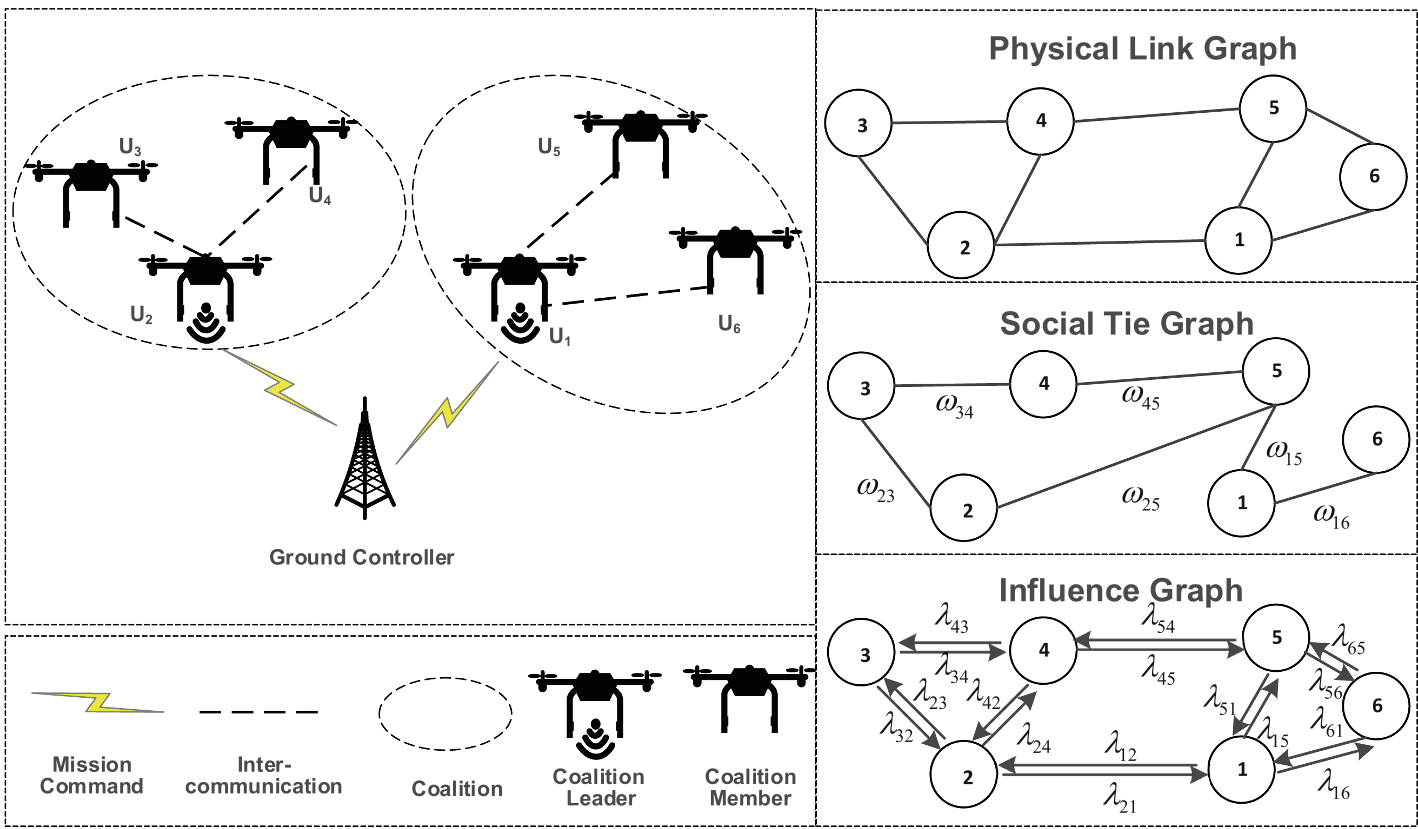 Figure 1: The Flying IoT framework with multi-hop delivery between ground controllers, coalition leaders, and members.
Experiments & Results
The SCTA scheme was tested against four benchmarks:
- Betweenness Centrality: Choosing drones that sit on the most "shortcuts."
- Closeness Centrality: Choosing drones that are physically closest to others.
- Random Selection.
- No-Social SCTA: Only using physical links.
Key Findings:
- Speed Advantage: SCTA achieved the highest task diffusion speed across all UAV counts.
- Social Synergy: As the probability of social ties between drones increases, SCTA's performance grows exponentially compared to physical-only methods. This proves that "social relationship" is a powerful proxy for network efficiency.
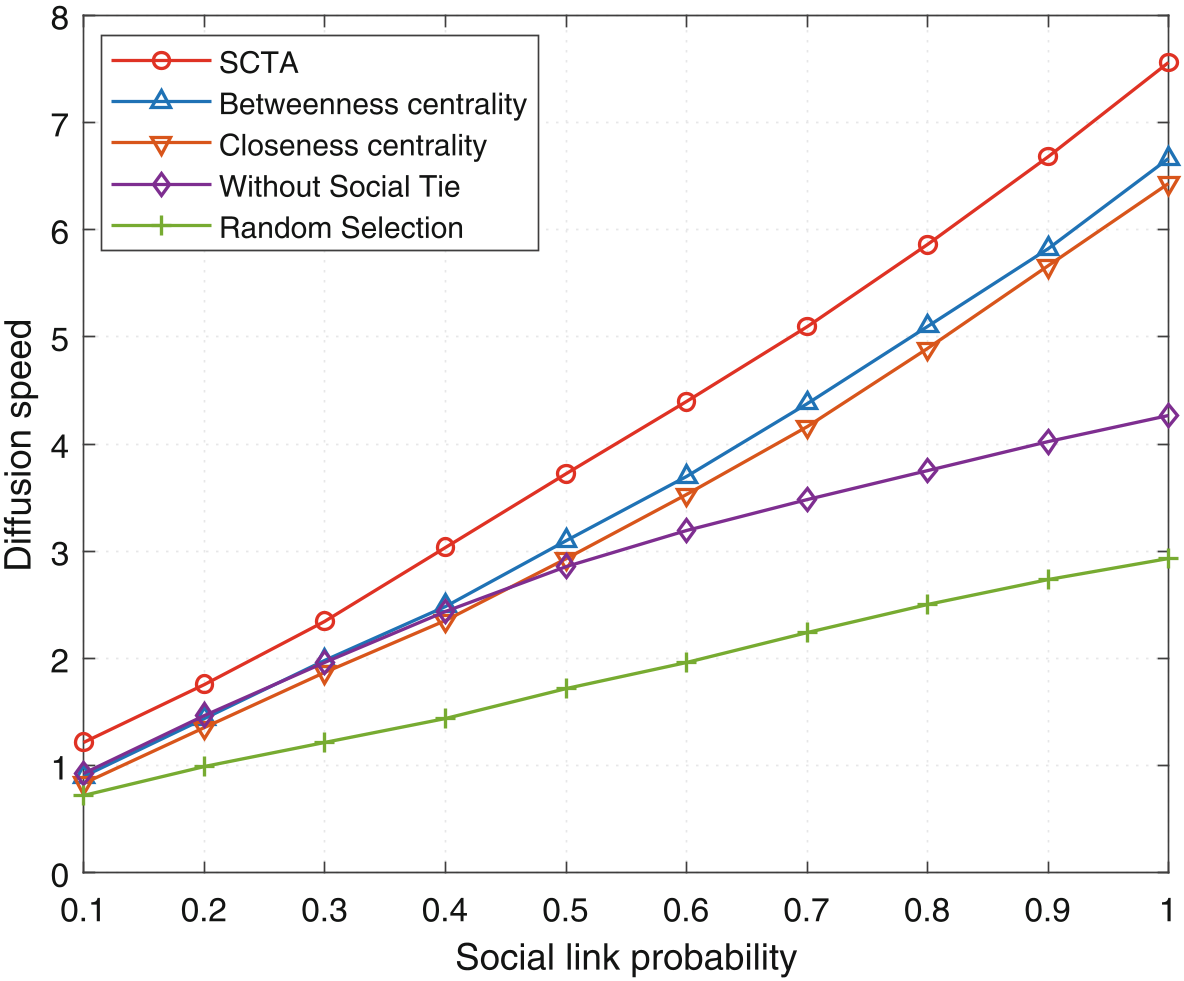 Figure 2: Performance comparison showing SCTA outperforming traditional centrality-based leader selection.
Critical Insight & Future Outlook
The brilliance of this work lies in the synergy between social attributes and physical constraints. By recognizing that drones executing the same mission (CTOR) are naturally better relays for that mission's data, the framework achieves a level of "intent-aware" routing that traditional algorithms lack.
Limitations: The current model assumes relatively stationary states during the task assignment phase. In high-mobility scenarios (e.g., high-speed air combat or racing), the social ties and physical links may change faster than the Shapley value can be updated.
Future Work: Integrating this with Reinforcement Learning could allow the drones to "learn" social weights dynamically, adapting to unpredictable link failures in disaster-rescue scenarios.